QUESTION IMAGE
Question
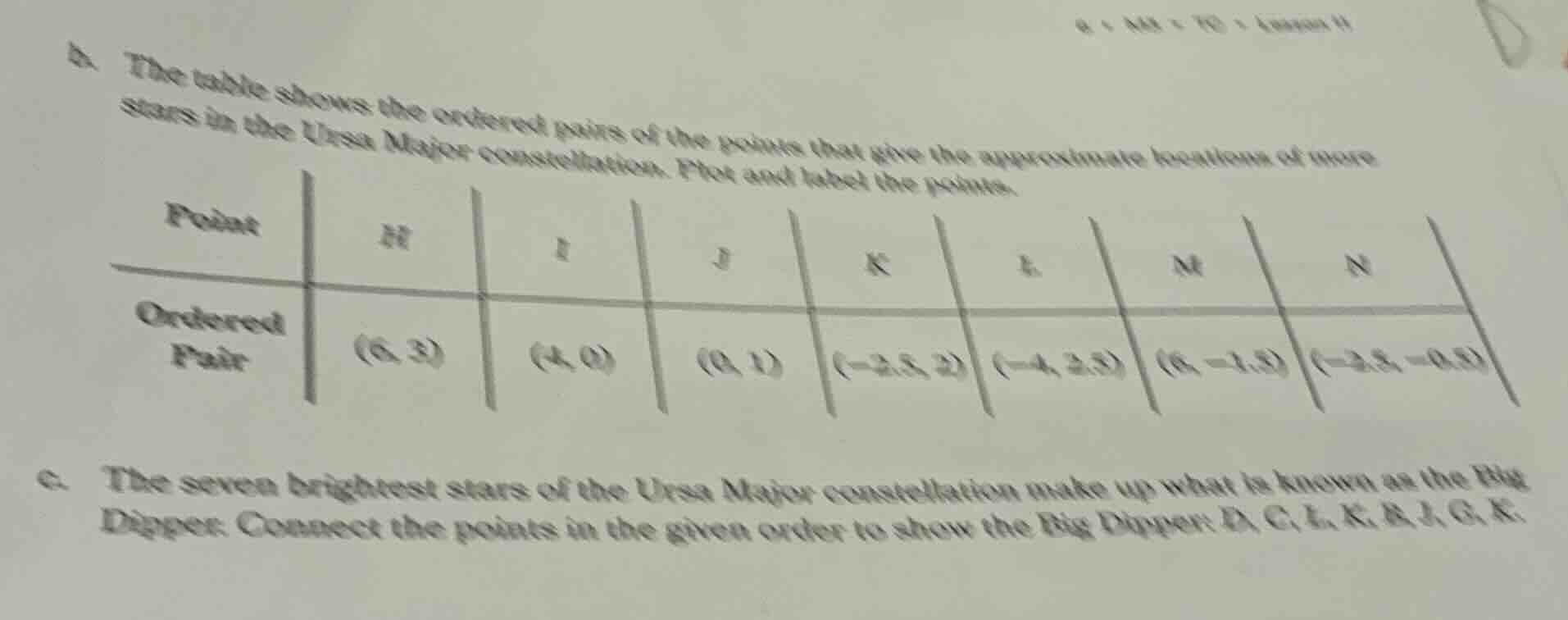
b. the table shows the ordered pairs of the points that give the approximate locations of more stars in the ursa major constellation. plot and label the points.
| point | h | i | j | k | l | m | n |
|---|
c. the seven brightest stars of the ursa major constellation make up what is known as the big dipper. connect the points in the given order to show the big dipper: d, c, l, k, h, j, g, k.
Step1: Understand coordinate plotting rules
Each ordered pair $(x,y)$ means: move $x$ units horizontally (right if positive, left if negative) from the origin $(0,0)$, then move $y$ units vertically (up if positive, down if negative).
Step2: Plot each given point
- $H(6,3)$: Right 6, Up 3
- $I(4,0)$: Right 4, No vertical move
- $J(0,1)$: No horizontal move, Up 1
- $K(-2.5,2)$: Left 2.5, Up 2
- $L(-4,2.5)$: Left 4, Up 2.5
- $M(6,-1.5)$: Right 6, Down 1.5
- $N(-3.5,-0.5)$: Left 3.5, Down 0.5
Step3: Label each plotted point
Write the corresponding letter ($H, I, J, K, L, M, N$) next to each plotted coordinate.
Step4: Connect points for Big Dipper
Using the given order $D, C, E, K, H, J, G, K$, draw line segments connecting each consecutive point, ending back at $K$. (Note: Points $D, C, E, G$ would be pre-plotted points not listed in this table, so connect the provided $K, H, J$ to their respective pre-plotted points as instructed.)

Snap & solve any problem in the app
Get step-by-step solutions on Sovi AI
Photo-based solutions with guided steps
Explore more problems and detailed explanations
- Plotted and labeled points: $H(6,3)$, $I(4,0)$, $J(0,1)$, $K(-2.5,2)$, $L(-4,2.5)$, $M(6,-1.5)$, $N(-3.5,-0.5)$ on a coordinate plane.
- Connected points in the order $D \to C \to E \to K \to H \to J \to G \to K$ to form the Big Dipper shape.