QUESTION IMAGE
Question
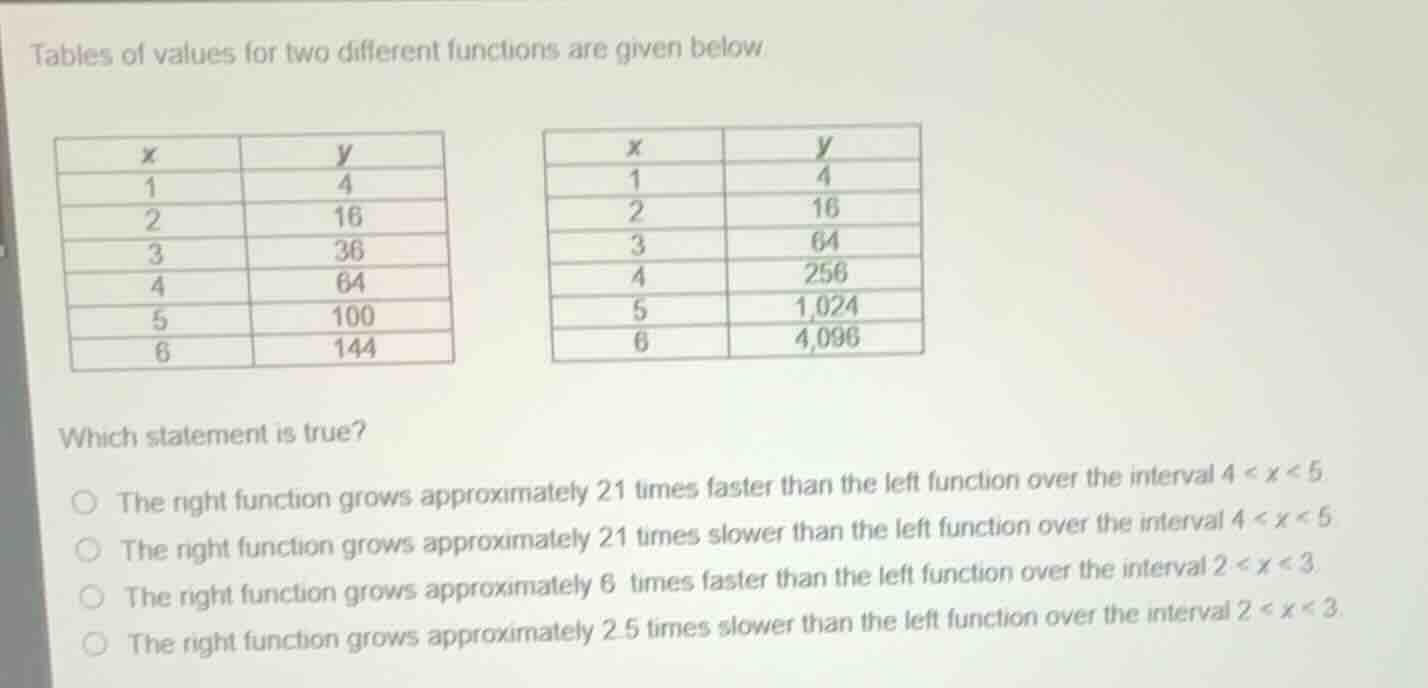
tables of values for two different functions are given below
| x | y | x | y | |
|---|---|---|---|---|
| 2 | 16 | 2 | 16 | |
| 3 | 36 | 3 | 64 | |
| 4 | 64 | 4 | 256 | |
| 5 | 100 | 5 | 1,024 | |
| 6 | 144 | 6 | 4,096 |
which statement is true?
- the right function grows approximately 21 times faster than the left function over the interval 4 < x < 5.
- the right function grows approximately 21 times slower than the left function over the interval 4 < x < 5.
- the right function grows approximately 6 times faster than the left function over the interval 2 < x < 3.
- the right function grows approximately 2.5 times slower than the left function over the interval 2 < x < 3.
Step1: Analyze left function (4 < x < 5)
Left function: At x=4, y=64; x=5, y=100. Growth: \( 100 - 64 = 36 \)
Step2: Analyze right function (4 < x < 5)
Right function: At x=4, y=256; x=5, y=1024. Growth: \( 1024 - 256 = 768 \)
Step3: Compare growth rates (4 < x < 5)
Ratio: \( \frac{768}{36} \approx 21.33 \), so right grows ~21x faster.
Step4: Check 2 < x < 3 (optional, confirm)
Left: x=2 (16) to x=3 (36). Growth: \( 36 - 16 = 20 \)
Right: x=2 (16) to x=3 (64). Growth: \( 64 - 16 = 48 \)
Ratio: \( \frac{48}{20} = 2.4 \), not 6 or 2.5 slower. So first option holds.

Snap & solve any problem in the app
Get step-by-step solutions on Sovi AI
Photo-based solutions with guided steps
Explore more problems and detailed explanations
The right function grows approximately 21 times faster than the left function over the interval \( 4 < x < 5 \).