QUESTION IMAGE
Question
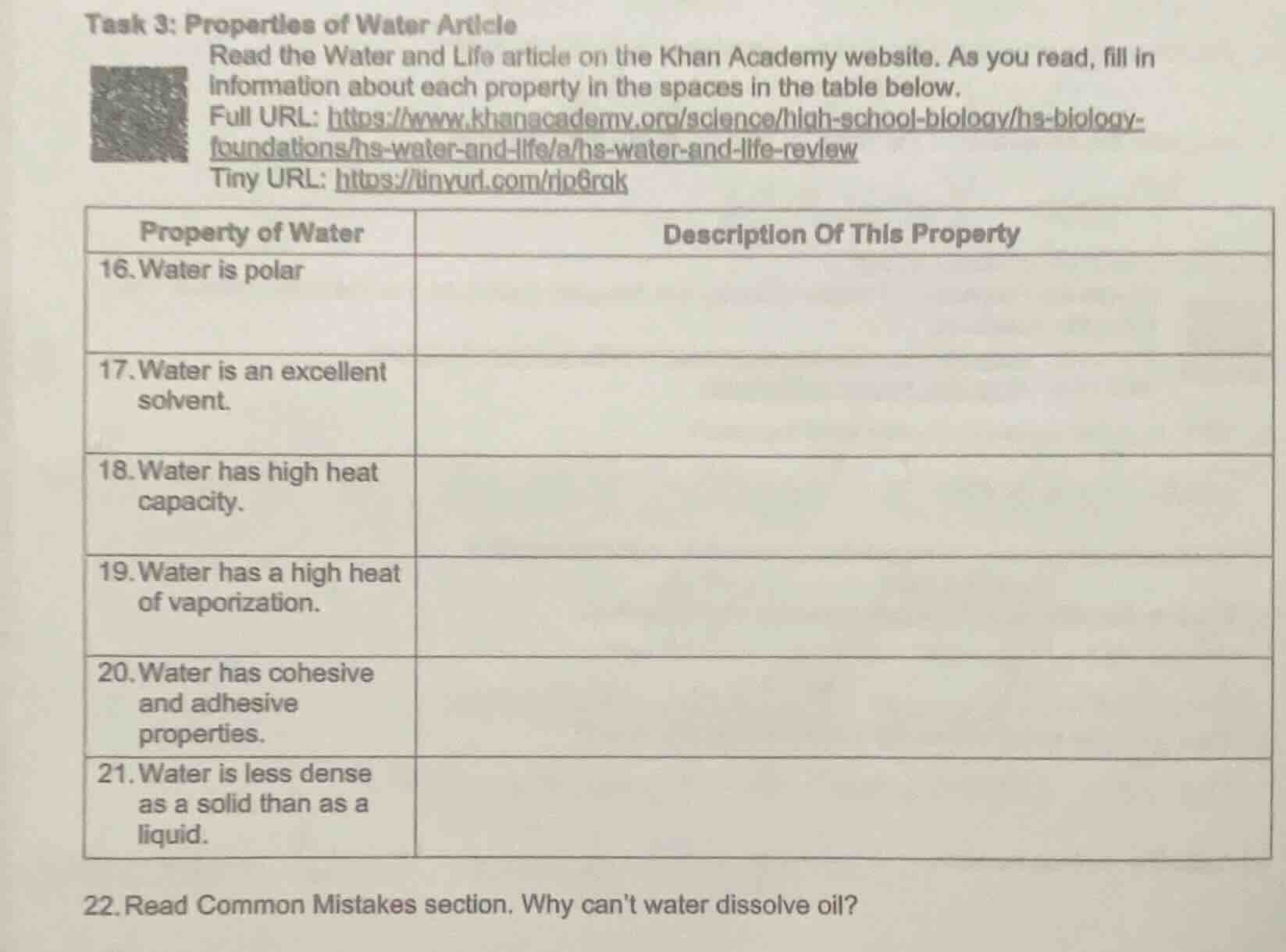
task 3: properties of water article
read the water and life article on the khan academy website. as you read, fill in
information about each property in the spaces in the table below.
full url: https://www.khanacademy.org/science/high-school-biology/hs-biology-
foundations/hs-water-and-life/a/hs-water-and-life-review
tiny url: https://tinyurl.com/rip6rgk
| property of water | description of this property |
|---|---|
| 17. water is an excellent solvent. | |
| 18. water has high heat capacity. | |
| 19. water has a high heat of vaporization. | |
| 20. water has cohesive and adhesive properties. | |
| 21. water is less dense as a solid than as a liquid. |
- read common mistakes section. why cant water dissolve oil?
To solve this, we refer to the Khan Academy article on water and life to get the descriptions of each water property:
16. Water is polar
The water molecule (\(H_2O\)) has a bent shape. The oxygen atom is more electronegative than hydrogen, so it pulls the shared electrons in the covalent bonds closer to itself. This creates a partial negative charge (\(\delta^-\)) on the oxygen and partial positive charges (\(\delta^+\)) on the hydrogens. Thus, the molecule has a positive end (near hydrogens) and a negative end (near oxygen), making it a polar molecule.
17. Water is an excellent solvent
Water’s polarity allows it to interact with (and dissolve) other polar substances or ionic compounds. Polar molecules (like sugars) and ions (like \(Na^+\) or \(Cl^-\)) are surrounded by water molecules (hydration shell), breaking them apart from their bulk structure. Non - polar substances (like oil) do not dissolve well as they lack charges to interact with water’s polar nature.
18. Water has high heat capacity
Heat capacity is the amount of heat energy required to raise a substance’s temperature. Water can absorb a large amount of heat before its temperature rises significantly. This is due to the hydrogen bonds between water molecules. To increase the temperature, these bonds must be broken, which requires a lot of energy. For example, it stabilizes Earth’s climate and helps organisms regulate body temperature.
19. Water has a high heat of vaporization
The heat of vaporization is the energy needed to convert a liquid to a gas. Water has a high value here because hydrogen bonds must be broken for water to evaporate. This property is important for cooling (e.g., sweating in humans: as sweat evaporates, it absorbs heat from the body, cooling it).
20. Water has cohesive and adhesive properties
- Cohesion: Water molecules are attracted to other water molecules via hydrogen bonds. This causes surface tension (e.g., insects walking on water) and helps water move in plants (transpiration pull).
- Adhesion: Water molecules are attracted to other polar or charged surfaces (like the xylem walls in plants). This helps water climb up narrow tubes (capillary action), aiding in water transport in plants.
21. Water is less dense as a solid than as a liquid
When water freezes into ice, the hydrogen bonds form a rigid, hexagonal lattice structure. This structure spaces the water molecules farther apart than in the liquid state. Since density is mass per unit volume, the increased volume (with similar mass) makes ice less dense than liquid water. This is why ice floats on water, insulating aquatic ecosystems in winter.
22. Why can’t water dissolve oil?
Oil is a non - polar substance (it has no significant positive or negative charges in its molecules). Water is polar, and for a substance to dissolve in water, it needs to interact with water’s polar nature (via charges or polarity). Since oil lacks polarity, water molecules are more attracted to each other (due to cohesion) than to oil molecules. Thus, oil and water do not mix, and oil is not dissolved by water.

Snap & solve any problem in the app
Get step-by-step solutions on Sovi AI
Photo-based solutions with guided steps
Explore more problems and detailed explanations
s (Descriptions for Table):
- The water molecule has a bent shape. Oxygen (more electronegative) pulls electrons, creating partial negative (\(\delta^-\)) on O and partial positive (\(\delta^+\)) on Hs, resulting in a polar molecule (positive and negative ends).
- Water’s polarity allows it to dissolve polar/ionic substances (via hydration shells) but not non - polar substances (like oil).
- Water absorbs large heat amounts before temperature rises, due to hydrogen bonds needing energy to break.
- A large amount of heat is required to convert liquid water to gas (vaporize it), as hydrogen bonds must be broken.
- Cohesion: Water molecules attract other water molecules (causes surface tension). Adhesion: Water molecules attract other polar/charged surfaces (causes capillary action).
- When frozen (ice), water forms a lattice structure with molecules spaced farther apart than in liquid water, making ice less dense.
- Oil is non - polar; water is polar. Polar and non - polar substances do not interact well, so water cannot dissolve oil.