QUESTION IMAGE
Question
te planes and transformations exam
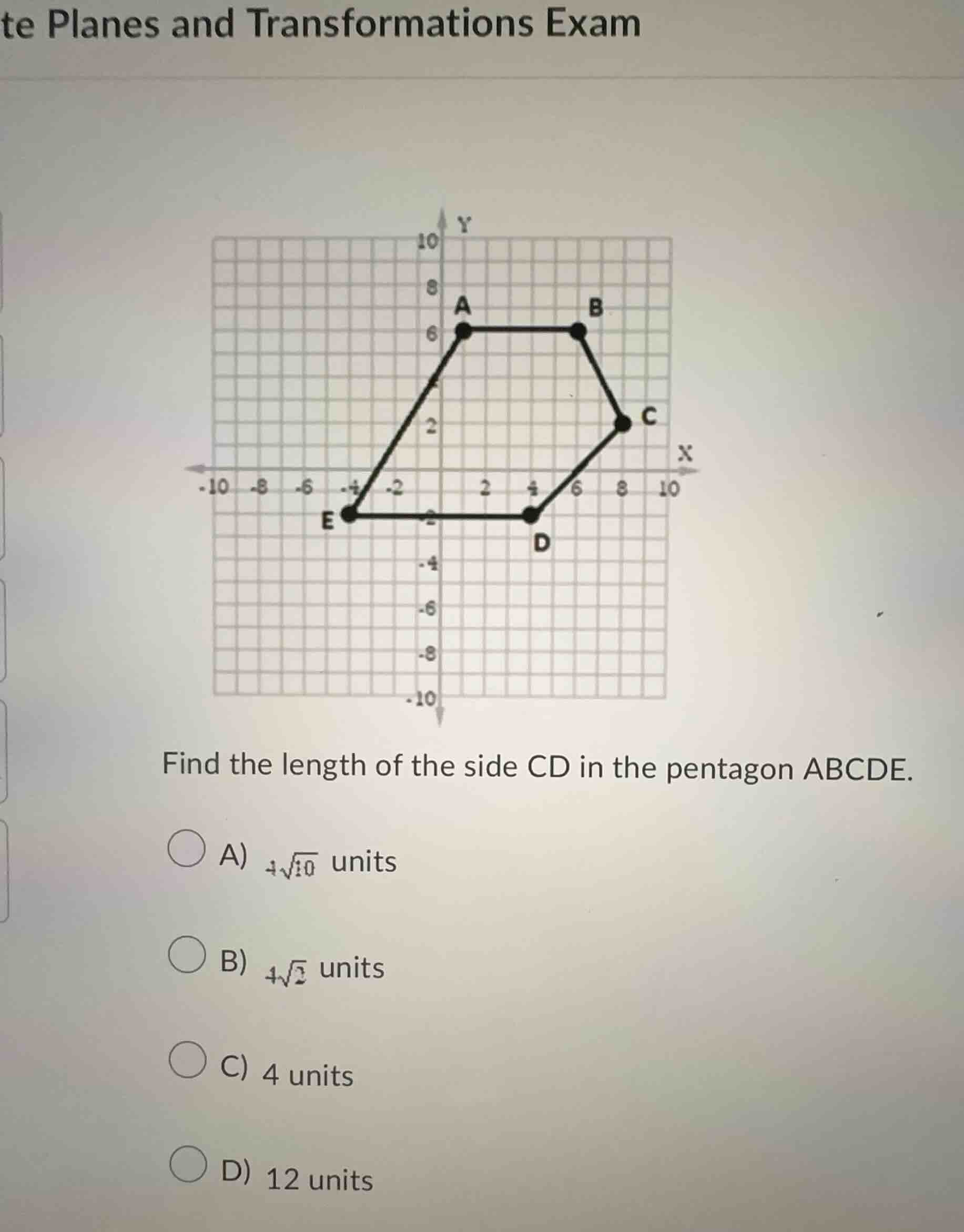
find the length of the side cd in the pentagon abcde.
a) $4\sqrt{10}$ units
b) $4\sqrt{2}$ units
c) 4 units
d) 12 units
Step1: Identify coordinates of C and D
From the graph, let's find the coordinates of points C and D.
- Point D: Looking at the grid, D is at (4, -2) (assuming each grid square is 1 unit). Wait, no, let's check again. Wait, the x-axis and y-axis: Let's see, E is at (-4, -2), D is at (4, -2)? Wait, no, maybe I misread. Wait, the grid: Let's look at the coordinates. Let's assume each square is 1 unit. So point C: Let's see, C is at (8, 2)? Wait, no, the y-coordinate for C: looking at the graph, C is at (8, 2)? Wait, no, the y-axis: the top is 10, bottom -10. Let's check the coordinates properly.
Wait, point A is at (0, 6), B at (5, 6)? Wait, no, maybe the grid is such that each square is 1 unit. Let's re-express:
Looking at the graph:
- Point D: Let's see, the x-coordinate: from the origin (0,0), moving right 4 units, y-coordinate: moving down 2 units, so D is (4, -2)? Wait, no, the E is at (-4, -2), D is at (4, -2)? Wait, no, the horizontal line from E to D: E is at (-4, -2), D is at (4, -2)? So the distance from E to D is 8 units? But we need CD.
Wait, point C: Let's see, C is at (8, 2)? Wait, no, the y-coordinate for C: looking at the graph, C is at (8, 2)? Wait, the vertical distance from D to C: D is at (4, -2), C is at (8, 2). So the coordinates of D are (4, -2) and C are (8, 2).
Step2: Apply distance formula
The distance formula between two points \((x_1, y_1)\) and \((x_2, y_2)\) is \(d = \sqrt{(x_2 - x_1)^2 + (y_2 - y_1)^2}\).
So for points C(8, 2) and D(4, -2):
\(x_1 = 4\), \(y_1 = -2\); \(x_2 = 8\), \(y_2 = 2\).
Compute the differences:
\(x_2 - x_1 = 8 - 4 = 4\)
\(y_2 - y_1 = 2 - (-2) = 4\)
Then, distance \(d = \sqrt{(4)^2 + (4)^2} = \sqrt{16 + 16} = \sqrt{32} = 4\sqrt{2}\)? Wait, no, wait, maybe I got the coordinates wrong.
Wait, maybe point C is at (8, 2) and D is at (4, -2)? Wait, no, let's check again. Wait, the vertical change: from D to C, the y-coordinate: D is at (4, -2), C is at (8, 2). So the vertical difference is 2 - (-2) = 4, horizontal difference is 8 - 4 = 4. So then distance is \(\sqrt{4^2 + 4^2} = \sqrt{16 + 16} = \sqrt{32} = 4\sqrt{2}\). But the option B is \(4\sqrt{2}\) units. Wait, but maybe my coordinates are wrong.
Wait, maybe point D is at (5, -2) and C at (9, 2)? No, maybe the grid is different. Wait, let's look at the options. The options are \(4\sqrt{10}\), \(4\sqrt{2}\), 4, 12.
Wait, maybe I made a mistake in coordinates. Let's re-express:
Looking at the graph:
- Point D: Let's see, the x-coordinate: from E (-4, -2) to D: the horizontal line, so E is (-4, -2), D is (4, -2)? So D is (4, -2). Then point C: Let's see, C is at (8, 2). So the horizontal distance between D (4, -2) and C (8, 2) is 8 - 4 = 4, vertical distance is 2 - (-2) = 4. So distance is \(\sqrt{4^2 + 4^2} = \sqrt{32} = 4\sqrt{2}\), which is option B.
Wait, but let's confirm. So the distance formula: \(d = \sqrt{(x_2 - x_1)^2 + (y_2 - y_1)^2}\). So if D is (4, -2) and C is (8, 2), then:
\(x_2 - x_1 = 8 - 4 = 4\)
\(y_2 - y_1 = 2 - (-2) = 4\)
So \(d = \sqrt{4^2 + 4^2} = \sqrt{16 + 16} = \sqrt{32} = 4\sqrt{2}\), which matches option B.

Snap & solve any problem in the app
Get step-by-step solutions on Sovi AI
Photo-based solutions with guided steps
Explore more problems and detailed explanations
B) \(4\sqrt{2}\) units