QUESTION IMAGE
Question
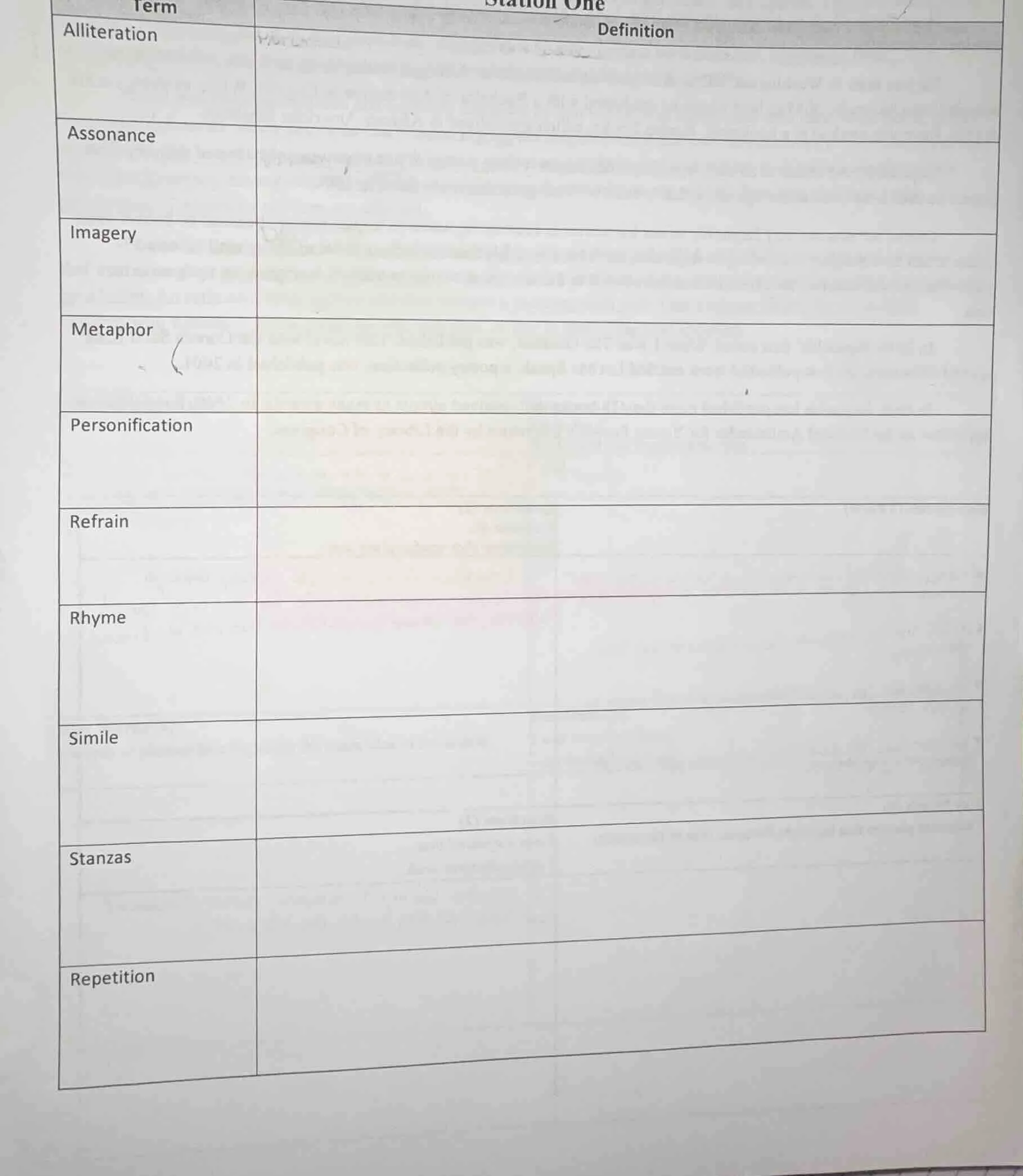
term station one definition alliteration assonance imagery metaphor personification refrain rhyme simile stanzas repetition
To solve this, we need to provide the definitions of each literary term:
Alliteration
The repetition of the same initial consonant sounds in a sequence of words, usually close together (e.g., Peter Piper picked a peck of pickled peppers).
Assonance
The repetition of vowel sounds within words, often in a sequence (e.g., The rain in Spain falls mainly on the plain – repeated long "a" sound).
Imagery
Descriptive language (using sensory details: sight, sound, touch, taste, smell) that creates a vivid mental picture or sensory experience for the reader.
Metaphor
A figure of speech that makes a direct comparison between two unrelated things, stating that one is the other (e.g., "Her heart is a stone" – compares heart to stone without "like" or "as").
Personification
Giving human traits, actions, or emotions to non - human entities (objects, animals, ideas, etc.) (e.g., "The wind whispered through the trees" – wind is given the human action of whispering).
Refrain
A repeated line, phrase, or group of lines in a poem or song, often used to create rhythm or emphasize a theme.
Rhyme
The repetition of similar sounds, usually at the end of words (e.g., "cat" and "hat" – perfect rhyme; "love" and "move" – slant rhyme).
Simile
A figure of speech that makes a comparison between two unrelated things using "like" or "as" (e.g., "She is as brave as a lion"; "His eyes sparkled like diamonds").
Stanzas
Groups of lines in a poem, similar to paragraphs in prose. Stanzas are separated by spaces and can have a set number of lines or follow a pattern.
Repetition
The deliberate reuse of words, phrases, or sounds for emphasis, rhythm, or to reinforce a theme (e.g., repeating a line multiple times in a poem).
If you need to fill the table, you can use these definitions in the "Definition" column corresponding to each term.

Snap & solve any problem in the app
Get step-by-step solutions on Sovi AI
Photo-based solutions with guided steps
Explore more problems and detailed explanations
To solve this, we need to provide the definitions of each literary term:
Alliteration
The repetition of the same initial consonant sounds in a sequence of words, usually close together (e.g., Peter Piper picked a peck of pickled peppers).
Assonance
The repetition of vowel sounds within words, often in a sequence (e.g., The rain in Spain falls mainly on the plain – repeated long "a" sound).
Imagery
Descriptive language (using sensory details: sight, sound, touch, taste, smell) that creates a vivid mental picture or sensory experience for the reader.
Metaphor
A figure of speech that makes a direct comparison between two unrelated things, stating that one is the other (e.g., "Her heart is a stone" – compares heart to stone without "like" or "as").
Personification
Giving human traits, actions, or emotions to non - human entities (objects, animals, ideas, etc.) (e.g., "The wind whispered through the trees" – wind is given the human action of whispering).
Refrain
A repeated line, phrase, or group of lines in a poem or song, often used to create rhythm or emphasize a theme.
Rhyme
The repetition of similar sounds, usually at the end of words (e.g., "cat" and "hat" – perfect rhyme; "love" and "move" – slant rhyme).
Simile
A figure of speech that makes a comparison between two unrelated things using "like" or "as" (e.g., "She is as brave as a lion"; "His eyes sparkled like diamonds").
Stanzas
Groups of lines in a poem, similar to paragraphs in prose. Stanzas are separated by spaces and can have a set number of lines or follow a pattern.
Repetition
The deliberate reuse of words, phrases, or sounds for emphasis, rhythm, or to reinforce a theme (e.g., repeating a line multiple times in a poem).
If you need to fill the table, you can use these definitions in the "Definition" column corresponding to each term.