QUESTION IMAGE
Question
test corrections change over time csa
cog 11.3
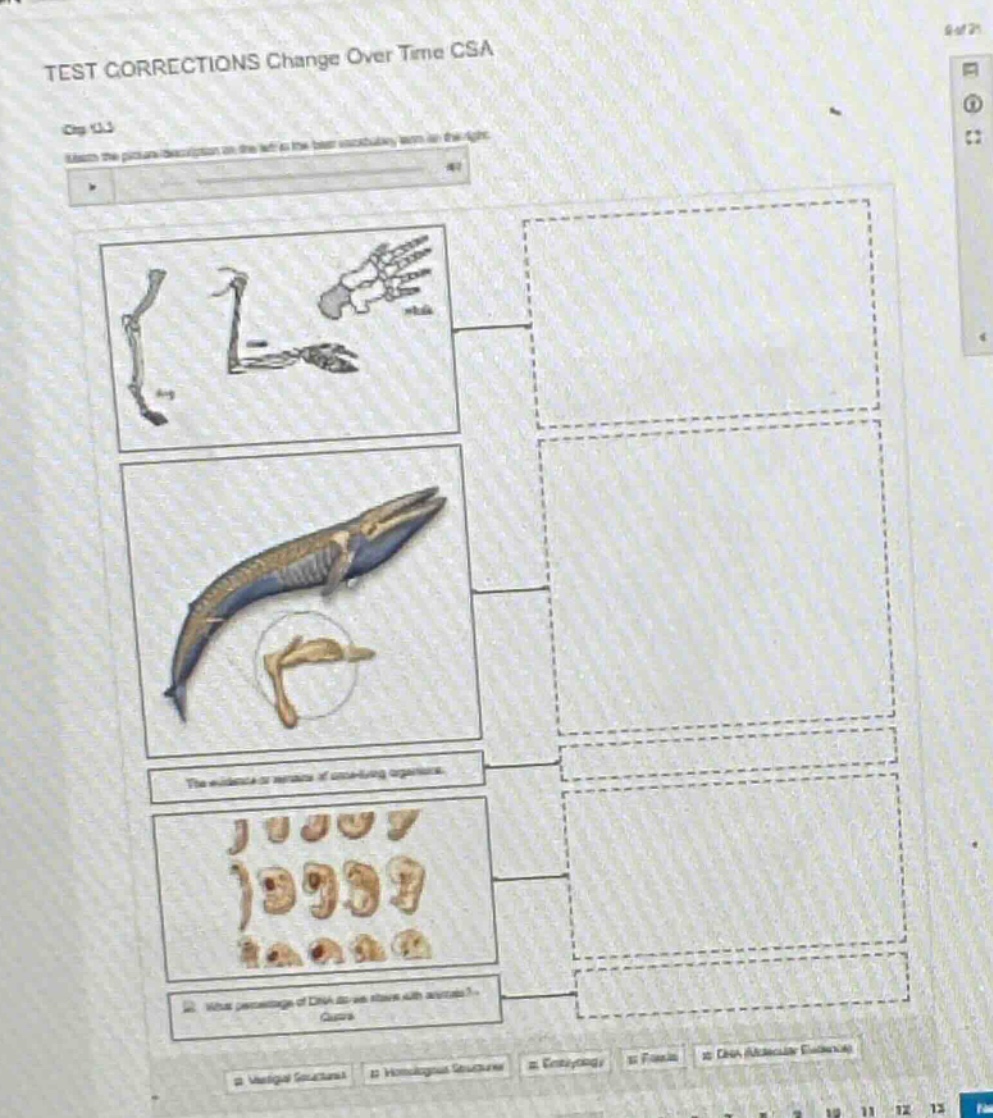
match the picture/description on the left to the best vocabulary term on the right.
the evidence or remains of once - living organisms.
what percentage of dna do we share with animals? - quora
options: a. vestigial structures b. homologous structures c. embryology d. fossils e. dna (molecular) evidence
Response
To solve this matching problem, we analyze each left - hand item and match it with the appropriate term on the right:
1. First Image (Bone Structures of Arm, Bird, Whale)
- Explanation: Homologous structures are defined as structures in different species that have a similar structure (and often a similar embryonic origin) but may have different functions. The bone structures of the arm (human), wing (bird), and flipper (whale) are similar in their anatomical layout, which is a classic example of homologous structures.
- Match: This image should be matched with "b. Homologous Structures".
2. Second Image (Whale with a Hind - Limb - like Structure)
- Explanation: Vestigial structures are remnants of organs or structures that had a function in an early ancestor but are now reduced and have little or no function in the current organism. The hind - limb - like structure in the whale is a vestigial structure as whales' ancestors had functional hind limbs, but in modern whales, this structure is non - functional.
- Match: This image should be matched with "a. Vestigial Structures".
3. "The evidence or remains of once - living organisms"
- Explanation: Fossils are the preserved remains or traces of once - living organisms. This definition directly corresponds to the concept of fossils.
- Match: This description should be matched with "d. Fossils".
4. Third Image (Embryos)
- Explanation: Embryology is the study of embryos, and the image showing different stages of embryos (or multiple embryos) is related to the concept of embryology. The development of embryos can provide evidence for evolution.
- Match: This image should be matched with "c. Embryology".
5. "What percentage of DNA do we share with animals?"
- Explanation: DNA (molecular) evidence is used to determine the relatedness between different organisms by comparing their DNA sequences. The question about the percentage of DNA shared with animals is related to molecular (DNA) evidence for evolution.
- Match: This question should be matched with "e. DNA (Molecular) Evidence".
Final Matches:
- Bone structures (arm, wing, flipper): b. Homologous Structures
- Whale with hind - limb - like structure: a. Vestigial Structures
- "The evidence or remains of once - living organisms": d. Fossils
- Embryos image: c. Embryology
- "What percentage of DNA do we share with animals?": e. DNA (Molecular) Evidence

Snap & solve any problem in the app
Get step-by-step solutions on Sovi AI
Photo-based solutions with guided steps
Explore more problems and detailed explanations
To solve this matching problem, we analyze each left - hand item and match it with the appropriate term on the right:
1. First Image (Bone Structures of Arm, Bird, Whale)
- Explanation: Homologous structures are defined as structures in different species that have a similar structure (and often a similar embryonic origin) but may have different functions. The bone structures of the arm (human), wing (bird), and flipper (whale) are similar in their anatomical layout, which is a classic example of homologous structures.
- Match: This image should be matched with "b. Homologous Structures".
2. Second Image (Whale with a Hind - Limb - like Structure)
- Explanation: Vestigial structures are remnants of organs or structures that had a function in an early ancestor but are now reduced and have little or no function in the current organism. The hind - limb - like structure in the whale is a vestigial structure as whales' ancestors had functional hind limbs, but in modern whales, this structure is non - functional.
- Match: This image should be matched with "a. Vestigial Structures".
3. "The evidence or remains of once - living organisms"
- Explanation: Fossils are the preserved remains or traces of once - living organisms. This definition directly corresponds to the concept of fossils.
- Match: This description should be matched with "d. Fossils".
4. Third Image (Embryos)
- Explanation: Embryology is the study of embryos, and the image showing different stages of embryos (or multiple embryos) is related to the concept of embryology. The development of embryos can provide evidence for evolution.
- Match: This image should be matched with "c. Embryology".
5. "What percentage of DNA do we share with animals?"
- Explanation: DNA (molecular) evidence is used to determine the relatedness between different organisms by comparing their DNA sequences. The question about the percentage of DNA shared with animals is related to molecular (DNA) evidence for evolution.
- Match: This question should be matched with "e. DNA (Molecular) Evidence".
Final Matches:
- Bone structures (arm, wing, flipper): b. Homologous Structures
- Whale with hind - limb - like structure: a. Vestigial Structures
- "The evidence or remains of once - living organisms": d. Fossils
- Embryos image: c. Embryology
- "What percentage of DNA do we share with animals?": e. DNA (Molecular) Evidence