QUESTION IMAGE
Question
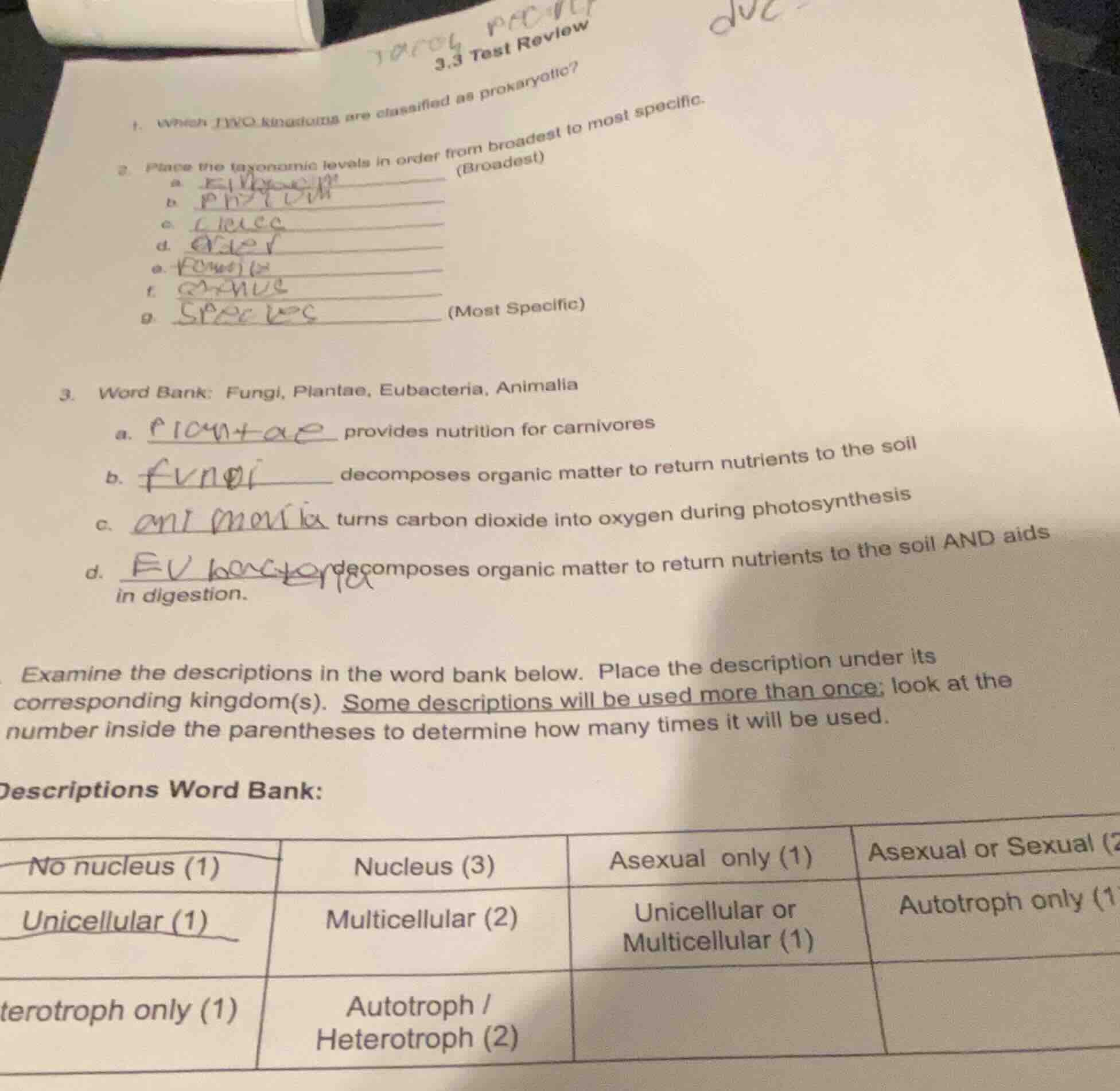
3.3 test review
- which two kingdoms are classified as prokaryotic?
- place the taxonomic levels in order from broadest to most specific.
a. ________ (broadest)
b. ________
c. ________
d. ________
e. ________
f. ________
g. ________ (most specific)
- word bank: fungi, plantae, eubacteria, animalia
a. ________ provides nutrition for carnivores
b. ________ decomposes organic matter to return nutrients to the soil
c. ________ turns carbon dioxide into oxygen during photosynthesis
d. ________ decomposes organic matter to return nutrients to the soil and aids in digestion.
examine the descriptions in the word bank below. place the description under its corresponding kingdom(s). some descriptions will be used more than once; look at the number inside the parentheses to determine how many times it will be used.
descriptions word bank:
no nucleus (1) | nucleus (3) | asexual only (1) | asexual or sexual (2)
unicellular (1) | multicellular (2) | unicellular or multicellular (1) | autotroph only (1)
heterotroph only (1) | autotroph / heterotroph (2) | |
- Prokaryotic kingdoms lack a membrane-bound nucleus; these are the two bacterial kingdoms.
- Taxonomic levels follow a standard hierarchical order from broadest to narrowest.
- Matches each kingdom to its key ecological/biological traits:
- Plantae are producers eaten by carnivores, perform photosynthesis.
- Fungi are decomposers that cycle soil nutrients.
- Eubacteria include decomposers and gut symbionts.
- (Note: The final table task is incomplete as no kingdoms are listed to map the traits to, so only the completed sections are addressed.)

Snap & solve any problem in the app
Get step-by-step solutions on Sovi AI
Photo-based solutions with guided steps
Explore more problems and detailed explanations
- Eubacteria and Archaebacteria
2.
a. Domain (Broadest)
b. Kingdom
c. Phylum
d. Class
e. Order
f. Family
g. Genus
h. Species (Most Specific)
3.
a. Plantae provides nutrition for carnivores
b. Fungi decomposes organic matter to return nutrients to the soil
c. Plantae turns carbon dioxide into oxygen during photosynthesis
d. Eubacteria decomposes organic matter to return nutrients to the soil AND aids in digestion.