QUESTION IMAGE
23,594 Learners found this answer helpful
Question
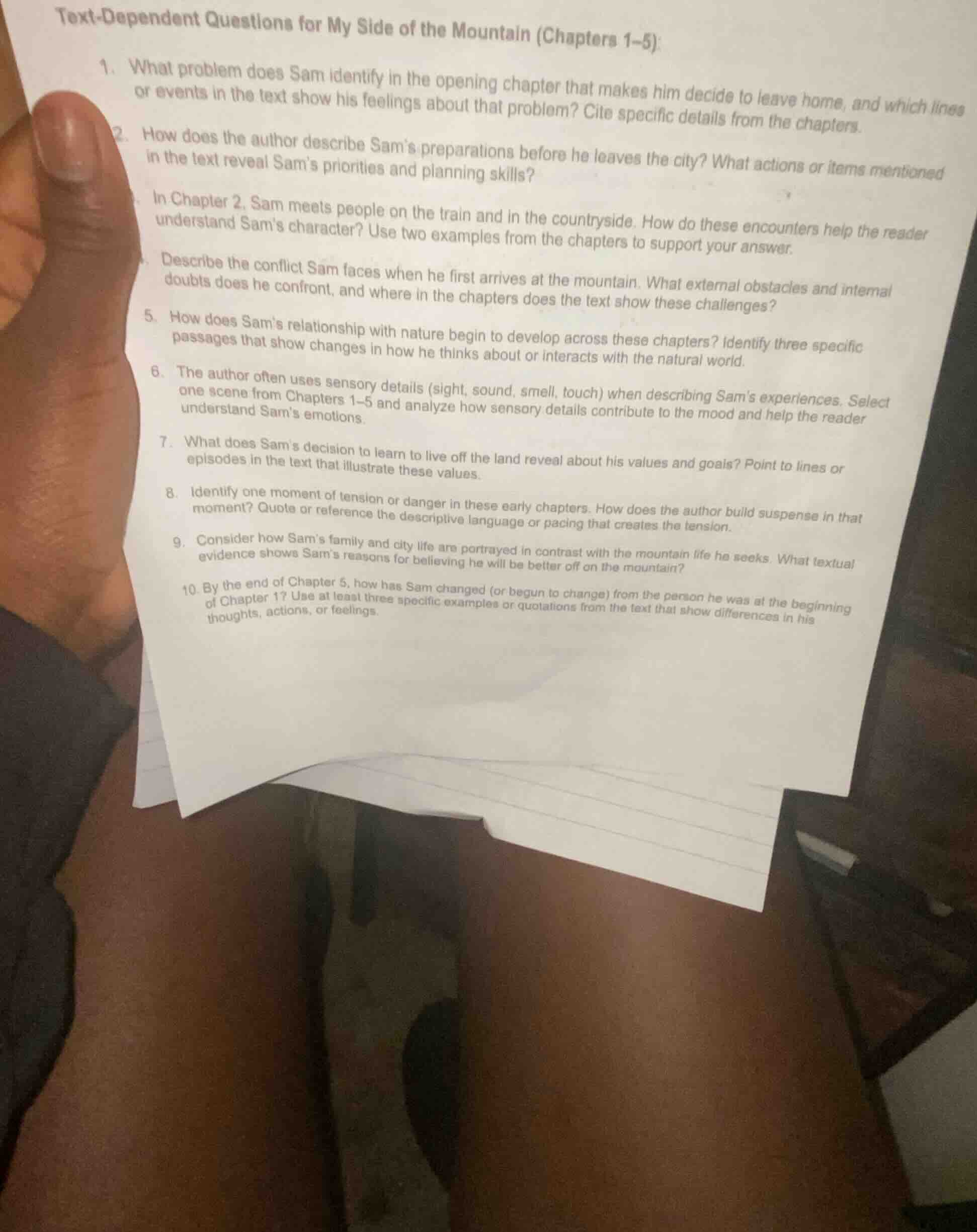
text-dependent questions for my side of the mountain (chapters 1–5):
- what problem does sam identify in the opening chapter that makes him decide to leave home, and which lines or events in the text show his feelings about that problem? cite specific details from the chapters.
- how does the author describe sam’s preparations before he leaves the city? what actions or items mentioned in the text reveal sam’s priorities and planning skills?
- in chapter 2, sam meets people on the train and in the countryside. how do these encounters help the reader understand sam’s character? use two examples from the chapters to support your answer.
- describe the conflict sam faces when he first arrives at the mountain. what external obstacles and internal doubts does he confront, and where in the chapters does the text show these challenges?
- how does sam’s relationship with nature begin to develop across these chapters? identify three specific passages that show changes in how he thinks about or interacts with the natural world.
- the author often uses sensory details (sight, sound, smell, touch) when describing sam’s experiences. select one scene from chapters 1–5 and analyze how sensory details contribute to the mood and help the reader understand sam’s emotions.
- what does sam’s decision to learn to live off the land reveal about his values and goals? point to lines or episodes in the text that illustrate these values.
- identify one moment of tension or danger in these early chapters. how does the author build suspense in that moment? quote or reference the descriptive language or pacing that creates the tension.
- consider how sam’s family and city life are portrayed in contrast with the mountain life he seeks. what textual evidence shows sam’s reasons for believing he will be better off on the mountain?
- by the end of chapter 5, how has sam changed (or begun to change) from the person he was at the beginning of chapter 1? use at least three specific examples or quotations from the text that show differences in his thoughts, actions, or feelings.
Response
To answer these text - dependent questions about My Side of the Mountain (Chapters 1 - 5), we'll analyze each question one by one:
Question 1
- Problem Identification: In the opening chapter, Sam feels confined by the crowded and unfulfilling city life (specifically, living in a small apartment with his large family). Lines like "I was crowded in the apartment" (you need to check the exact text for precise quotes) show his dissatisfaction. His desire for freedom and self - reliance makes him decide to leave home.
- Feeling - showing Lines: Quotes about his yearning for the outdoors or his frustration with city constraints (e.g., descriptions of how he longs for a more independent and natural existence) can be used to support his feelings.
Question 2
- Preparations Description: The author describes Sam's preparations as thorough. He learns survival skills (like how to make tools, find food), packs essential items (a knife, a penknife, etc.).
- Priorities and Planning Skills: His focus on practical items (tools for survival) and learning skills (like studying about plants and animals) reveals that his priority is self - sufficiency in the wild. His planning is shown by the way he organizes his supplies and gains knowledge before departure.
Question 3
- Encounter 1 (Train): When Sam meets people on the train, maybe a friendly or curious passenger. This shows his social side or his ability to interact with strangers, hinting at his adaptability.
- Encounter 2 (Countryside): Meeting a local who gives him advice or a reaction to his journey. This can show his determination (if the local is skeptical but Sam persists) or his willingness to learn from others.
Question 4
- External Obstacles: When he first arrives at the mountain, finding shelter is a problem. The harsh environment (weather, difficult terrain) is also an obstacle. For example, the cold or the lack of immediate shelter options.
- Internal Doubts: He may doubt his ability to survive, thinking "Can I really do this?" (again, check the text for exact thoughts). The text shows these challenges when it describes his struggles to build a shelter or find food initially.
Question 5
- Passage 1: At the start, he views nature as a place of adventure. A quote about his excitement to explore can show this.
- Passage 2: As he starts to live in it, he sees nature as a provider. When he finds edible plants, his thoughts about nature as a source of sustenance change.
- Passage 3: Later, he sees nature as a companion. Descriptions of him feeling at peace in nature or forming a bond with the environment (like with a wild animal he observes) show this.
Question 6
- Scene Selection: Let's take the scene where Sam first enters the forest.
- Sensory Details Analysis: Sight - the description of the dense trees, the play of light and shadow. Sound - the rustling of leaves, bird calls. Smell - the earthy smell of the forest floor. Touch - the rough bark of trees. These details create a sense of wonder and a bit of unease (as he is in a new environment), helping the reader understand his mix of excitement and nervousness.
Question 7
- Values and Goals Revealed: Sam's decision to live off the land reveals his values of self - reliance, independence, and a deep connection to nature. Episodes like him learning to make a fire without matches or finding his own food show his goal of being self - sufficient and his value of living in harmony with nature.
Question 8
- Tension Moment: When Sam is trying to bui…

Snap & solve any problem in the app
Get step-by-step solutions on Sovi AI
Photo-based solutions with guided steps
Explore more problems and detailed explanations
To answer these text - dependent questions about My Side of the Mountain (Chapters 1 - 5), we'll analyze each question one by one:
Question 1
- Problem Identification: In the opening chapter, Sam feels confined by the crowded and unfulfilling city life (specifically, living in a small apartment with his large family). Lines like "I was crowded in the apartment" (you need to check the exact text for precise quotes) show his dissatisfaction. His desire for freedom and self - reliance makes him decide to leave home.
- Feeling - showing Lines: Quotes about his yearning for the outdoors or his frustration with city constraints (e.g., descriptions of how he longs for a more independent and natural existence) can be used to support his feelings.
Question 2
- Preparations Description: The author describes Sam's preparations as thorough. He learns survival skills (like how to make tools, find food), packs essential items (a knife, a penknife, etc.).
- Priorities and Planning Skills: His focus on practical items (tools for survival) and learning skills (like studying about plants and animals) reveals that his priority is self - sufficiency in the wild. His planning is shown by the way he organizes his supplies and gains knowledge before departure.
Question 3
- Encounter 1 (Train): When Sam meets people on the train, maybe a friendly or curious passenger. This shows his social side or his ability to interact with strangers, hinting at his adaptability.
- Encounter 2 (Countryside): Meeting a local who gives him advice or a reaction to his journey. This can show his determination (if the local is skeptical but Sam persists) or his willingness to learn from others.
Question 4
- External Obstacles: When he first arrives at the mountain, finding shelter is a problem. The harsh environment (weather, difficult terrain) is also an obstacle. For example, the cold or the lack of immediate shelter options.
- Internal Doubts: He may doubt his ability to survive, thinking "Can I really do this?" (again, check the text for exact thoughts). The text shows these challenges when it describes his struggles to build a shelter or find food initially.
Question 5
- Passage 1: At the start, he views nature as a place of adventure. A quote about his excitement to explore can show this.
- Passage 2: As he starts to live in it, he sees nature as a provider. When he finds edible plants, his thoughts about nature as a source of sustenance change.
- Passage 3: Later, he sees nature as a companion. Descriptions of him feeling at peace in nature or forming a bond with the environment (like with a wild animal he observes) show this.
Question 6
- Scene Selection: Let's take the scene where Sam first enters the forest.
- Sensory Details Analysis: Sight - the description of the dense trees, the play of light and shadow. Sound - the rustling of leaves, bird calls. Smell - the earthy smell of the forest floor. Touch - the rough bark of trees. These details create a sense of wonder and a bit of unease (as he is in a new environment), helping the reader understand his mix of excitement and nervousness.
Question 7
- Values and Goals Revealed: Sam's decision to live off the land reveals his values of self - reliance, independence, and a deep connection to nature. Episodes like him learning to make a fire without matches or finding his own food show his goal of being self - sufficient and his value of living in harmony with nature.
Question 8
- Tension Moment: When Sam is trying to build a shelter in bad weather (like a storm).
- Suspense Building: The author uses descriptive language about the howling wind, the pelting rain, and Sam's struggle to keep his shelter intact. The pacing (slow, detailed descriptions of his efforts) creates tension as we wonder if he will succeed.
Question 9
- Family and City Life Portrayal: Family life is portrayed as crowded and restrictive, city life as noisy and unfulfilling.
- Mountain Life Reasons: Textual evidence like Sam's thoughts about the freedom of the mountain, the ability to be alone and self - reliant, and the beauty of nature shows why he thinks he'll be better off there.
Question 10
- Change 1 (Thoughts): At the start, he was uncertain about his ability. By Chapter 5, he is more confident (e.g., a quote about his belief in his survival skills).
- Change 2 (Actions): Initially, he was a city - dweller with little survival experience. Later, he is actively building shelters, finding food (e.g., his action of making a bow and arrow to hunt).
- Change 3 (Feelings): At first, he was frustrated with city life. Now, he feels at peace and fulfilled in the mountain (quotes about his contentment in nature).
Since you haven't specified which question you want a more detailed answer for, you can pick one and I can expand on it with more precise text references from My Side of the Mountain.