QUESTION IMAGE
Question
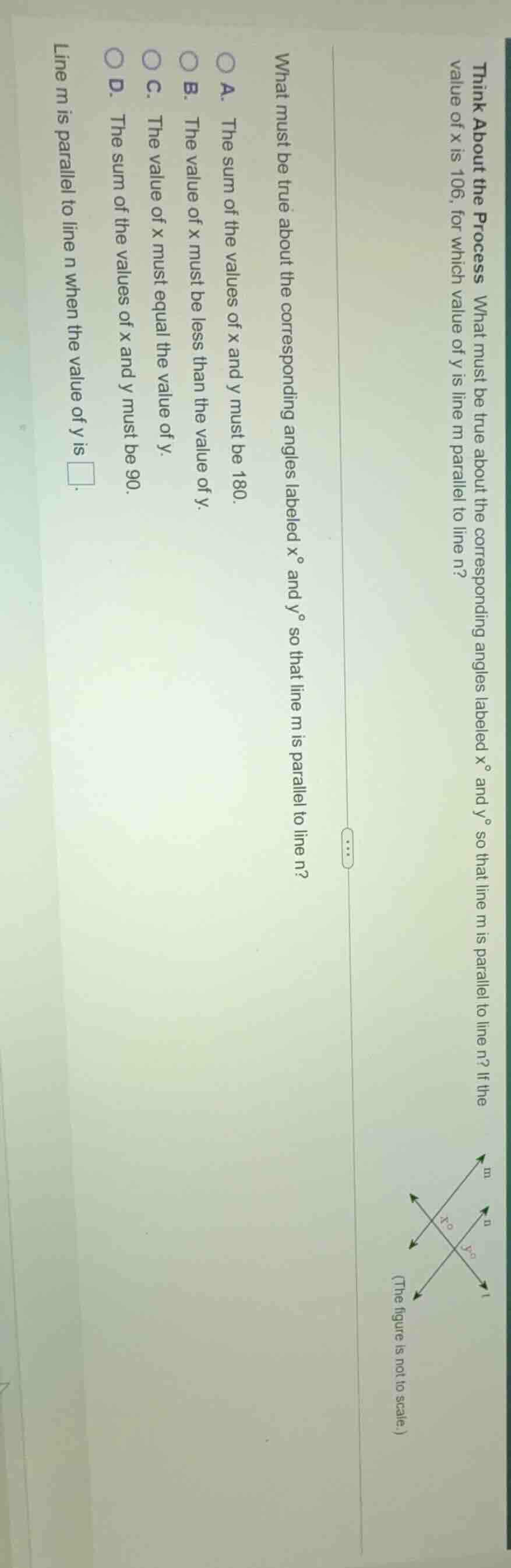
think about the process what must be true about the corresponding angles labeled ( x^circ ) and ( y^circ ) so that line ( m ) is parallel to line ( n )? if the value of ( x ) is 106, for which value of ( y ) is line ( m ) parallel to line ( n )?
what must be true about the corresponding angles labeled ( x^circ ) and ( y^circ ) so that line ( m ) is parallel to line ( n )?
a. the sum of the values of ( x ) and ( y ) must be 180.
b. the value of ( x ) must be less than the value of ( y ).
c. the value of ( x ) must equal the value of ( y ).
d. the sum of the values of ( x ) and ( y ) must be 90.
line ( m ) is parallel to line ( n ) when the value of ( y ) is (square).
(the figure is not to scale.)
To determine the relationship between \( x^\circ \) and \( y^\circ \) for lines \( m \) and \( n \) to be parallel, we use the concept of supplementary angles (same - side interior angles or linear pair - related when considering parallel lines and a transversal). When two lines are parallel and cut by a transversal, consecutive interior angles are supplementary, meaning their sum is \( 180^\circ \). Here, \( x \) and \( y \) are supplementary angles (they form a linear pair - like relationship for the parallel lines condition), so \( x + y=180 \).
Option A states that the sum of \( x \) and \( y \) must be \( 180 \), which matches the supplementary angle property for parallel lines. Option B is incorrect because there's no requirement for \( x \) to be less than \( y \). Option C is incorrect as \( x \) and \( y \) are supplementary, not equal (unless \( x = y=90 \), but that's a special case, not a general rule). Option D is incorrect as the sum is \( 180 \), not \( 90 \).
For the second part, if \( x = 106 \), and \( x + y=180 \) (from the parallel lines condition), then we solve for \( y \) using the equation \( y=180 - x \). Substitute \( x = 106 \) into the equation: \( y=180 - 106=74 \).

Snap & solve any problem in the app
Get step-by-step solutions on Sovi AI
Photo-based solutions with guided steps
Explore more problems and detailed explanations
- The correct option for the first question is A. The sum of the values of \( x \) and \( y \) must be \( 180 \).
- When \( x = 106 \), the value of \( y \) is \( 74 \).