QUESTION IMAGE
Question
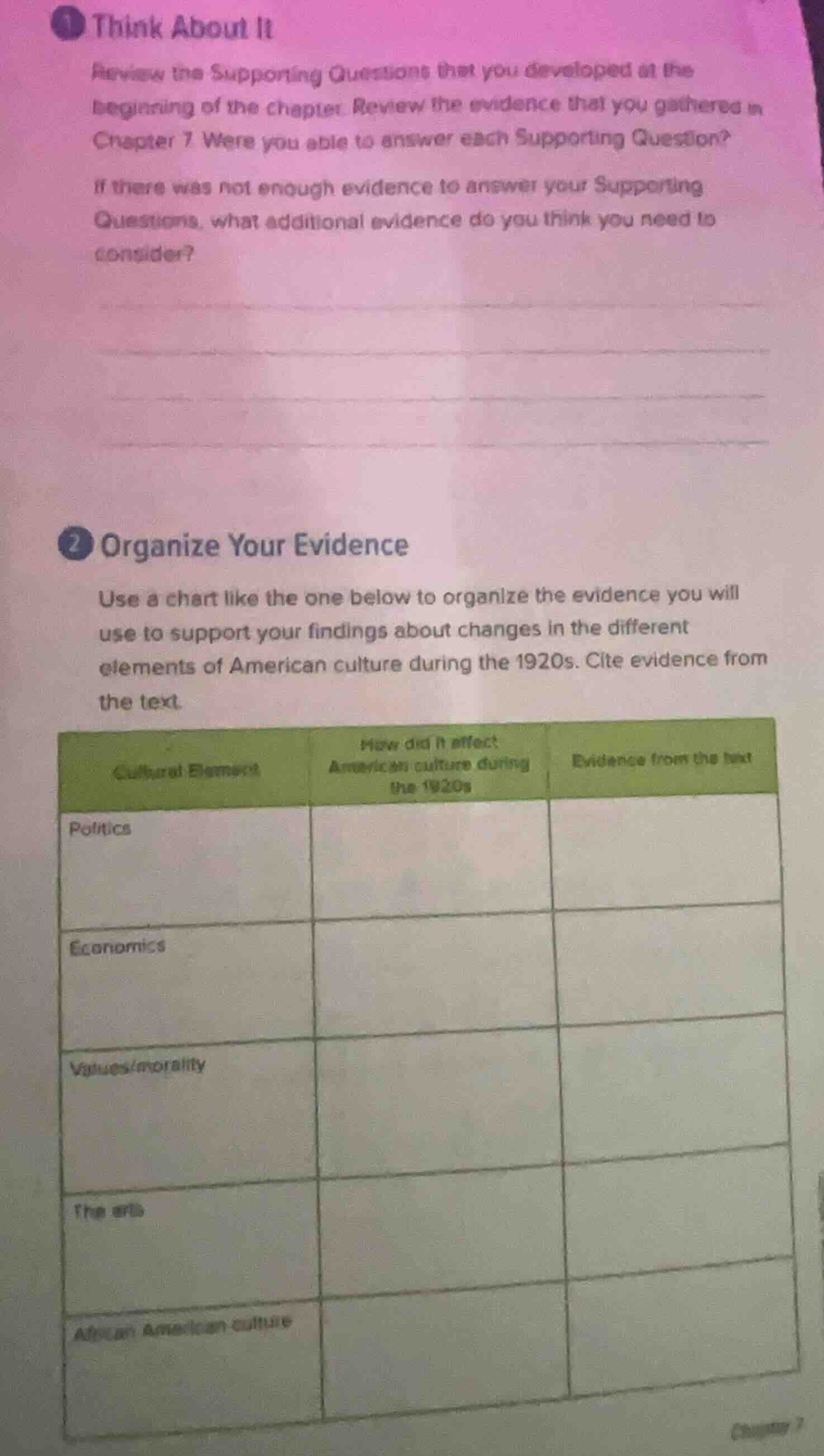
1 think about it
review the supporting questions that you developed at the beginning of the chapter. review the evidence that you gathered in chapter 7. were you able to answer each supporting question?
if there was not enough evidence to answer your supporting questions, what additional evidence do you think you need to consider?
2 organize your evidence
use a chart like the one below to organize the evidence you will use to support your findings about changes in the different elements of american culture during the 1920s. cite evidence from the text.
| cultural element | how did it affect american culture during the 1920s | evidence from the text |
|---|---|---|
| economics | ||
| values/morality | ||
| the arts | ||
| african american culture |
To complete this task, we analyze each cultural element and its impact on 1920s American culture, using textbook evidence:
1. Politics
- How did it affect? : The 1920s saw a shift to conservative politics (e.g., Harding’s “return to normalcy,” isolationist foreign policy, and reduced government regulation).
- Evidence : Textbooks note the Teapot Dome scandal (exposing political corruption) and the rise of nativist policies (e.g., immigration quotas like the National Origins Act of 1924).
2. Economics
- How did it affect? : Economic prosperity (the “Roaring Twenties”) fueled consumerism, credit expansion, and the growth of industries like automobiles (Ford’s assembly line) and radio.
- Evidence : Textbooks cite the growth of the stock market, the expansion of consumer credit (installment plans), and the decline of agriculture (overproduction post - WWI).
3. Values/Morality
- How did it affect? : Traditional values clashed with modernity (e.g., flappers challenging gender norms, Prohibition (18th Amendment) leading to speakeasies and organized crime, and the Scopes Trial (1925) over evolution vs. creationism).
- Evidence : Textbooks describe the rise of flapper culture (short skirts, bobbed hair), the popularity of speakeasies during Prohibition, and the media coverage of the Scopes “Monkey Trial.”
4. The Arts
- How did it affect? : The Harlem Renaissance flourished (African - American art, literature, and music), and new art forms (jazz, Art Deco) emerged.
- Evidence : Textbooks highlight works by Langston Hughes (poetry), Duke Ellington (jazz), and the spread of jazz from Harlem to mainstream culture, plus Art Deco architecture (e.g., skyscrapers like the Chrysler Building).
5. African American Culture
- How did it affect? : The Great Migration (to Northern cities) and the Harlem Renaissance empowered African Americans culturally and politically (e.g., the rise of Black nationalism, Marcus Garvey’s UNIA).
- Evidence : Textbooks reference the Great Migration statistics (millions of Black Americans moving North) and the influence of figures like Garvey (“Back to Africa” movement) and the literary works of the Harlem Renaissance.
Filled Table:
| Cultural Element | How did it affect American culture during the 1920s? | Evidence from the text |
|---|---|---|
| Economics | Economic boom; consumerism; credit expansion; industrial growth (auto, radio) | Ford’s assembly line; stock market growth; installment plans; agricultural decline |
| Values/Morality | Clash of traditional vs. modern values (flappers, Prohibition, Scopes Trial) | Flapper culture; speakeasies; Scopes Trial (1925) |
| The arts | Harlem Renaissance; jazz age; Art Deco | Langston Hughes’ poetry; Duke Ellington’s jazz; Art Deco architecture |
| African American culture | Great Migration; Harlem Renaissance; Black nationalism (Garvey) | Great Migration statistics; UNIA (Garvey); Harlem Renaissance literature/music |
This table organizes the evidence to show how each element shaped 1920s American culture.

Snap & solve any problem in the app
Get step-by-step solutions on Sovi AI
Photo-based solutions with guided steps
Explore more problems and detailed explanations
To complete this task, we analyze each cultural element and its impact on 1920s American culture, using textbook evidence:
1. Politics
- How did it affect? : The 1920s saw a shift to conservative politics (e.g., Harding’s “return to normalcy,” isolationist foreign policy, and reduced government regulation).
- Evidence : Textbooks note the Teapot Dome scandal (exposing political corruption) and the rise of nativist policies (e.g., immigration quotas like the National Origins Act of 1924).
2. Economics
- How did it affect? : Economic prosperity (the “Roaring Twenties”) fueled consumerism, credit expansion, and the growth of industries like automobiles (Ford’s assembly line) and radio.
- Evidence : Textbooks cite the growth of the stock market, the expansion of consumer credit (installment plans), and the decline of agriculture (overproduction post - WWI).
3. Values/Morality
- How did it affect? : Traditional values clashed with modernity (e.g., flappers challenging gender norms, Prohibition (18th Amendment) leading to speakeasies and organized crime, and the Scopes Trial (1925) over evolution vs. creationism).
- Evidence : Textbooks describe the rise of flapper culture (short skirts, bobbed hair), the popularity of speakeasies during Prohibition, and the media coverage of the Scopes “Monkey Trial.”
4. The Arts
- How did it affect? : The Harlem Renaissance flourished (African - American art, literature, and music), and new art forms (jazz, Art Deco) emerged.
- Evidence : Textbooks highlight works by Langston Hughes (poetry), Duke Ellington (jazz), and the spread of jazz from Harlem to mainstream culture, plus Art Deco architecture (e.g., skyscrapers like the Chrysler Building).
5. African American Culture
- How did it affect? : The Great Migration (to Northern cities) and the Harlem Renaissance empowered African Americans culturally and politically (e.g., the rise of Black nationalism, Marcus Garvey’s UNIA).
- Evidence : Textbooks reference the Great Migration statistics (millions of Black Americans moving North) and the influence of figures like Garvey (“Back to Africa” movement) and the literary works of the Harlem Renaissance.
Filled Table:
| Cultural Element | How did it affect American culture during the 1920s? | Evidence from the text |
|---|---|---|
| Economics | Economic boom; consumerism; credit expansion; industrial growth (auto, radio) | Ford’s assembly line; stock market growth; installment plans; agricultural decline |
| Values/Morality | Clash of traditional vs. modern values (flappers, Prohibition, Scopes Trial) | Flapper culture; speakeasies; Scopes Trial (1925) |
| The arts | Harlem Renaissance; jazz age; Art Deco | Langston Hughes’ poetry; Duke Ellington’s jazz; Art Deco architecture |
| African American culture | Great Migration; Harlem Renaissance; Black nationalism (Garvey) | Great Migration statistics; UNIA (Garvey); Harlem Renaissance literature/music |
This table organizes the evidence to show how each element shaped 1920s American culture.