QUESTION IMAGE
Question
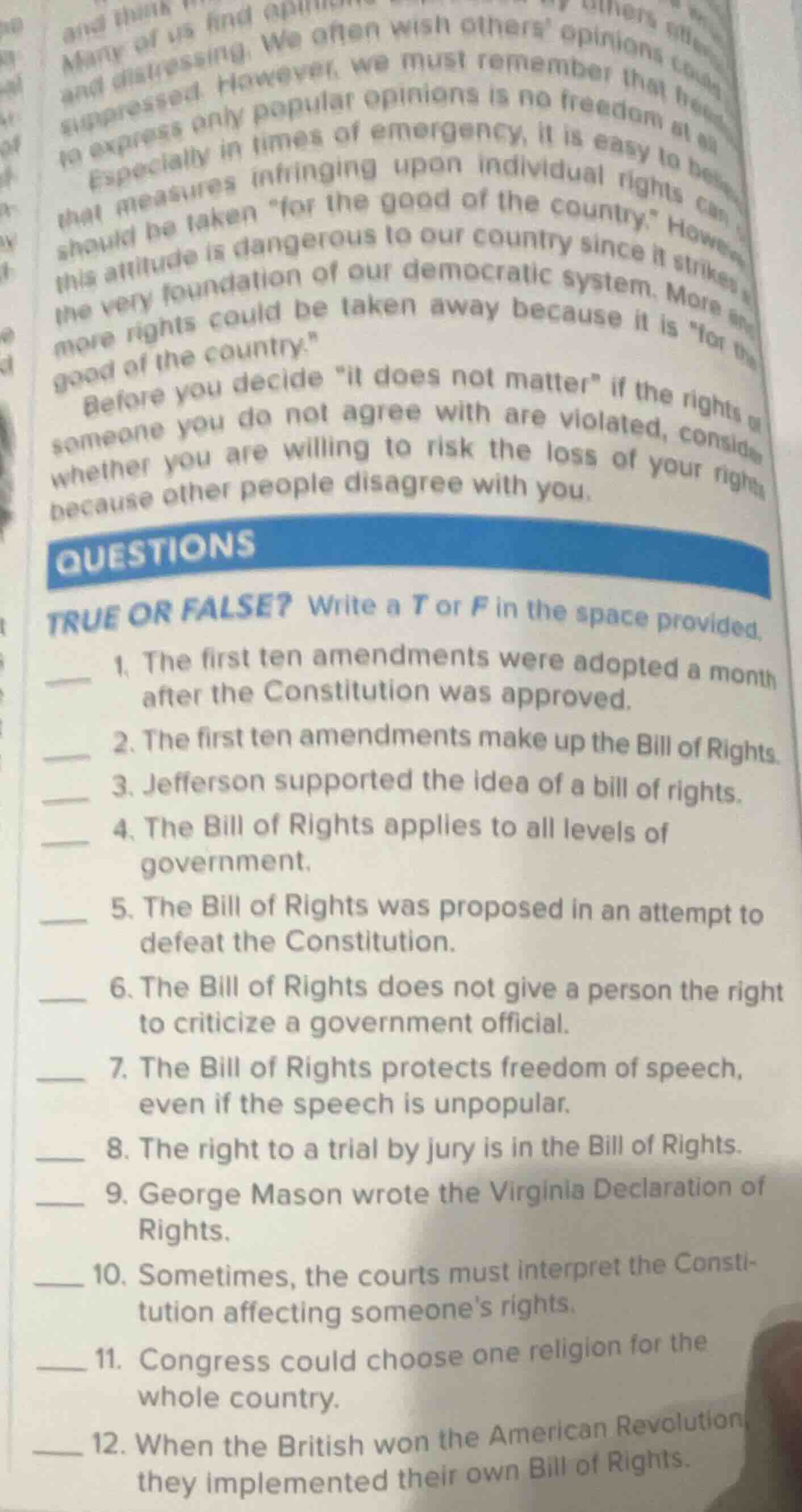
and think and think many of us find opinions of others and distressing. we often wish others opinions could suppressed. however, we must remember that he to express only popular opinions is no freedom at a especially in times of emergency, it is easy to be that measures infringing upon individual rights can should be taken \for the good of the country.\ howev this attitude is dangerous to our country since it strike the very foundation of our democratic system. more an more rights could be taken away because it is \for th good of the country.\ before you decide \it does not matter\ if the rights o someone you do not agree with are violated, conside whether you are willing to risk the loss of your right because other people disagree with you. questions true or false? write a t or f in the space provided. 1. the first ten amendments were adopted a month after the constitution was approved. 2. the first ten amendments make up the bill of rights. 3. jefferson supported the idea of a bill of rights. 4. the bill of rights applies to all levels of government. 5. the bill of rights was proposed in an attempt to defeat the constitution. 6. the bill of rights does not give a person the right to criticize a government official. 7. the bill of rights protects freedom of speech, even if the speech is unpopular. 8. the right to a trial by jury is in the bill of rights. 9. george mason wrote the virginia declaration of rights. 10. sometimes, the courts must interpret the consti- tution affecting someones rights. 11. congress could choose one religion for the whole country. 12. when the british won the american revolution, they implemented their own bill of rights.
- The U.S. Constitution was approved in 1788, and the Bill of Rights (first 10 amendments) was adopted in 1791, over 2 years later.
- The first ten amendments to the U.S. Constitution are explicitly the Bill of Rights.
- Thomas Jefferson was a strong advocate for adding a bill of rights to the Constitution.
- Through incorporation doctrine, the Bill of Rights applies to federal, state, and local governments.
- The Bill of Rights was proposed to satisfy anti-federalists and ratify the Constitution, not defeat it.
- The 1st Amendment protects the right to criticize government officials.
- The 1st Amendment protects all speech, including unpopular or dissenting views.
- The 6th (criminal) and 7th (civil) Amendments guarantee the right to a jury trial.
- George Mason authored the Virginia Declaration of Rights, a precursor to the Bill of Rights.
- Courts interpret the Constitution to clarify rights in new or ambiguous situations.
- The 1st Amendment's Establishment Clause prohibits Congress from establishing a national religion.
- The American colonies won the American Revolution, not the British, so this scenario never happened.

Snap & solve any problem in the app
Get step-by-step solutions on Sovi AI
Photo-based solutions with guided steps
Explore more problems and detailed explanations
- F
- T
- T
- T
- F
- F
- T
- T
- T
- T
- F
- F