QUESTION IMAGE
Question
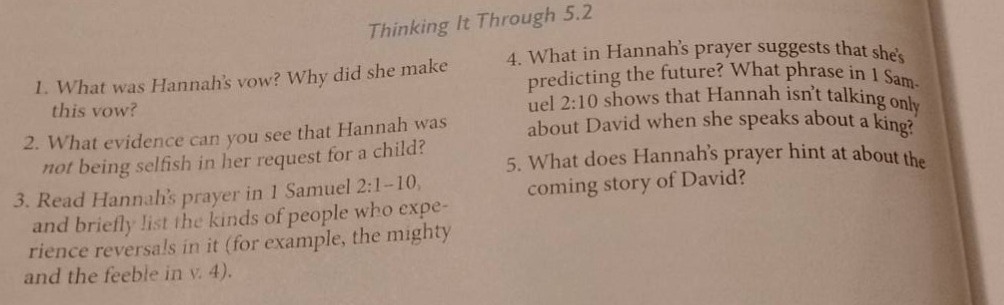
thinking it through 5.2
- what was hannahs vow? why did she make this vow?
- what evidence can you see that hannah was not being selfish in her request for a child?
- read hannahs prayer in 1 samuel 2:1–10, and briefly list the kinds of people who experience reversals in it (for example, the mighty and the feeble in v. 4).
- what in hannahs prayer suggests that shes predicting the future? what phrase in 1 samuel 2:10 shows that hannah isnt talking only about david when she speaks about a king?
- what does hannahs prayer hint at about the coming story of david?
Brief Explanations
All answers are based on the text of 1 Samuel, focusing on Hannah's context, the content of her prayer, and its connections to the broader narrative of David. Key points include the nature of her vow, her selfless intent, the thematic contrasts in her prayer, the scope of her words, and the foreshadowing of God's plan for an anointed ruler.

Snap & solve any problem in the app
Get step-by-step solutions on Sovi AI
Photo-based solutions with guided steps
Explore more problems and detailed explanations
- Hannah's vow was to dedicate her son to God's service at the tabernacle if God gave her a child. She made it because she was barren and deeply desired a child, and she believed God could grant this request.
- Evidence includes her intention to dedicate the child fully to God (not keep him for her own sole benefit) and her humility in praying at the tabernacle, showing her request was rooted in faith rather than selfish desire.
- People facing reversals: the mighty and the feeble (v.4), the full and the hungry (v.5), the barren and the fruitful (v.5), the rich and the poor (v.7), the wicked and the righteous (v.9).
- Hannah's prayer uses universal language about God's power to lift up the lowly and bring down the proud, which suggests she is speaking about God's general justice over all people, not just predicting a specific future event. The phrase "He will give strength to his king and exalt the horn of his anointed one" (1 Samuel 2:10) shows she is not only talking about David, as it refers to God's anointed rulers more broadly, and at the time of her prayer, David was not yet born or chosen.
- Hannah's prayer hints that God will raise up a humble, anointed leader (like David) from unlikely circumstances, exalting the lowly and using them to fulfill His purposes, as it emphasizes God's power to elevate those who are overlooked and bring down the proud, which aligns with David's rise from a shepherd boy to king.