QUESTION IMAGE
Question
three oblique pyramids have the same regular square base. which one has a volume of 15 cubic units if the area of the bases are all 15 square units?
Step1: Recall Volume Formula for Pyramid
The volume \( V \) of a pyramid is given by \( V = \frac{1}{3}Bh \), where \( B \) is the area of the base and \( h \) is the height (perpendicular to the base). For oblique pyramids, the height is the perpendicular distance from the apex to the base, not the slant height.
Step2: Analyze Each Pyramid
- First Pyramid: The right triangle with legs 3 and 4 has hypotenuse 5 (but we need height). Wait, the height here—wait, the perpendicular height? Wait, no, the height of the pyramid is the perpendicular distance. Wait, looking at the first diagram: the right angle is at the base, so the height (perpendicular to base) is 4? Wait, no, wait the base area \( B = 15 \). Let's check each:
Wait, no, the height of the pyramid is the perpendicular height (the vertical leg in the right triangle shown). Let's re-express:
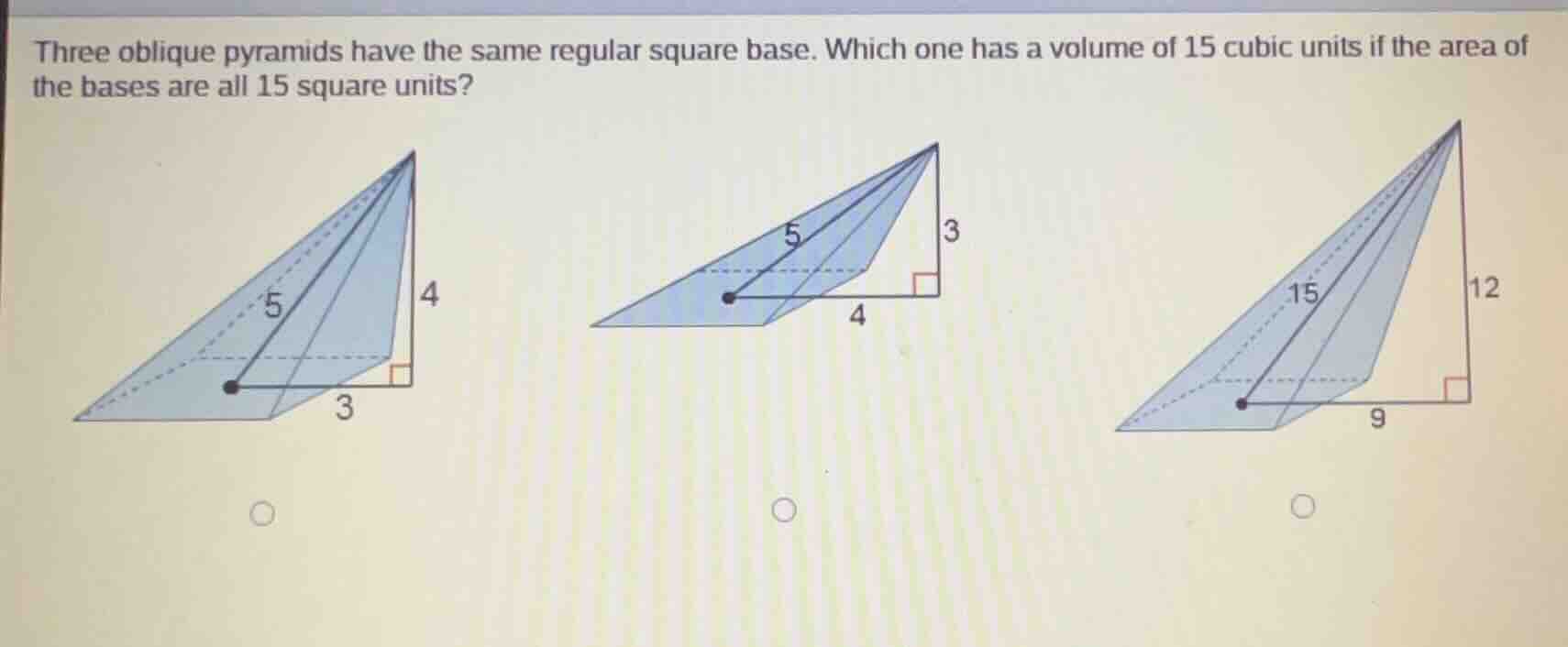
For a pyramid, volume \( V = \frac{1}{3} \times \text{Base Area} \times \text{Height} \). The base area \( B = 15 \). So we need to find which pyramid has height \( h \) such that \( \frac{1}{3} \times 15 \times h = 15 \). Solving for \( h \): \( 5h = 15 \implies h = 3 \). So we need the pyramid with height 3.
Now check the three pyramids:
- First Pyramid: The right triangle has legs 3 and 4, so height (perpendicular) is 4? Wait, no, the diagram: the vertical side is 4, horizontal 3, hypotenuse 5. So height here is 4? Then volume would be \( \frac{1}{3} \times 15 \times 4 = 20 \), not 15.
- Second Pyramid: The right triangle has legs 4 and 3, hypotenuse 5. Wait, the vertical leg is 3. So height \( h = 3 \). Then volume \( \frac{1}{3} \times 15 \times 3 = 15 \). That's the one.
- Third Pyramid: The vertical leg is 12, horizontal 9, hypotenuse 15. Height \( h = 12 \). Volume \( \frac{1}{3} \times 15 \times 12 = 60 \), not 15.
So the second pyramid (middle one) has height 3, so volume \( \frac{1}{3} \times 15 \times 3 = 15 \).

Snap & solve any problem in the app
Get step-by-step solutions on Sovi AI
Photo-based solutions with guided steps
Explore more problems and detailed explanations
The middle oblique pyramid (with the right triangle having legs 4 and 3, height 3) has a volume of 15 cubic units.