QUESTION IMAGE
Question
three types of colonies
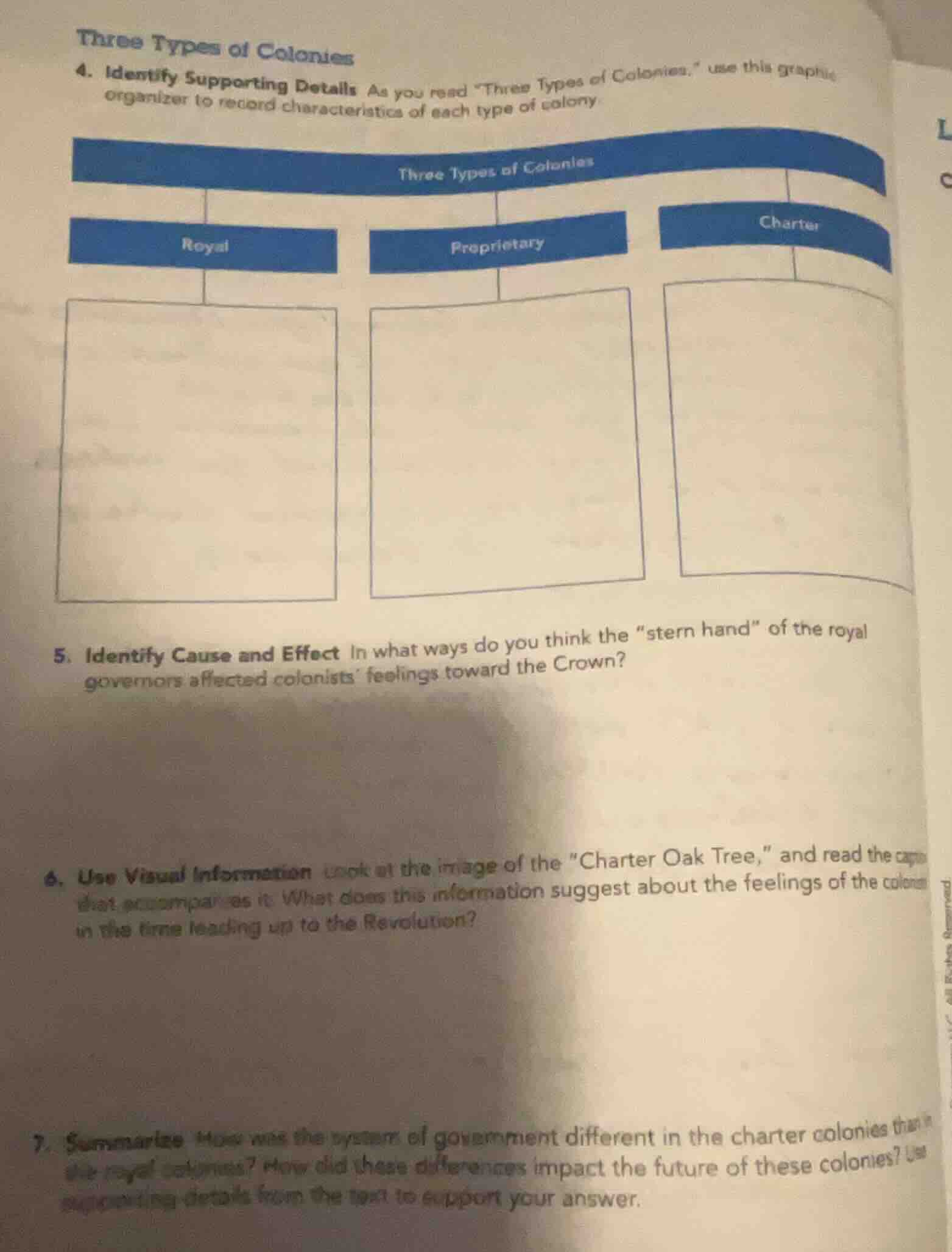
- identify supporting details as you read \three types of colonies,\ use this graphic organizer to record characteristics of each type of colony.
three types of colonies
royal
proprietary
charter
- identify cause and effect in what ways do you think the \stern hand\ of the royal governors affected colonists feelings toward the crown?
- use visual information look at the image of the \charter oak tree,\ and read the caption that accompanies it. what does this information suggest about the feelings of the colonists in the time leading up to the revolution?
- summarize how was the system of government different in the charter colonies than in the royal colonies? how did these differences impact the future of these colonies? use supporting details from the text to support your answer.
For Question 4:
- Royal Colonies: Ruled directly by British-appointed governors; laws approved by the Crown; colonists had limited self-rule.
- Proprietary Colonies: Ruled by proprietors (individuals granted land by the Crown); proprietors appointed governors, had more local control.
- Charter Colonies: Ruled by charters (written agreements) between colonists and the Crown; colonists elected their own governors and legislatures, had the most self-rule.
For Question 5:
The strict control of royal governors created resentment: they dissolved colonial legislatures, ignored local needs, and enforced unpopular British policies (like tax acts). This eroded trust in the Crown, pushing colonists toward demanding more self-governance and eventually supporting independence.
For Question 6:
The Charter Oak Tree is tied to Connecticut's defense of its colonial charter against the Crown (which tried to revoke it to take more control). This suggests colonists valued their self-governing rights deeply and were willing to resist British attempts to limit their autonomy, reflecting growing anti-Crown sentiment pre-Revolution.
For Question 7:
Charter colonies had full self-rule (elected governors/legislatures, self-made laws), while royal colonies were controlled by British-appointed leaders. These differences meant charter colonies had more experience with self-governance, making them quicker to organize resistance to British control and more prepared to form independent governments after the Revolution.

Snap & solve any problem in the app
Get step-by-step solutions on Sovi AI
Photo-based solutions with guided steps
Explore more problems and detailed explanations
- Question 4 Graphic Organizer Entries
- Royal: Ruled by British-appointed governors; limited self-rule; Crown approves laws
- Proprietary: Ruled by Crown-granted proprietors; appoint local governors; more local control
- Charter: Ruled by colonial charters; colonists elect leaders; maximum self-rule
- Question 5: The "stern hand" of royal governors bred resentment and distrust of the Crown, pushing colonists to demand greater self-rule and laying groundwork for revolutionary sentiment.
- Question 6: The Charter Oak Tree suggests colonists fiercely valued their self-governing rights and were willing to resist British efforts to curtail their autonomy, showing growing anti-British feeling before the Revolution.
- Question 7: Charter colonies had elected, self-governing bodies, while royal colonies were controlled by British-appointed officials. Charter colonies' prior self-rule experience made them more ready to resist British control and establish independent post-revolution governments.