QUESTION IMAGE
Question
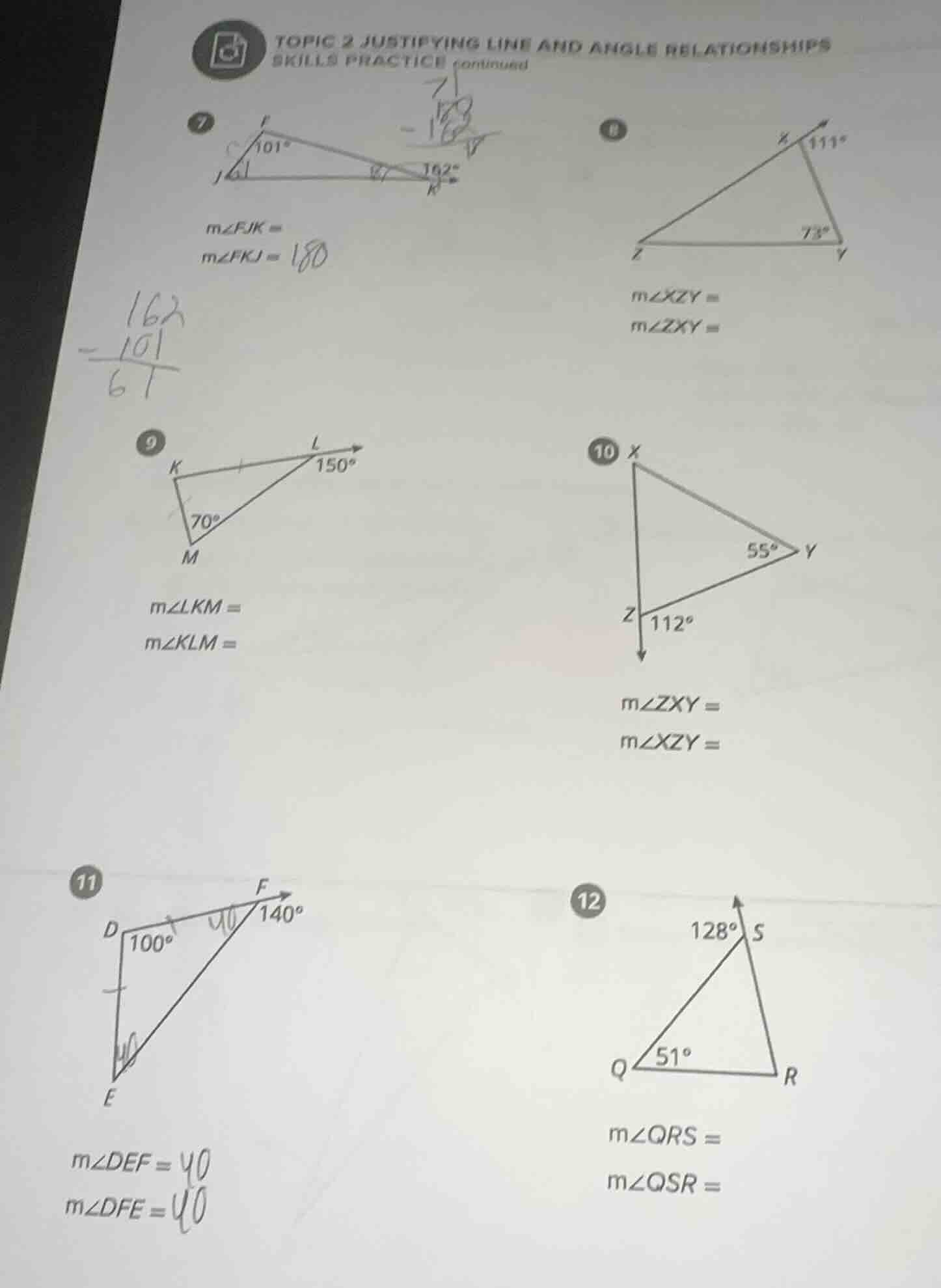
topic 2 justifying line and angle relationships skills practice continued
7
m∠fjk =
m∠fkj =
8
m∠xzy =
m∠zxy =
9
m∠lkm =
m∠klm =
10
m∠zxy =
m∠xzy =
11
m∠def =
m∠dfe =
12
m∠qrs =
m∠qsr =
Problem 7
Step 1: Find \( m\angle FKJ \)
\( \angle FKJ \) and the \( 162^\circ \) angle are supplementary (they form a linear pair), so \( m\angle FKJ = 180^\circ - 162^\circ = 18^\circ \).
Step 2: Find \( m\angle FJK \)
The sum of angles in a triangle is \( 180^\circ \). In \( \triangle FJK \), we know \( \angle JFK = 101^\circ \) and \( \angle FKJ = 18^\circ \). So \( m\angle FJK = 180^\circ - 101^\circ - 18^\circ = 61^\circ \).
Step 1: Find \( m\angle XZY \)
\( \angle XZY \) and the \( 111^\circ \) angle are supplementary, so \( m\angle XZY = 180^\circ - 111^\circ = 69^\circ \). Wait, no, wait. Wait, in triangle \( XZY \), we know \( \angle Y = 73^\circ \), and we need to find \( \angle XZY \) and \( \angle ZXY \). Wait, first, the angle at \( Z \) adjacent to \( 111^\circ \): actually, the exterior angle at \( Z \) is \( 111^\circ \)? Wait, no, the diagram shows \( \angle \) at \( Z \) (the vertex) with an exterior angle? Wait, no, the angle given at \( Z \) (the top) is \( 111^\circ \) as an exterior angle? Wait, no, let's re - examine. The triangle is \( XYZ \), with \( \angle \) at \( Z \) (the vertex) has an exterior angle of \( 111^\circ \)? Wait, no, the angle marked \( 111^\circ \) is adjacent to \( \angle XZY \), so they are supplementary. So \( m\angle XZY = 180^\circ - 111^\circ = 69^\circ \)? Wait, no, that can't be, because then in triangle \( XYZ \), angles sum to \( 180^\circ \). Wait, \( \angle Y = 73^\circ \), \( \angle XZY \) (let's call it \( \angle Z \)) and \( \angle ZXY \) ( \( \angle X \)) sum to \( 180^\circ \). Wait, maybe I made a mistake. Wait, the exterior angle at \( Z \) is \( 111^\circ \), so the interior angle \( \angle XZY = 180 - 111 = 69^\circ \). Then \( \angle ZXY = 180 - 73 - 69 = 38^\circ \). Wait, no, let's do it correctly. The exterior angle at \( Z \) is \( 111^\circ \), so interior angle \( \angle XZY = 180 - 111 = 69^\circ \). Then in triangle \( XYZ \), \( \angle ZXY + \angle XZY + \angle Y=180 \). So \( \angle ZXY = 180 - 73 - 69 = 38^\circ \). Wait, but maybe the \( 111^\circ \) is the exterior angle at \( X \)? No, the diagram shows the angle at \( X \) (the top vertex) with an exterior angle of \( 111^\circ \). So the interior angle at \( X \) ( \( \angle ZXY \)) is \( 180 - 111 = 69^\circ \)? Wait, I think I misread the diagram. Let's start over. The triangle is \( XYZ \), with vertex \( X \), \( Y \), \( Z \). The angle at \( X \) has an exterior angle of \( 111^\circ \), so interior angle \( \angle ZXY = 180 - 111 = 69^\circ \). Then, in triangle \( XYZ \), \( \angle ZXY + \angle XZY + \angle Y = 180 \). \( \angle Y = 73^\circ \), so \( \angle XZY = 180 - 69 - 73 = 38^\circ \). Wait, now I'm confused. Wait, maybe the \( 111^\circ \) is the exterior angle at \( Z \), so interior angle at \( Z \) ( \( \angle XZY \)) is \( 180 - 111 = 69^\circ \), then \( \angle ZXY = 180 - 73 - 69 = 38^\circ \). Let's check the sum: \( 38 + 69 + 73 = 180 \), yes. So:
Step 1: Find \( m\angle XZY \)
The exterior angle at \( Z \) is \( 111^\circ \), so \( m\angle XZY = 180^\circ - 111^\circ = 69^\circ \)? No, wait, no. Wait, the angle at \( Z \) (the vertex) has an exterior angle of \( 111^\circ \), so the interior angle is \( 180 - 111 = 69^\circ \). Then, in triangle \( XYZ \), angles sum to \( 180 \). So \( \angle ZXY = 180 - 73 - 69 = 38^\circ \). Wait, but maybe the \( 111^\circ \) is the exterior angle at \( X \), so interior angle at \( X \) ( \( \angle ZXY \)) is \( 180 - 111 = 69^\circ \), then \( \angle XZY = 180 - 69 - 73 = 38^\circ \). Either way, let's correct. Let's use the exterior angle theorem or linear pair. Let's assume that the angle adjacent to \( \angle XZY \) is \( 111^\circ \), so they are supplementary. So \( m\angle XZY = 180 - 111 = 69^\circ \). Then \( m\angle ZXY = 180 - 73 - 69 = 38^\circ \).
Step 2: Find \( m\angle ZXY \)
Using the triangle angle sum theorem: \( m\angle ZXY = 180^\circ - m\angle Y - m\angle XZY = 180 - 73 - 69 = 38^\circ \).
Step 1: Find \( m\angle KLM \)
The angle marked \( 150^\circ \) is an exterior angle at \( L \), so the interior angle \( m\angle KLM = 180^\circ - 150^\circ = 30^\circ \).
Step 2: Find \( m\angle LKM \)
In triangle \( KLM \), we know \( \angle M = 70^\circ \) and \( \angle KLM = 30^\circ \). Using the triangle angle sum theorem, \( m\angle LKM = 180^\circ - 70^\circ - 30^\circ = 80^\circ \).

Snap & solve any problem in the app
Get step-by-step solutions on Sovi AI
Photo-based solutions with guided steps
Explore more problems and detailed explanations
\( m\angle FJK = 61^\circ \), \( m\angle FKJ = 18^\circ \)