QUESTION IMAGE
Question
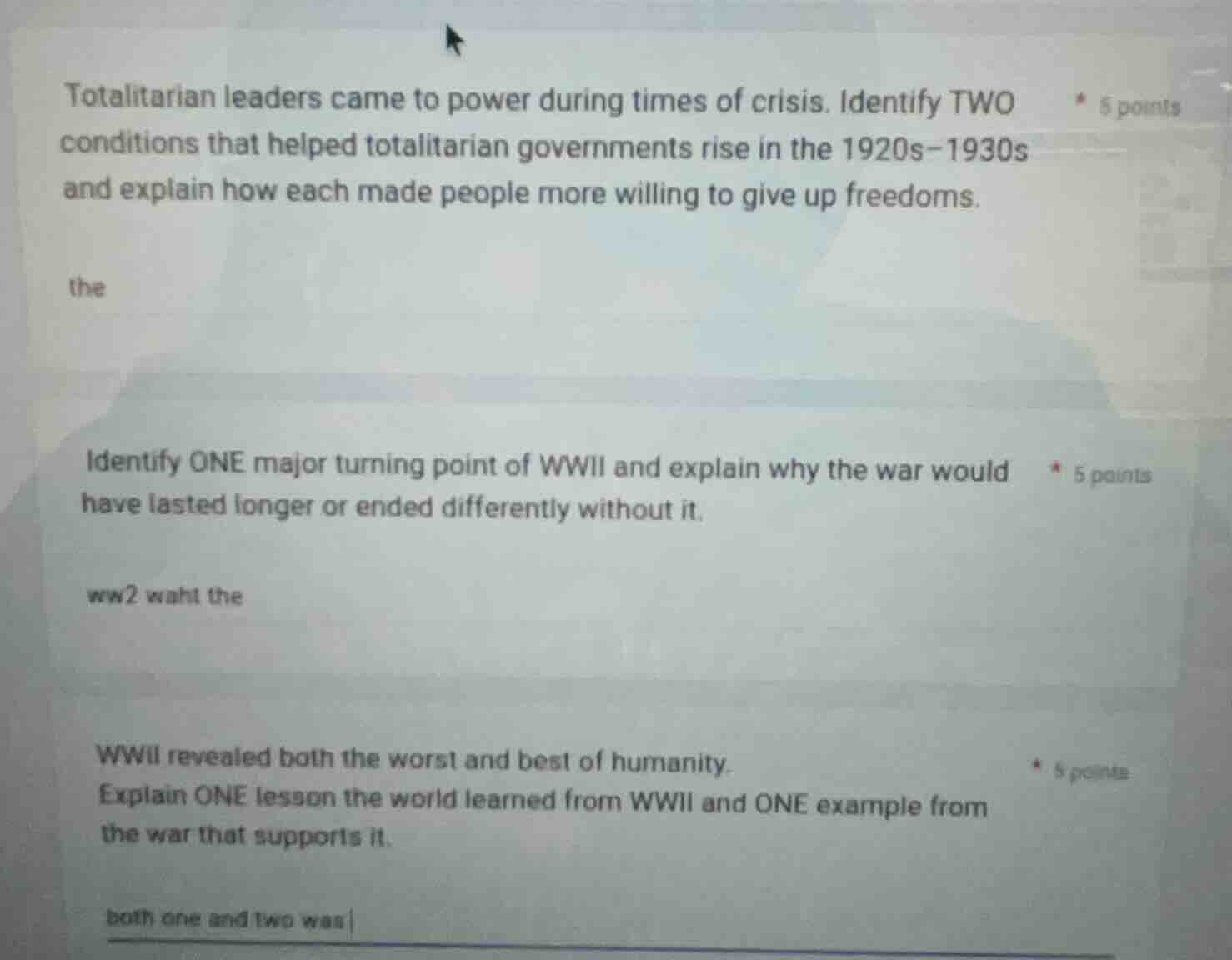
totalitarian leaders came to power during times of crisis. identify two conditions that helped totalitarian governments rise in the 1920s–1930s and explain how each made people more willing to give up freedoms.
the
identify one major turning point of wwii and explain why the war would have lasted longer or ended differently without it.
ww2 waht the
wwii revealed both the worst and best of humanity.
explain one lesson the world learned from wwii and one example from the war that supports it.
both one and two was|
First Sub - Question (Totalitarian Governments Rise)
One condition is economic crisis (e.g., Great Depression). High unemployment, poverty, and economic instability made people desperate. Totalitarian leaders promised economic recovery, so people were willing to give up freedoms for economic security. Another condition is political instability (e.g., weak democratic governments after WWI). People lost faith in democratic systems that couldn't solve problems, so they supported totalitarian regimes that offered strong leadership and order, even at the cost of freedoms.
The Battle of Stalingrad is a major turning point. It was a brutal battle where the Soviet Union defeated Nazi Germany. Before Stalingrad, Germany was on the offensive in the east. After the defeat, Germany's eastern front was weakened, and it had to shift to a defensive posture. Without Stalingrad, Germany might have continued to advance into the Soviet Union, potentially capturing more resources and territory, which would have prolonged the war as the Soviet Union would have faced even greater challenges, and the Western Allies would have had a more difficult time coordinating a counter - offensive.
One lesson is the danger of appeasement. The Munich Agreement (1938) is an example. Britain and France appeased Hitler by allowing him to annex the Sudetenland. This emboldened Hitler, who then continued to expand (e.g., invading Poland), leading to WWII. The lesson is that giving in to aggressive dictators to avoid conflict can lead to even greater conflict.

Snap & solve any problem in the app
Get step-by-step solutions on Sovi AI
Photo-based solutions with guided steps
Explore more problems and detailed explanations
- Condition 1: Economic crisis (Great Depression). Explanation: Widespread unemployment, poverty, and business failures made people desperate for solutions. Totalitarian leaders (e.g., Hitler, Mussolini) promised economic recovery through state - controlled economic plans. People, in their desperation for a better economic situation, were willing to give up political and civil freedoms in exchange for the hope of economic stability.
- Condition 2: Political instability (weak post - WWI democracies). Explanation: After World War I, many European democracies were weak, with fragmented political parties and ineffective governance. People were disillusioned with the inability of these democracies to address issues like territorial disputes and social unrest. Totalitarian regimes offered strong, decisive leadership and a sense of national unity, so people were willing to surrender freedoms to gain a more stable and ordered society.