QUESTION IMAGE
Question
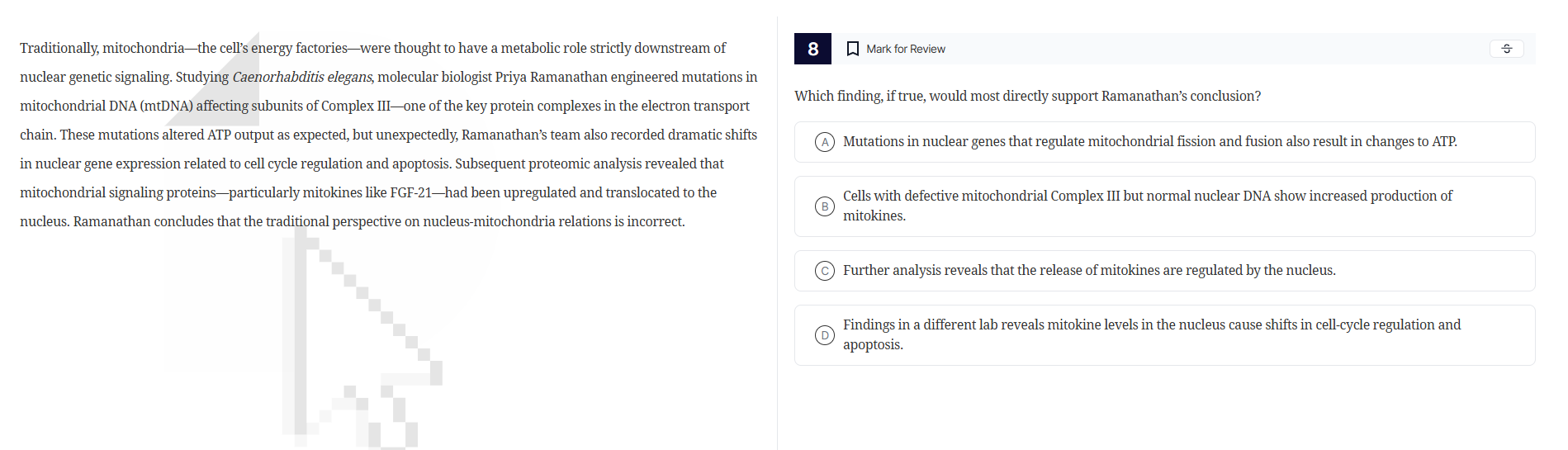
traditionally, mitochondria—the cell’s energy factories—were thought to have a metabolic role strictly downstream of nuclear genetic signaling. studying caenorhabditis elegans, molecular biologist priya ramanathan engineered mutations in mitochondrial dna (mtdna) affecting subunits of complex iii—one of the key protein complexes in the electron transport chain. these mutations altered atp output as expected, but unexpectedly, ramanathan’s team also recorded dramatic shifts in nuclear gene expression related to cell cycle regulation and apoptosis. subsequent proteomic analysis revealed that mitochondrial signaling proteins—particularly mitokines like fgf-21—had been upregulated and translocated to the nucleus. ramanathan concludes that the traditional perspective on nucleus-mitochondria relations is incorrect.
8
mark for review
which finding, if true, would most directly support ramanathan’s conclusion?
a mutations in nuclear genes that regulate mitochondrial fission and fusion also result in changes to atp.
b cells with defective mitochondrial complex iii but normal nuclear dna show increased production of mitokines.
c further analysis reveals that the release of mitokines are regulated by the nucleus.
d findings in a different lab reveals mitokine levels in the nucleus cause shifts in cell-cycle regulation and apoptosis.
To support Ramanathan's conclusion that the traditional nucleus - mitochondria relation view is wrong (mitochondria don't just follow nuclear genetic signaling), we need a finding that shows mitochondria can influence the nucleus.
- Option A: It focuses on nuclear genes affecting mitochondria, which is the traditional view, so it doesn't support the conclusion.
- Option B: It only shows defective Complex III leads to more mitokines, but doesn't link mitokines to nuclear changes, so it's not direct support.
- Option C: It says the nucleus regulates mitokines, which is the traditional direction of influence, not supporting the new conclusion.
- Option D: It shows that mitokine levels in the nucleus (mitokines come from mitochondria) cause shifts in cell - cycle regulation and apoptosis. This shows that mitochondria (via mitokines) can influence nuclear - related processes, directly supporting the idea that the traditional view is incorrect.

Snap & solve any problem in the app
Get step-by-step solutions on Sovi AI
Photo-based solutions with guided steps
Explore more problems and detailed explanations
D. Findings in a different lab reveals mitokine levels in the nucleus cause shifts in cell - cycle regulation and apoptosis.