QUESTION IMAGE
Question
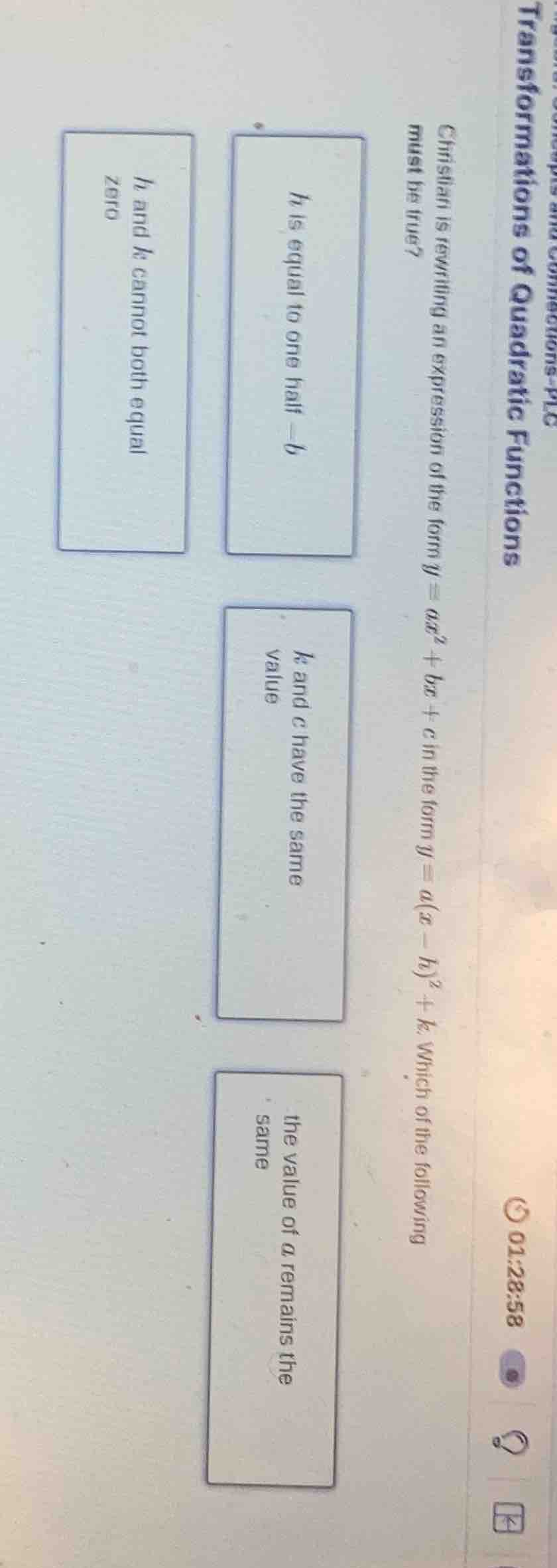
transformations of quadratic functions christian is rewriting an expression of the form ( y = ax^2 + bx + c ) in the form ( y = a(x - h)^2 + k ). which of the following must be true? ( h ) is equal to one half ( -b ) ( k ) and ( c ) have the same value the value of ( a ) remains the same ( h ) and ( k ) cannot both equal zero
Step1: Expand vertex form
$$\begin{align*}
y&=a(x-h)^2 + k\\
&=a(x^2-2hx+h^2)+k\\
&=ax^2-2ahx+ah^2+k
\end{align*}$$
Step2: Compare to standard form
Compare $ax^2-2ahx+ah^2+k$ to $ax^2+bx+c$:
- Coefficient of $x^2$: $a=a$
- Coefficient of $x$: $-2ah=b \implies h=-\frac{b}{2a}$
- Constant term: $ah^2+k=c$
Step3: Evaluate each option
- $h = \frac{1}{2}-b$: Incorrect, $h=-\frac{b}{2a}$.
- $k$ and $c$ same: Incorrect, $k=c-ah^2$.
- $a$ remains same: Correct, matches coefficient comparison.
- $h,k$ not both zero: Incorrect, if $b=0$ and $c=0$, $h=0,k=0$.

Snap & solve any problem in the app
Get step-by-step solutions on Sovi AI
Photo-based solutions with guided steps
Explore more problems and detailed explanations
the value of $a$ remains the same