QUESTION IMAGE
Question
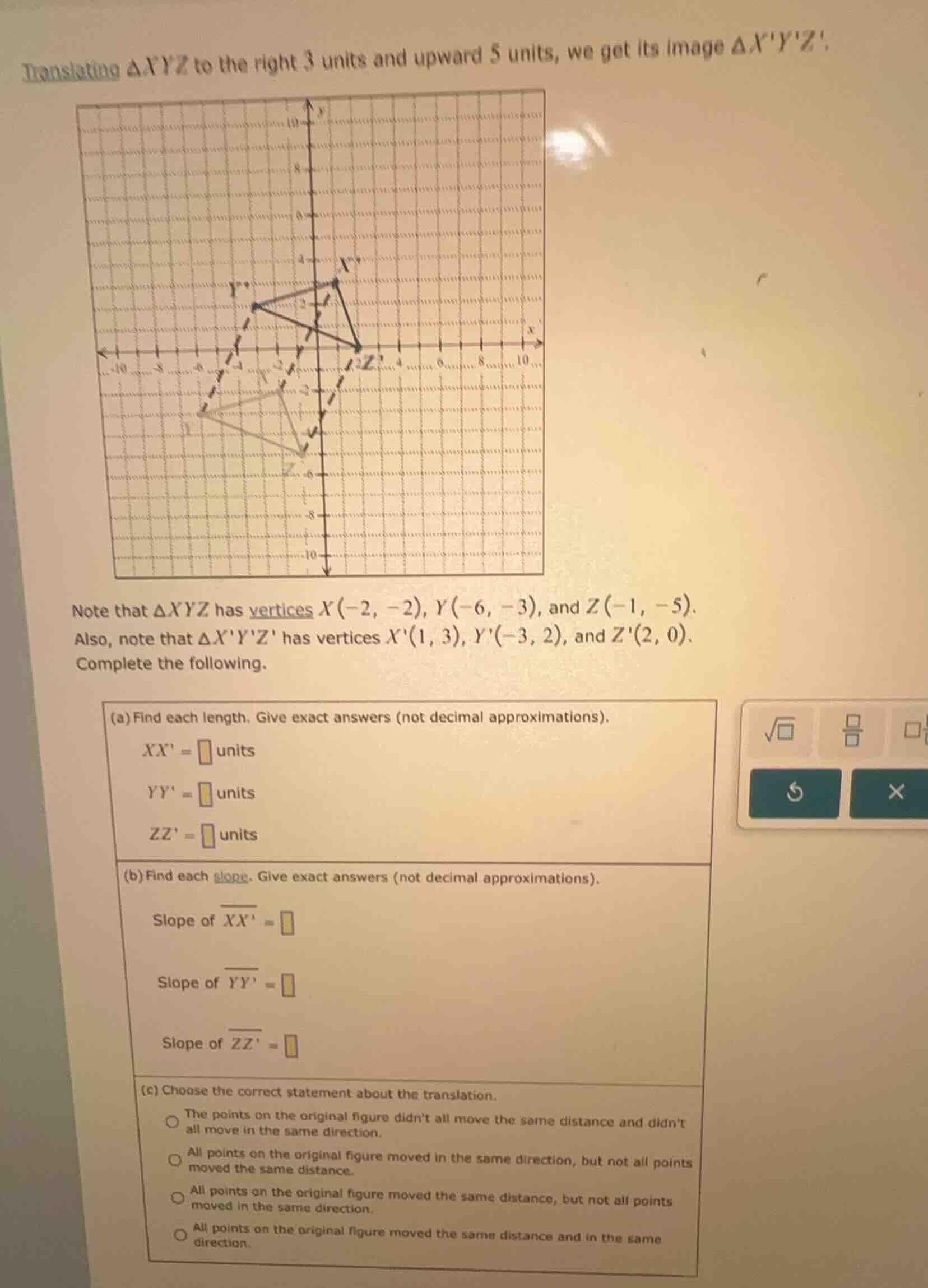
translating $\triangle xyz$ to the right 3 units and upward 5 units, we get its image $\triangle xyz$.
note that $\triangle xyz$ has vertices $x(-2, -2)$, $y(-6, -3)$, and $z(-1, -5)$.
also, note that $\triangle xyz$ has vertices $x(1, 3)$, $y(-3, 2)$, and $z(2, 0)$.
complete the following.
(a) find each length. give exact answers (not decimal approximations).
$xx = \square$ units
$yy = \square$ units
$zz = \square$ units
(b) find each slope. give exact answers (not decimal approximations).
slope of $overline{xx} = \square$
slope of $overline{yy} = \square$
slope of $overline{zz} = \square$
(c) choose the correct statement about the translation.
\bigcirc the points on the original figure didnt all move the same distance and didnt all move in the same direction.
\bigcirc all points on the original figure moved in the same direction, but not all points moved the same distance.
\bigcirc all points on the original figure moved the same distance, but not all points moved in the same direction.
\bigcirc all points on the original figure moved the same distance and in the same direction.
Part (a)
To find the length of \( XX' \), \( YY' \), and \( ZZ' \), we use the distance formula between two points \((x_1, y_1)\) and \((x_2, y_2)\): \( d = \sqrt{(x_2 - x_1)^2 + (y_2 - y_1)^2} \). Also, since the translation is 3 units right and 5 units up, the horizontal change is \( 3 \) and vertical change is \( 5 \), so the distance can also be calculated as \( \sqrt{3^2 + 5^2} \) (by the Pythagorean theorem, as translation is a rigid motion with horizontal and vertical components).
For \( XX' \):
- \( X(-2, -2) \) and \( X'(1, 3) \)
- Horizontal change: \( 1 - (-2) = 3 \)
- Vertical change: \( 3 - (-2) = 5 \)
- Distance \( XX' = \sqrt{3^2 + 5^2} = \sqrt{9 + 25} = \sqrt{34} \)
For \( YY' \):
- \( Y(-6, -3) \) and \( Y'(-3, 2) \)
- Horizontal change: \( -3 - (-6) = 3 \)
- Vertical change: \( 2 - (-3) = 5 \)
- Distance \( YY' = \sqrt{3^2 + 5^2} = \sqrt{9 + 25} = \sqrt{34} \)
For \( ZZ' \):
- \( Z(-1, -5) \) and \( Z'(2, 0) \)
- Horizontal change: \( 2 - (-1) = 3 \)
- Vertical change: \( 0 - (-5) = 5 \)
- Distance \( ZZ' = \sqrt{3^2 + 5^2} = \sqrt{9 + 25} = \sqrt{34} \)
Part (b)
The slope \( m \) between two points \((x_1, y_1)\) and \((x_2, y_2)\) is given by \( m = \frac{y_2 - y_1}{x_2 - x_1} \).
Slope of \( XX' \):
- \( X(-2, -2) \) and \( X'(1, 3) \)
- Slope \( = \frac{3 - (-2)}{1 - (-2)} = \frac{5}{3} \)
Slope of \( YY' \):
- \( Y(-6, -3) \) and \( Y'(-3, 2) \)
- Slope \( = \frac{2 - (-3)}{-3 - (-6)} = \frac{5}{3} \)
Slope of \( ZZ' \):
- \( Z(-1, -5) \) and \( Z'(2, 0) \)
- Slope \( = \frac{0 - (-5)}{2 - (-1)} = \frac{5}{3} \)
Part (c)
In a translation (a type of rigid transformation), every point of the original figure is moved the same distance (the length of the translation vector) and in the same direction (the direction of the translation vector). From part (a), we saw that \( XX' = YY' = ZZ' = \sqrt{34} \) (same distance), and from part (b), the slopes of \( XX' \), \( YY' \), and \( ZZ' \) are equal (same direction, since slope represents direction in terms of rise over run). So the correct statement is: "All points on the original figure moved the same distance and in the same direction."
Final Answers
(a)
\( XX' = \boldsymbol{\sqrt{34}} \) units
\( YY' = \boldsymbol{\sqrt{34}} \) units
\( ZZ' = \boldsymbol{\sqrt{34}} \) units
(b)
Slope of \( XX' = \boldsymbol{\frac{5}{3}} \)
Slope of \( YY' = \boldsymbol{\frac{5}{3}} \)
Slope of \( ZZ' = \boldsymbol{\frac{5}{3}} \)
(c)
The correct statement is: "All points on the original figure moved the same distance and in the same direction." (the last option among the given choices)

Snap & solve any problem in the app
Get step-by-step solutions on Sovi AI
Photo-based solutions with guided steps
Explore more problems and detailed explanations
Part (a)
To find the length of \( XX' \), \( YY' \), and \( ZZ' \), we use the distance formula between two points \((x_1, y_1)\) and \((x_2, y_2)\): \( d = \sqrt{(x_2 - x_1)^2 + (y_2 - y_1)^2} \). Also, since the translation is 3 units right and 5 units up, the horizontal change is \( 3 \) and vertical change is \( 5 \), so the distance can also be calculated as \( \sqrt{3^2 + 5^2} \) (by the Pythagorean theorem, as translation is a rigid motion with horizontal and vertical components).
For \( XX' \):
- \( X(-2, -2) \) and \( X'(1, 3) \)
- Horizontal change: \( 1 - (-2) = 3 \)
- Vertical change: \( 3 - (-2) = 5 \)
- Distance \( XX' = \sqrt{3^2 + 5^2} = \sqrt{9 + 25} = \sqrt{34} \)
For \( YY' \):
- \( Y(-6, -3) \) and \( Y'(-3, 2) \)
- Horizontal change: \( -3 - (-6) = 3 \)
- Vertical change: \( 2 - (-3) = 5 \)
- Distance \( YY' = \sqrt{3^2 + 5^2} = \sqrt{9 + 25} = \sqrt{34} \)
For \( ZZ' \):
- \( Z(-1, -5) \) and \( Z'(2, 0) \)
- Horizontal change: \( 2 - (-1) = 3 \)
- Vertical change: \( 0 - (-5) = 5 \)
- Distance \( ZZ' = \sqrt{3^2 + 5^2} = \sqrt{9 + 25} = \sqrt{34} \)
Part (b)
The slope \( m \) between two points \((x_1, y_1)\) and \((x_2, y_2)\) is given by \( m = \frac{y_2 - y_1}{x_2 - x_1} \).
Slope of \( XX' \):
- \( X(-2, -2) \) and \( X'(1, 3) \)
- Slope \( = \frac{3 - (-2)}{1 - (-2)} = \frac{5}{3} \)
Slope of \( YY' \):
- \( Y(-6, -3) \) and \( Y'(-3, 2) \)
- Slope \( = \frac{2 - (-3)}{-3 - (-6)} = \frac{5}{3} \)
Slope of \( ZZ' \):
- \( Z(-1, -5) \) and \( Z'(2, 0) \)
- Slope \( = \frac{0 - (-5)}{2 - (-1)} = \frac{5}{3} \)
Part (c)
In a translation (a type of rigid transformation), every point of the original figure is moved the same distance (the length of the translation vector) and in the same direction (the direction of the translation vector). From part (a), we saw that \( XX' = YY' = ZZ' = \sqrt{34} \) (same distance), and from part (b), the slopes of \( XX' \), \( YY' \), and \( ZZ' \) are equal (same direction, since slope represents direction in terms of rise over run). So the correct statement is: "All points on the original figure moved the same distance and in the same direction."
Final Answers
(a)
\( XX' = \boldsymbol{\sqrt{34}} \) units
\( YY' = \boldsymbol{\sqrt{34}} \) units
\( ZZ' = \boldsymbol{\sqrt{34}} \) units
(b)
Slope of \( XX' = \boldsymbol{\frac{5}{3}} \)
Slope of \( YY' = \boldsymbol{\frac{5}{3}} \)
Slope of \( ZZ' = \boldsymbol{\frac{5}{3}} \)
(c)
The correct statement is: "All points on the original figure moved the same distance and in the same direction." (the last option among the given choices)