QUESTION IMAGE
Question
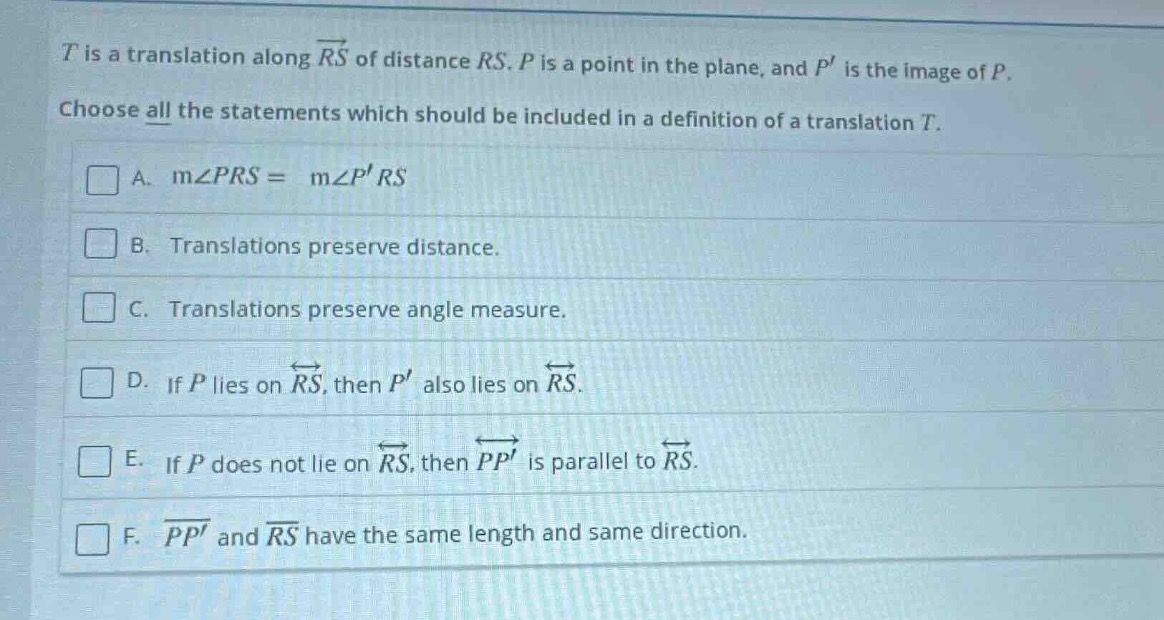
t is a translation along \\(\overrightarrow{rs}\\) of distance \\(rs\\). \\(p\\) is a point in the plane, and \\(p\\) is the image of \\(p\\).
choose all the statements which should be included in a definition of a translation \\(t\\).
\\(\square\\) a. \\(m\angle prs = m\angle prs\\)
\\(\square\\) b. translations preserve distance.
\\(\square\\) c. translations preserve angle measure.
\\(\square\\) d. if \\(p\\) lies on \\(\overleftrightarrow{rs}\\), then \\(p\\) also lies on \\(\overleftrightarrow{rs}\\).
\\(\square\\) e. if \\(p\\) does not lie on \\(\overleftrightarrow{rs}\\), then \\(\overleftrightarrow{pp}\\) is parallel to \\(\overrightarrow{rs}\\).
\\(\square\\) f. \\(\overline{pp}\\) and \\(\overrightarrow{rs}\\) have the same length and same direction.
- Option A: This is not a defining property; angles formed with the translation vector are not necessarily equal for a point and its image.
- Option B: Translations are rigid motions, so they preserve distance between all points, which is a core defining feature.
- Option C: As rigid motions, translations preserve all angle measures between lines/segments, a key defining property.
- Option D: If a point is on the translation vector line, its image must stay on that line since translation moves along the vector, which is part of the definition.
- Option E: For points not on the translation vector line, the segment connecting the point and its image is parallel to the translation vector, a defining characteristic of translation.
- Option F: By definition, a translation moves every point along a vector identical to the given translation vector (same length and direction), so $\overrightarrow{PP'}$ matches $\overrightarrow{RS}$.

Snap & solve any problem in the app
Get step-by-step solutions on Sovi AI
Photo-based solutions with guided steps
Explore more problems and detailed explanations
B. Translations preserve distance.
C. Translations preserve angle measure.
D. If $P$ lies on $\overleftrightarrow{RS}$, then $P'$ also lies on $\overleftrightarrow{RS}$.
E. If $P$ does not lie on $\overleftrightarrow{RS}$, then $\overleftrightarrow{PP'}$ is parallel to $\overleftrightarrow{RS}$.
F. $\overrightarrow{PP'}$ and $\overrightarrow{RS}$ have the same length and same direction.