QUESTION IMAGE
Question
- translation: $(x, y) \
ightarrow (x + 3, y - 5)$
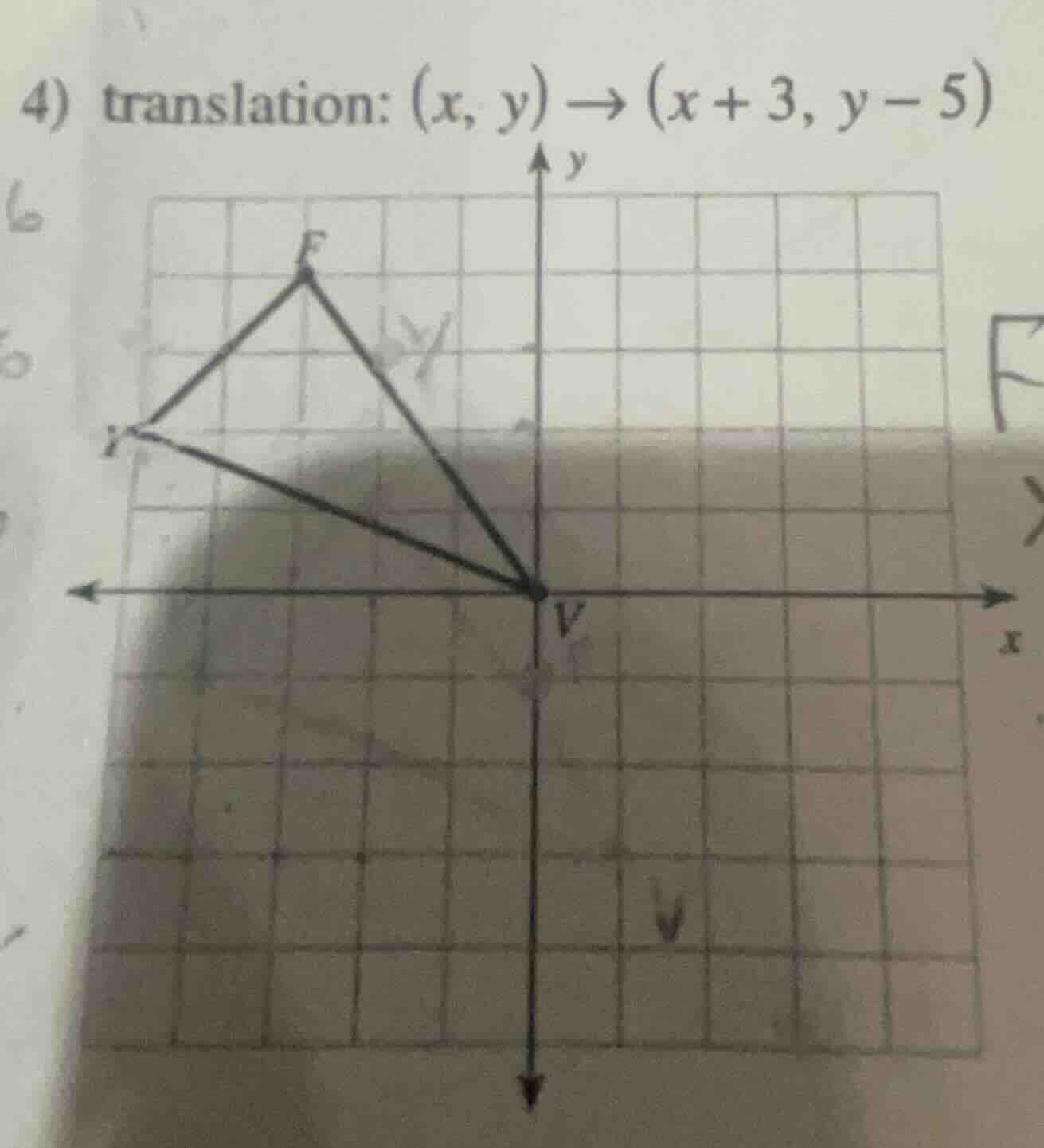
To solve the translation of the vertices (assuming we need to find the translated coordinates of points like \( V \), \( F \), and the other vertex, let's first identify the coordinates of the original vertices. From the graph:
- Let's assume \( V \) is at \( (0, 0) \) (since it's at the origin).
- Let \( F \) be at \( (-3, 4) \) (by counting the grid units: 3 left on the x - axis and 4 up on the y - axis).
- Let the other vertex (let's call it \( I \)) be at \( (-5, 2) \) (5 left on the x - axis and 2 up on the y - axis).
The translation rule is \( (x,y)\to(x + 3,y-5) \)
Step 1: Translate point \( V(0,0) \)
Using the translation rule \( (x,y)\to(x + 3,y - 5) \)
Substitute \( x = 0 \) and \( y=0 \) into the rule:
\( x_{new}=0 + 3=3 \)
\( y_{new}=0-5=-5 \)
So the translated coordinates of \( V \) are \( (3,-5) \)
Step 2: Translate point \( F(-3,4) \)
Substitute \( x=-3 \) and \( y = 4 \) into the translation rule \( (x,y)\to(x + 3,y-5) \)
\( x_{new}=-3 + 3=0 \)
\( y_{new}=4-5=-1 \)
So the translated coordinates of \( F \) are \( (0,-1) \)
Step 3: Translate point \( I(-5,2) \)
Substitute \( x = - 5 \) and \( y=2 \) into the translation rule \( (x,y)\to(x + 3,y-5) \)
\( x_{new}=-5 + 3=-2 \)
\( y_{new}=2-5=-3 \)
So the translated coordinates of \( I \) are \( (-2,-3) \)
If we assume the question is to find the translated coordinates of the vertices, the translated coordinates are:
- \( V':(3,-5) \)
- \( F':(0,-1) \)
- \( I':(-2,-3) \)
(If you had a specific vertex in mind, you can use the above steps with its original coordinates. For example, if we take \( V(0,0) \), the translated point is \( (3,-5) \))

Snap & solve any problem in the app
Get step-by-step solutions on Sovi AI
Photo-based solutions with guided steps
Explore more problems and detailed explanations
To solve the translation of the vertices (assuming we need to find the translated coordinates of points like \( V \), \( F \), and the other vertex, let's first identify the coordinates of the original vertices. From the graph:
- Let's assume \( V \) is at \( (0, 0) \) (since it's at the origin).
- Let \( F \) be at \( (-3, 4) \) (by counting the grid units: 3 left on the x - axis and 4 up on the y - axis).
- Let the other vertex (let's call it \( I \)) be at \( (-5, 2) \) (5 left on the x - axis and 2 up on the y - axis).
The translation rule is \( (x,y)\to(x + 3,y-5) \)
Step 1: Translate point \( V(0,0) \)
Using the translation rule \( (x,y)\to(x + 3,y - 5) \)
Substitute \( x = 0 \) and \( y=0 \) into the rule:
\( x_{new}=0 + 3=3 \)
\( y_{new}=0-5=-5 \)
So the translated coordinates of \( V \) are \( (3,-5) \)
Step 2: Translate point \( F(-3,4) \)
Substitute \( x=-3 \) and \( y = 4 \) into the translation rule \( (x,y)\to(x + 3,y-5) \)
\( x_{new}=-3 + 3=0 \)
\( y_{new}=4-5=-1 \)
So the translated coordinates of \( F \) are \( (0,-1) \)
Step 3: Translate point \( I(-5,2) \)
Substitute \( x = - 5 \) and \( y=2 \) into the translation rule \( (x,y)\to(x + 3,y-5) \)
\( x_{new}=-5 + 3=-2 \)
\( y_{new}=2-5=-3 \)
So the translated coordinates of \( I \) are \( (-2,-3) \)
If we assume the question is to find the translated coordinates of the vertices, the translated coordinates are:
- \( V':(3,-5) \)
- \( F':(0,-1) \)
- \( I':(-2,-3) \)
(If you had a specific vertex in mind, you can use the above steps with its original coordinates. For example, if we take \( V(0,0) \), the translated point is \( (3,-5) \))