QUESTION IMAGE
Question
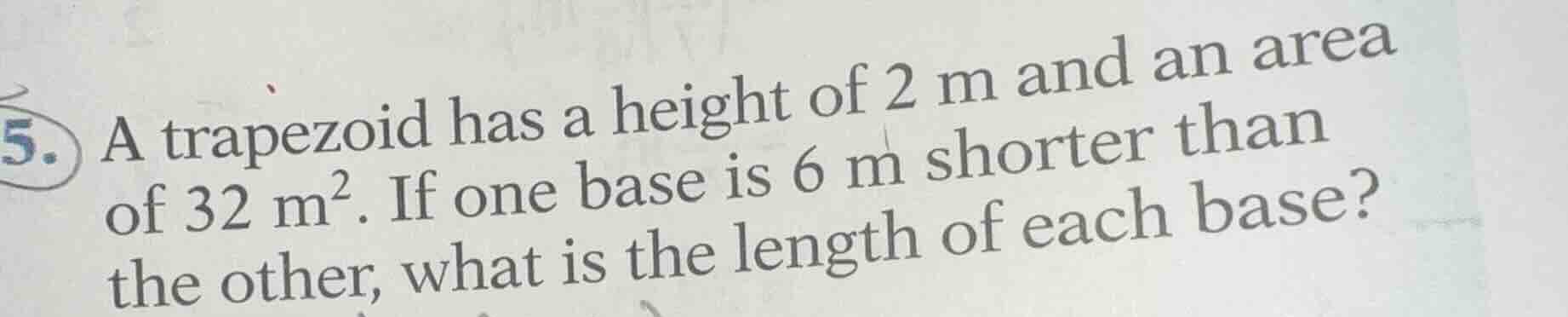
- a trapezoid has a height of 2 m and an area of 32 m². if one base is 6 m shorter than the other, what is the length of each base?
Step1: Recall the formula for the area of a trapezoid
The area \( A \) of a trapezoid is given by the formula \( A=\frac{(b_1 + b_2)h}{2} \), where \( b_1 \) and \( b_2 \) are the lengths of the two bases and \( h \) is the height. We know that \( h = 2\space m \), \( A=32\space m^2 \), and let \( b_2=b_1 - 6 \) (assuming \( b_2 \) is the shorter base).
Step2: Substitute the known values into the formula
Substitute \( A = 32 \), \( h=2 \), and \( b_2=b_1 - 6 \) into the area formula:
\[
32=\frac{(b_1+(b_1 - 6))\times2}{2}
\]
Simplify the right - hand side. The 2 in the numerator and the 2 in the denominator cancel out, so we get:
\[
32=b_1+(b_1 - 6)
\]
Step3: Solve the equation for \( b_1 \)
Simplify the right - hand side of the equation: \( 32 = 2b_1-6 \)
Add 6 to both sides of the equation: \( 32 + 6=2b_1-6 + 6 \), which gives \( 38 = 2b_1 \)
Divide both sides by 2: \( b_1=\frac{38}{2}=19\space m \)
Step4: Find the length of \( b_2 \)
Since \( b_2=b_1 - 6 \), substitute \( b_1 = 19 \) into this equation: \( b_2=19 - 6 = 13\space m \)

Snap & solve any problem in the app
Get step-by-step solutions on Sovi AI
Photo-based solutions with guided steps
Explore more problems and detailed explanations
The lengths of the two bases are \( 19\space m \) and \( 13\space m \)