QUESTION IMAGE
Question
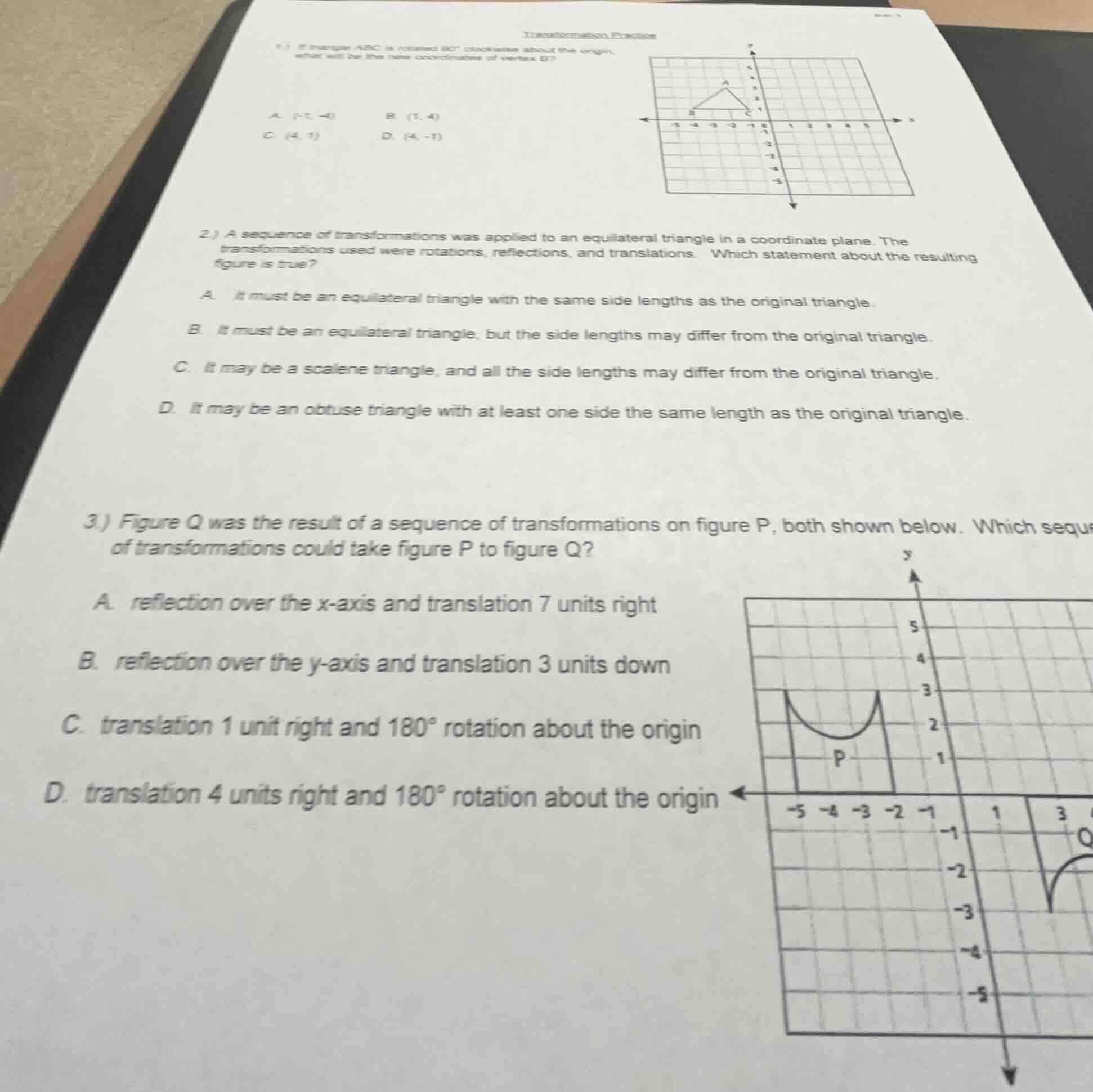
1 ) if triangle abc is rotated 90° clockwise about the origin, what will be the new coordinates of vertex b?
a (-1, -4) b (1, 4)
c (4, 1) d (4, -1)
2 ) a sequence of transformations was applied to an equilateral triangle in a coordinate plane. the transformations used were rotations, reflections, and translations. which statement about the resulting figure is true?
a. it must be an equilateral triangle with the same side lengths as the original triangle.
b. it must be an equilateral triangle, but the side lengths may differ from the original triangle.
c. it may be a scalene triangle, and all the side lengths may differ from the original triangle.
d. it may be an obtuse triangle with at least one side the same length as the original triangle.
3 ) figure q was the result of a sequence of transformations on figure p, both shown below. which sequence of transformations could take figure p to figure q?
a. reflection over the x - axis and translation 7 units right
b. reflection over the y - axis and translation 3 units down
c. translation 1 unit right and 180° rotation about the origin
d. translation 4 units right and 180° rotation about the origin
Question 1
Step1: Find original coordinates of B
From the graph, vertex B has coordinates \((-4, 1)\).
Step2: Apply 90° clockwise rotation rule
The rule for a 90° clockwise rotation about the origin is \((x, y) \to (y, -x)\).
Step3: Substitute coordinates of B
For \(B(-4, 1)\), applying the rule: \(x = -4\), \(y = 1\). New coordinates: \((1, -(-4))=(1, 4)\)? Wait, no, wait. Wait, 90° clockwise: \((x,y)\) becomes \((y, -x)\). So \((-4,1)\) becomes \((1, 4)\)? Wait, no, let's check again. Wait, 90° clockwise rotation: the formula is \((x, y) \mapsto (y, -x)\). So for point \((-4, 1)\), \(x=-4\), \(y = 1\). So new \(x = y = 1\), new \(y=-x = -(-4)=4\). Wait, but the options have (4,1), (4,-1), etc. Wait, maybe I misread the original coordinates. Wait, looking at the graph, B is at (-4, 1)? Wait, the x-axis: -5, -4, -3, -2, -1, 0, 1... So B is at (-4, 1)? Wait, no, maybe the y-axis: the grid, let's see, the triangle is above the x-axis? Wait, the options: A (-1,-4), B (1,4), C (4,1), D (4,-1). Wait, maybe the original coordinates of B are (-1, 4)? No, the graph: let's re-examine. The x-axis: from -5 to 5, y-axis from -5 to 5. The triangle has B at (-4, 1)? Wait, no, maybe I made a mistake. Wait, 90° clockwise rotation: another way, 90° clockwise is equivalent to 270° counterclockwise. The rule is \((x,y) \to (y, -x)\). Wait, let's take a point (a,b), 90° clockwise: (b, -a). So if B is at (-4, 1), then (1, 4). But option B is (1,4). Wait, maybe that's correct. Wait, but let's check again. Wait, maybe the original coordinates of B are (-4, 1). Then 90° clockwise: (1, 4). So the answer is B.
Rotations, reflections, and translations are rigid transformations, which preserve the shape and size of the figure. An equilateral triangle subjected to rigid transformations will remain an equilateral triangle with the same side lengths. So option A is correct because rigid transformations preserve congruence (same shape and size). Option B is wrong because side lengths don't change. Option C is wrong because it can't be scalene (side lengths change). Option D is wrong because it can't be obtuse (angles and side lengths preserved).
Let's analyze each option:
- Option A: Reflect over x-axis (flips over x-axis) and translate 7 units right. Figure P is a "U" shape opening up. Reflecting over x-axis would make it open down. Then translating 7 units right: let's check coordinates. Figure P is at x from -5 to -2, y from 0 to 3. Reflect over x-axis: y becomes -y. Then translate 7 units right: x increases by 7. So -5 +7=2, -2 +7=5. So the reflected and translated figure would be at x from 2 to 5, y from 0 to -3, which matches Figure Q (which is a "U" opening down at x from 2 to 5, y from -3 to 0). Let's check other options:
- Option B: Reflect over y-axis (flips over y-axis) and translate 3 units down. Reflecting P over y-axis would move it to x from 2 to 5, but P is at x from -5 to -2. Reflecting over y-axis: x becomes -x, so -5→5, -2→2. Then translating 3 units down: y decreases by 3. But Figure Q is at x from 2 to 5, y from -3 to 0, but the shape after reflecting over y-axis would be opening up, then translating down would still be opening up, but Q is opening down. So B is wrong.
- Option C: Translate 1 unit right and 180° rotation. 180° rotation: (x,y)→(-x,-y). Translating 1 unit right: (x+1, y). Then rotating 180°: (- (x+1), -y). This would not match Q.
- Option D: Translate 4 units right and 180° rotation. Similar to C, would not result in Q. So A is correct.

Snap & solve any problem in the app
Get step-by-step solutions on Sovi AI
Photo-based solutions with guided steps
Explore more problems and detailed explanations
B. (1, 4)