QUESTION IMAGE
Question
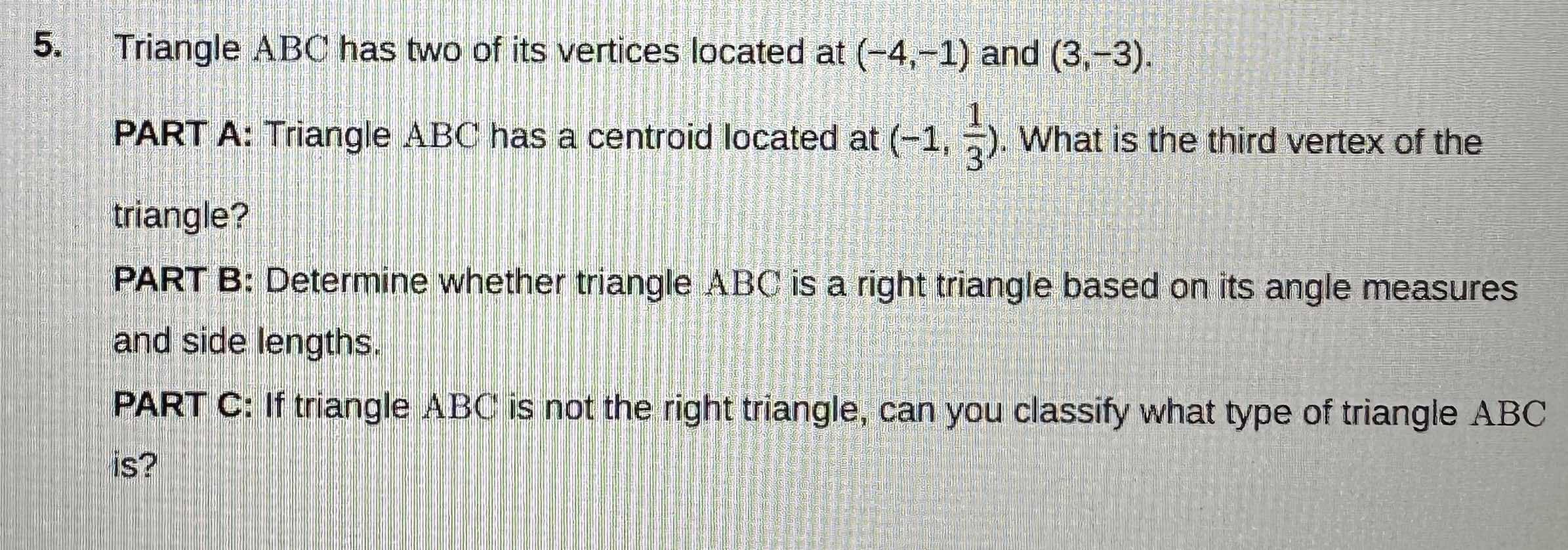
- triangle abc has two of its vertices located at (-4,-1) and (3,-3).
part a: triangle abc has a centroid located at (-1, \frac{1}{3}). what is the third vertex of the triangle?
part b: determine whether triangle abc is a right triangle based on its angle measures and side lengths.
part c: if triangle abc is not the right triangle, can you classify what type of triangle abc is?
PART A
Step1: Recall centroid formula
The centroid \( G(x_G, y_G) \) of a triangle with vertices \( (x_1, y_1) \), \( (x_2, y_2) \), \( (x_3, y_3) \) is given by \( x_G=\frac{x_1 + x_2 + x_3}{3} \) and \( y_G=\frac{y_1 + y_2 + y_3}{3} \). Let the two given vertices be \( A(-4, -1) \), \( B(3, -3) \) and the third vertex be \( C(x, y) \), and centroid \( G(-1, \frac{1}{3}) \).
Step2: Solve for \( x \) (x-coordinate of third vertex)
Using the x - coordinate formula: \( -1=\frac{-4 + 3 + x}{3} \)
Multiply both sides by 3: \( - 3=-4 + 3+x \)
Simplify right - hand side: \( -3=-1 + x \)
Add 1 to both sides: \( x=-3 + 1=-2 \)
Step3: Solve for \( y \) (y - coordinate of third vertex)
Using the y - coordinate formula: \( \frac{1}{3}=\frac{-1-3 + y}{3} \)
Multiply both sides by 3: \( 1=-1-3 + y \)
Simplify right - hand side: \( 1=-4 + y \)
Add 4 to both sides: \( y=1 + 4 = 5 \)
Step1: Find the lengths of the sides
First, we have vertices \( A(-4,-1) \), \( B(3,-3) \), \( C(-2,5) \)
The distance formula between two points \( (x_1,y_1) \) and \( (x_2,y_2) \) is \( d=\sqrt{(x_2 - x_1)^2+(y_2 - y_1)^2} \)
- Length of \( AB \): \( AB=\sqrt{(3 + 4)^2+(-3 + 1)^2}=\sqrt{49 + 4}=\sqrt{53}\approx7.28 \)
- Length of \( BC \): \( BC=\sqrt{(-2 - 3)^2+(5 + 3)^2}=\sqrt{25 + 64}=\sqrt{89}\approx9.43 \)
- Length of \( AC \): \( AC=\sqrt{(-2 + 4)^2+(5 + 1)^2}=\sqrt{4 + 36}=\sqrt{40}=2\sqrt{10}\approx6.32 \)
Step2: Check Pythagorean theorem
We check if \( AB^{2}+AC^{2}=BC^{2} \), \( AB^{2}+BC^{2}=AC^{2} \) or \( AC^{2}+BC^{2}=AB^{2} \)
- \( AB^{2}=53 \), \( AC^{2}=40 \), \( BC^{2}=89 \)
- \( AB^{2}+AC^{2}=53 + 40=93
eq89 = BC^{2} \)
- \( AB^{2}+BC^{2}=53 + 89 = 142
eq40=AC^{2} \)
- \( AC^{2}+BC^{2}=40 + 89=129
eq53 = AB^{2} \)
To classify the triangle, we can look at the angles (using the law of cosines or by comparing the squares of the sides). We know that for a triangle with side lengths \( a,b,c \) (where \( c \) is the longest side), if \( c^{2}
Here, the longest side is \( BC \) with \( BC^{2}=89 \), and \( AB^{2}+AC^{2}=53 + 40 = 93 \). Since \( BC^{2}=89<93 = AB^{2}+AC^{2} \), the angle opposite to \( BC \) (angle \( A \)) is acute. Also, since all \( c^{2}
eq AC \), the triangle is a scalene triangle (all sides of different lengths) and acute.

Snap & solve any problem in the app
Get step-by-step solutions on Sovi AI
Photo-based solutions with guided steps
Explore more problems and detailed explanations
The third vertex is \( (-2,5) \)