QUESTION IMAGE
Question
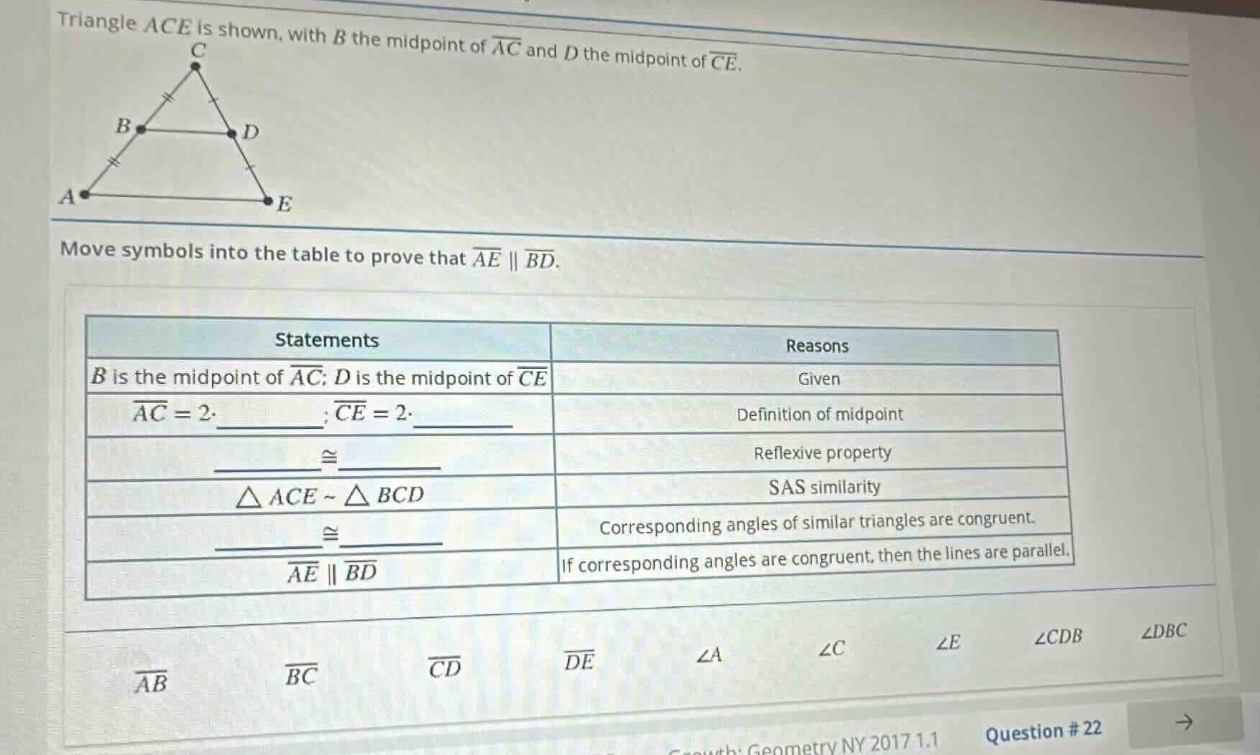
triangle ace is shown, with b the midpoint of \\(\overline{ac}\\) and d the midpoint of \\(\overline{ce}\\).
move symbols into the table to prove that \\(\overline{ae} \parallel \overline{bd}\\).
| statements | reasons |
|---|---|
| \\(\overline{ac} = 2\cdot\underline{quadquad}; \overline{ce} = 2\cdot\underline{quadquad}\\) | definition of midpoint |
| \\(\underline{quadquad} \cong \underline{quadquad}\\) | reflexive property |
| \\(\triangle ace \sim \triangle bcd\\) | sas similarity |
| \\(\underline{quadquad} \cong \underline{quadquad}\\) | corresponding angles of similar triangles are congruent. |
| \\(\overline{ae} \parallel \overline{bd}\\) | if corresponding angles are congruent, then the lines are parallel. |
symbols to choose from: \\(\overline{ab}\\), \\(\overline{bc}\\), \\(\overline{cd}\\), \\(\overline{de}\\), \\(\angle a\\), \\(\angle c\\), \\(\angle e\\), \\(\angle cdb\\), \\(\angle dbc\\)
Step1: Fill midpoint segments
$\overline{AC} = 2\cdot\overline{BC}$; $\overline{CE} = 2\cdot\overline{CD}$
Step2: Reflexive congruent angle
$\angle C \cong \angle C$
Step3: Corresponding congruent angles
$\angle A \cong \angle DBC$ (or $\angle E \cong \angle CDB$)

Snap & solve any problem in the app
Get step-by-step solutions on Sovi AI
Photo-based solutions with guided steps
Explore more problems and detailed explanations
| Statements | Reasons |
|---|---|
| $\overline{AC} = 2\cdot\overline{BC}$; $\overline{CE} = 2\cdot\overline{CD}$ | Definition of midpoint |
| $\angle C \cong \angle C$ | Reflexive property |
| $\triangle ACE \sim \triangle BCD$ | SAS similarity |
| $\angle A \cong \angle DBC$ | Corresponding angles of similar triangles are congruent. |
| $\overline{AE} \parallel \overline{BD}$ | If corresponding angles are congruent, then the lines are parallel. |