QUESTION IMAGE
Question
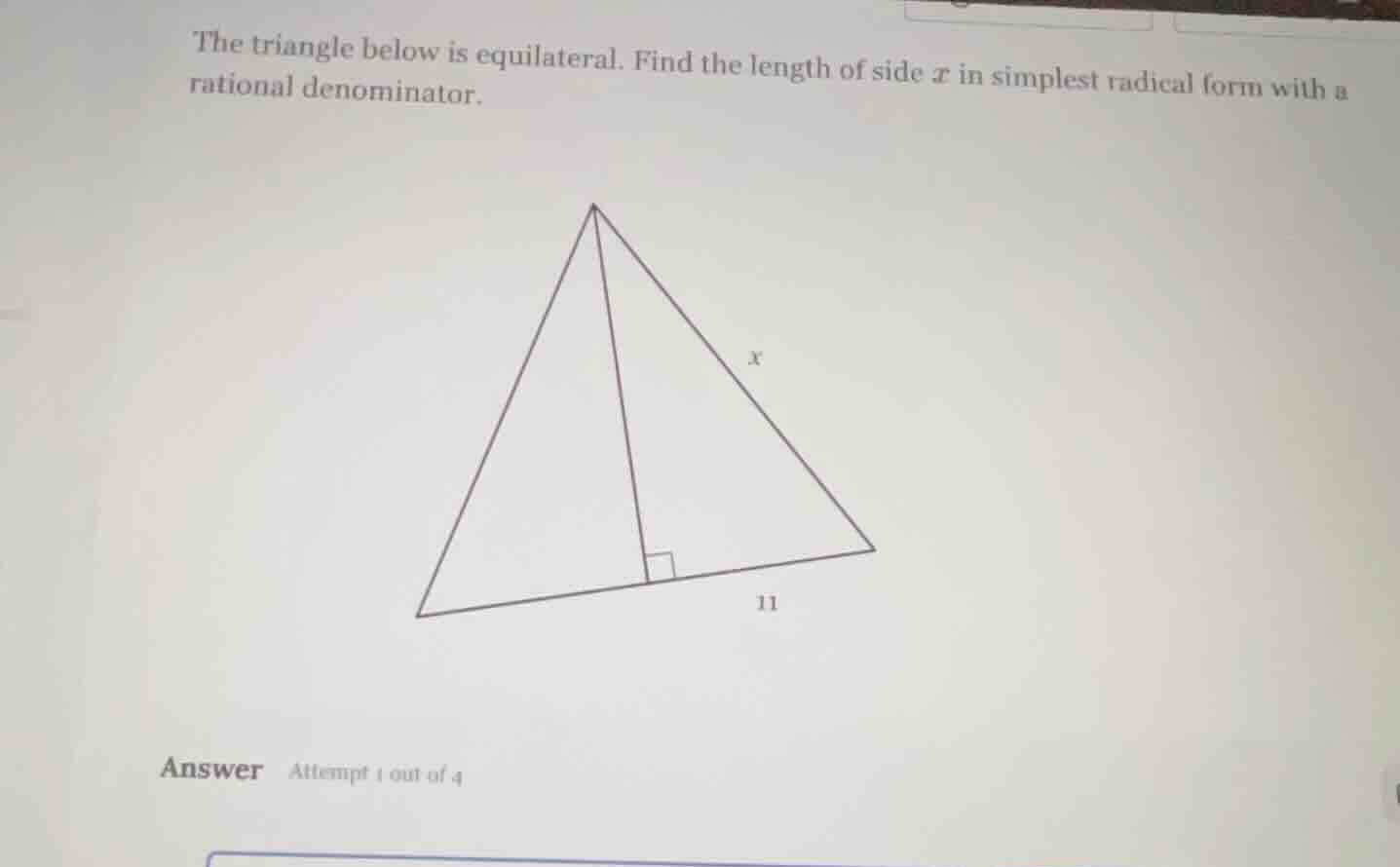
the triangle below is equilateral. find the length of side ( x ) in simplest radical form with a rational denominator.
answer attempt 1 out of 4
Step1: Identify triangle properties
In an equilateral triangle, all sides are equal, and the altitude bisects the base. So the base of the right triangle (formed by the altitude) is 11, and the hypotenuse is \( x \), and the other leg (half of the equilateral triangle's side) is also 11? Wait, no—wait, the altitude in an equilateral triangle splits it into two 30-60-90 triangles. Wait, actually, in the right triangle here, one leg is 11 (the segment of the base), and the hypotenuse is \( x \), and the other leg is the altitude. But since it's equilateral, the side length \( x \) should be such that the base of the right triangle is half the side? Wait, no, the diagram shows a right angle, so the altitude is drawn, splitting the equilateral triangle into two congruent right triangles. So in each right triangle, one leg is 11 (the base segment), the hypotenuse is \( x \) (the side of the equilateral triangle), and the other leg is the height. But in an equilateral triangle, all sides are equal, so the hypotenuse \( x \) is the side, and the base of the right triangle is half the side? Wait, no, the problem says the base segment is 11. Wait, maybe the side length of the equilateral triangle is such that when we draw the altitude, it splits the base into two equal parts? Wait, no, the diagram shows a right angle, so the altitude is perpendicular to the base, so the two segments of the base are equal. Wait, maybe the side length \( x \) is the hypotenuse, and one leg is 11, and the other leg is the height. But in an equilateral triangle, the height \( h \) of a triangle with side length \( s \) is \( h = \frac{\sqrt{3}}{2}s \). But here, the right triangle has legs 11 (the base segment) and \( h \), and hypotenuse \( s = x \). Wait, no—wait, if the triangle is equilateral, then all sides are equal, so the hypotenuse \( x \) is equal to the side length, and the base of the right triangle is half the side length? Wait, maybe the diagram has the base segment as 11, which is half the side length? Wait, no, the problem says "the triangle below is equilateral. Find the length of side \( x \)". Wait, maybe the right triangle has one leg 11, and the hypotenuse \( x \), and the angle opposite the 11 leg is 30 degrees? No, in an equilateral triangle, all angles are 60 degrees, so the right triangle has angles 30, 60, 90. So in a 30-60-90 triangle, the sides are in the ratio \( 1 : \sqrt{3} : 2 \), where the side opposite 30 degrees is the shortest leg, opposite 60 is \( \sqrt{3} \) times that, and hypotenuse is twice the shortest leg. Wait, if the base segment (the leg opposite 30 degrees) is 11, then the hypotenuse (the side of the equilateral triangle) would be \( 2 \times 11 = 22 \)? No, that can't be. Wait, maybe I got it wrong. Wait, the right triangle: one leg is 11, the hypotenuse is \( x \), and the angle at the top is 60 degrees? Wait, no, the equilateral triangle has all angles 60 degrees, so the angle at the top of the right triangle is 60 degrees. So in the right triangle, the angle opposite the leg 11 is 60 degrees? Wait, no, the right angle is between the altitude and the base, so the angle at the top of the right triangle is 60 degrees. So in the right triangle, we have:
- Angle at the top: 60 degrees
- Right angle: 90 degrees
- So the third angle is 30 degrees.
So the side opposite 30 degrees is the shortest leg. Wait, if the leg adjacent to the 60-degree angle is 11, then the hypotenuse \( x \) can be found using trigonometry. Let's use cosine: \( \cos(60^\circ) = \frac{\text{adjacent}}{\text{hypotenuse}} = \frac{11}{x} \). Si…

Snap & solve any problem in the app
Get step-by-step solutions on Sovi AI
Photo-based solutions with guided steps
Explore more problems and detailed explanations
\( \boxed{22} \)