QUESTION IMAGE
Question
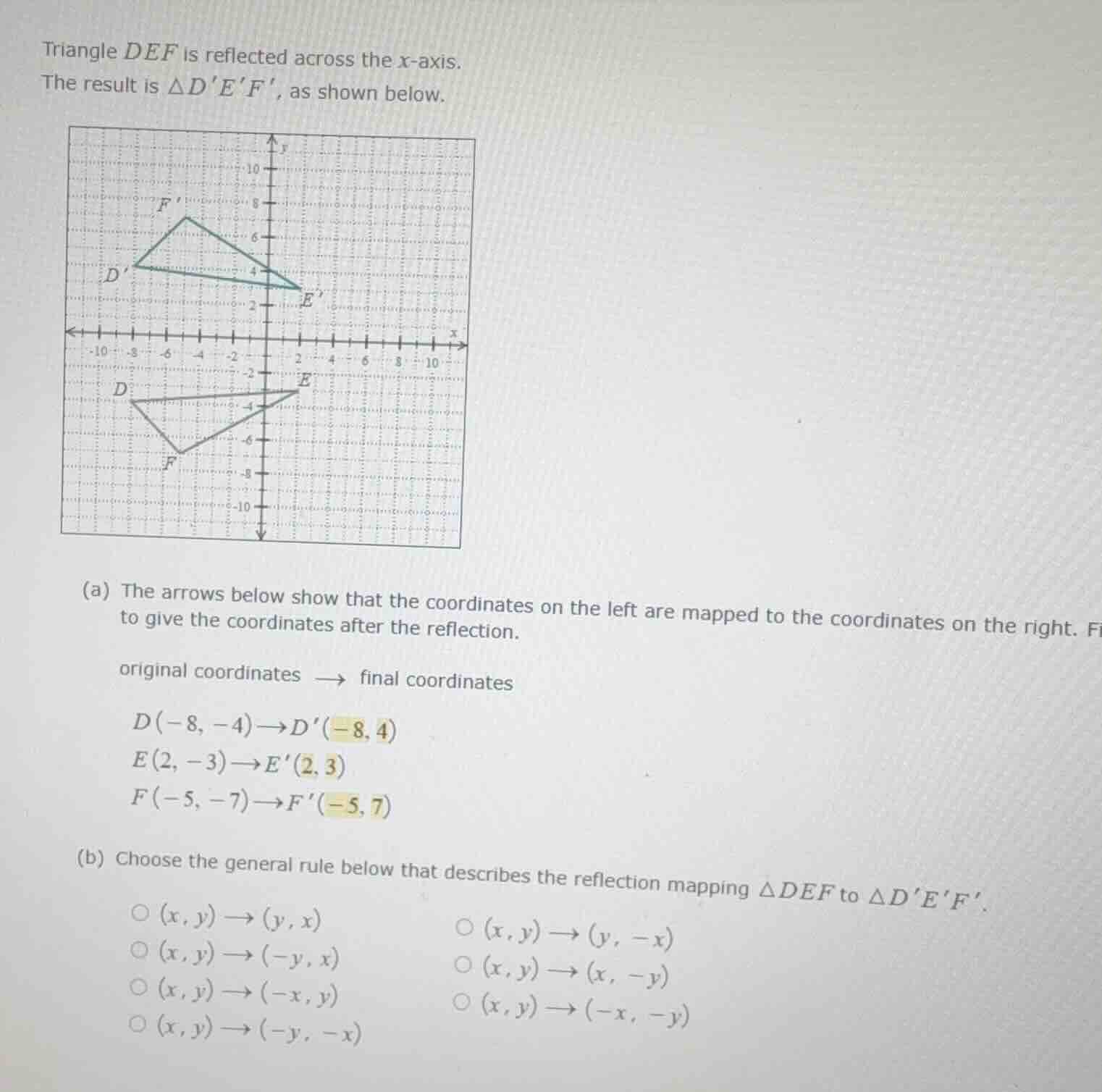
triangle def is reflected across the x-axis. the result is $\triangle def$, as shown below. (a) the arrows below show that the coordinates on the left are mapped to the coordinates on the right. fi original coordinates $\
ightarrow$ final coordinates $d(-8, -4)\
ightarrow d(-8, 4)$ $e(2, -3)\
ightarrow e(2, 3)$ $f(-5, -7)\
ightarrow f(-5, 7)$ (b) choose the general rule below that describes the reflection mapping $\triangle def$ to $\triangle def$. $\circ (x, y) \
ightarrow (y, x)$ $\circ (x, y) \
ightarrow (y, -x)$ $\circ (x, y) \
ightarrow (-y, x)$ $\circ (x, y) \
ightarrow (x, -y)$ $\circ (x, y) \
ightarrow (-x, y)$ $\circ (x, y) \
ightarrow (-x, -y)$ $\circ (x, y) \
ightarrow (-y, -x)$
Step1: Analyze coordinate mapping
For $D(-8,-4)\to D'(-8,4)$, $E(2,-3)\to E'(2,3)$, $F(-5,-7)\to F'(-5,7)$: the $x$-coordinate stays the same, the $y$-coordinate is multiplied by $-1$.
Step2: Match to general rule
Compare the coordinate changes to the given options. The pattern matches $(x,y)\to(x,-y)$.

Snap & solve any problem in the app
Get step-by-step solutions on Sovi AI
Photo-based solutions with guided steps
Explore more problems and detailed explanations
(a) The completed mappings are:
$D(-8,-4)\to D'(-8,4)$
$E(2,-3)\to E'(2,3)$
$F(-5,-7)\to F'(-5,7)$
(b) $\boldsymbol{(x,y)\to(x,-y)}$