QUESTION IMAGE
Question
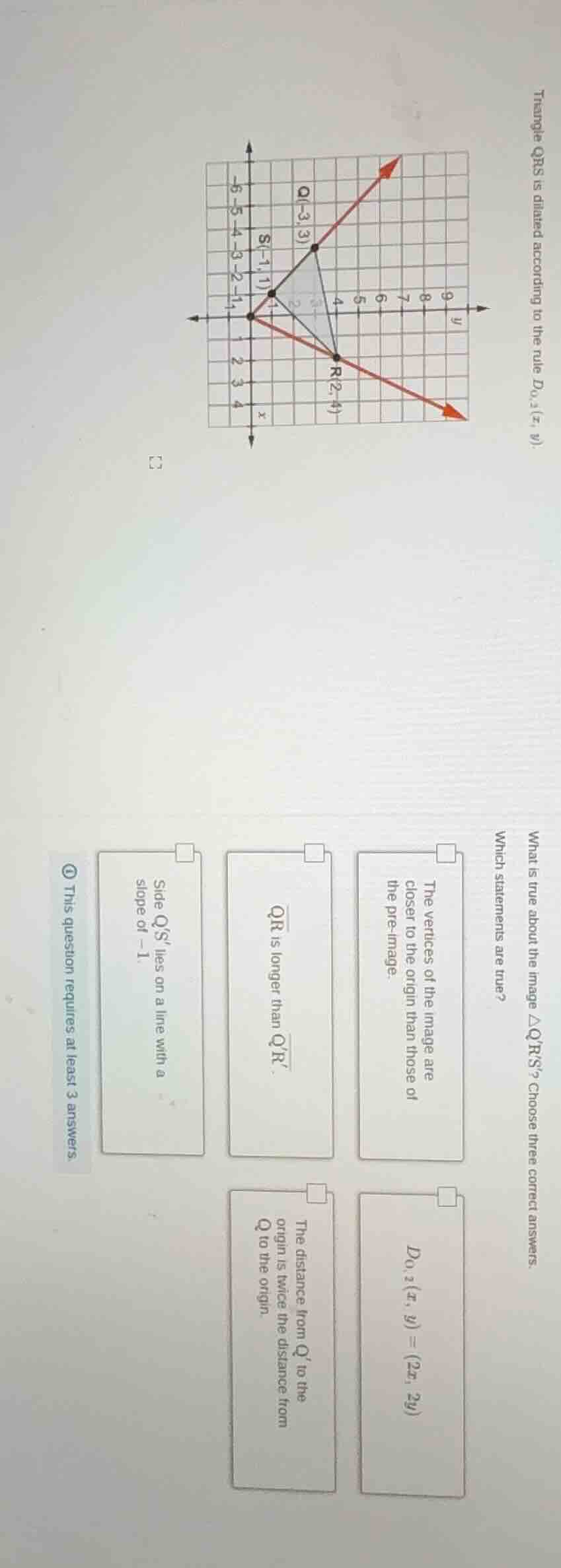
triangle qrs is dilated according to the rule $d_{0,2}(x,y)$. what is true about the image $\triangle qrs$? choose three correct answers. which statements are true? the vertices of the image are closer to the origin than those of the pre - image. $d_{0,2}(x,y)=(2x,2y)$ $\overline{qr}$ is longer than $\overline{qr}$. the distance from $q$ to the origin is twice the distance from $q$ to the origin. side $qs$ lies on a line with a slope of - 1. \textcircled{1} this question requires at least 3 answers
To solve this, we analyze each statement using the dilation rule \( D_{O,2}(x,y)=(2x,2y) \) (assuming the rule is \( D_{O,2} \) as the image suggests a scale factor of 2, maybe a typo in the problem's \( D_{O,3} \)):
1. "The vertices of the image are closer to the origin than those of the pre - image."
Dilation with a scale factor \( k > 1 \) (here \( k = 2 \)) increases the distance from the origin. So image vertices are farther, not closer. This statement is false.
2. " \( D_{O,2}(x,y)=(2x,2y) \)"
By the definition of dilation about the origin with scale factor \( k \), the rule is \( (x,y)\to(kx,ky) \). For \( k = 2 \), it is \( (2x,2y) \). This statement is true.
3. " \( \overline{QR} \) is longer than \( \overline{Q'R'} \)."
Dilation with \( k = 2 \) scales lengths by \( k \). So \( Q'R'=2\times QR \), meaning \( \overline{Q'R'} \) is longer. This statement is false.
4. "The distance from \( Q' \) to the origin is twice the distance from \( Q \) to the origin."
If \( Q=(x,y) \), then \( Q'=(2x,2y) \). The distance of \( Q \) from the origin is \( \sqrt{x^{2}+y^{2}} \), and for \( Q' \) it is \( \sqrt{(2x)^{2}+(2y)^{2}} = 2\sqrt{x^{2}+y^{2}} \). So this is true.
5. "Side \( Q'S' \) lies on a line with a slope of - 1."
First, find coordinates of pre - image \( Q \) and \( S \). From the graph, \( Q(0,0) \) (assuming \( Q \) is at the origin) and \( S(-1,1) \). After dilation \( Q'=(0,0) \), \( S'=(-2,2) \). The slope of \( Q'S' \) is \( \frac{2 - 0}{-2 - 0}=\frac{2}{-2}=-1 \). So this statement is true.
Correct Statements:
- \( D_{O,2}(x,y)=(2x,2y) \)
- "The distance from \( Q' \) to the origin is twice the distance from \( Q \) to the origin."
- "Side \( Q'S' \) lies on a line with a slope of - 1."

Snap & solve any problem in the app
Get step-by-step solutions on Sovi AI
Photo-based solutions with guided steps
Explore more problems and detailed explanations
- \( D_{O,2}(x,y)=(2x,2y) \)
- The distance from \( Q' \) to the origin is twice the distance from \( Q \) to the origin.
- Side \( Q'S' \) lies on a line with a slope of - 1.
(If we strictly follow the options' formatting, assuming the options are:
A. The vertices of the image are closer to the origin than those of the pre - image.
B. \( D_{O,2}(x,y)=(2x,2y) \)
C. \( \overline{QR} \) is longer than \( \overline{Q'R'} \)
D. The distance from \( Q' \) to the origin is twice the distance from \( Q \) to the origin.
E. Side \( Q'S' \) lies on a line with a slope of - 1
The correct answers are B, D, E)