QUESTION IMAGE
Question
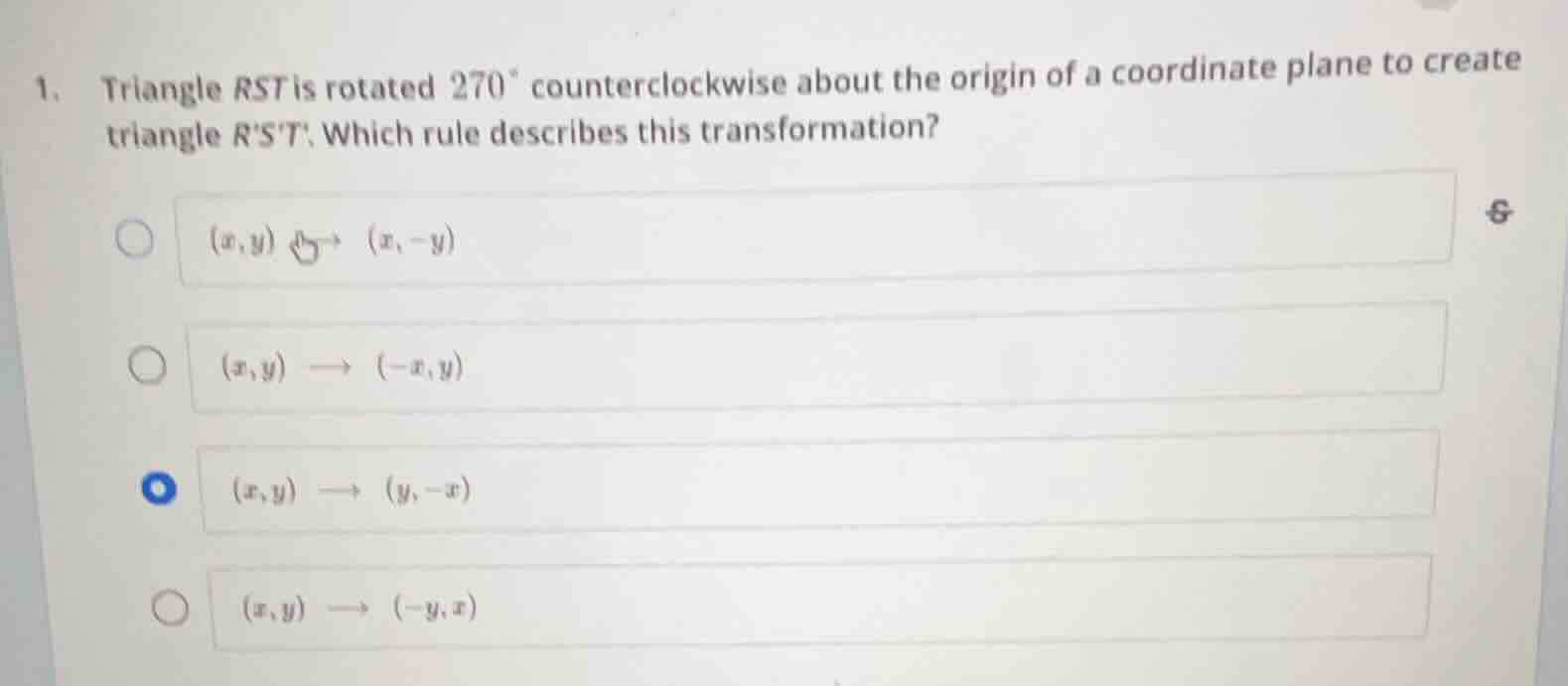
- triangle rst is rotated (270^circ) counterclockwise about the origin of a coordinate plane to create triangle rst. which rule describes this transformation?
(\bigcirc) ((x,y) \to (x, -y))
(\bigcirc) ((x,y) \to (-x, y))
(\bigcirc) ((x,y) \to (y, -x))
(\bigcirc) ((x,y) \to (-y, x))
Step1: Recall rotation rules
The rule for a \(270^\circ\) counterclockwise rotation about the origin is equivalent to a \(90^\circ\) clockwise rotation. The transformation rule for a \(270^\circ\) counterclockwise rotation is \((x,y)\to(y, -x)\).
Step2: Analyze each option
- Option 1: \((x,y)\to(x, -y)\) is the rule for a reflection over the \(x\)-axis, not a \(270^\circ\) rotation.
- Option 2: \((x,y)\to(-x, y)\) is the rule for a reflection over the \(y\)-axis, not a \(270^\circ\) rotation.
- Option 3: \((x,y)\to(y, -x)\) matches the rule for a \(270^\circ\) counterclockwise rotation.
- Option 4: \((x,y)\to(-y, x)\) is the rule for a \(90^\circ\) counterclockwise rotation, not \(270^\circ\).

Snap & solve any problem in the app
Get step-by-step solutions on Sovi AI
Photo-based solutions with guided steps
Explore more problems and detailed explanations
\((x,y)\to(y, -x)\) (the third option: \((x,y)\to(y, -x)\))