QUESTION IMAGE
Question
trigonometric ratios
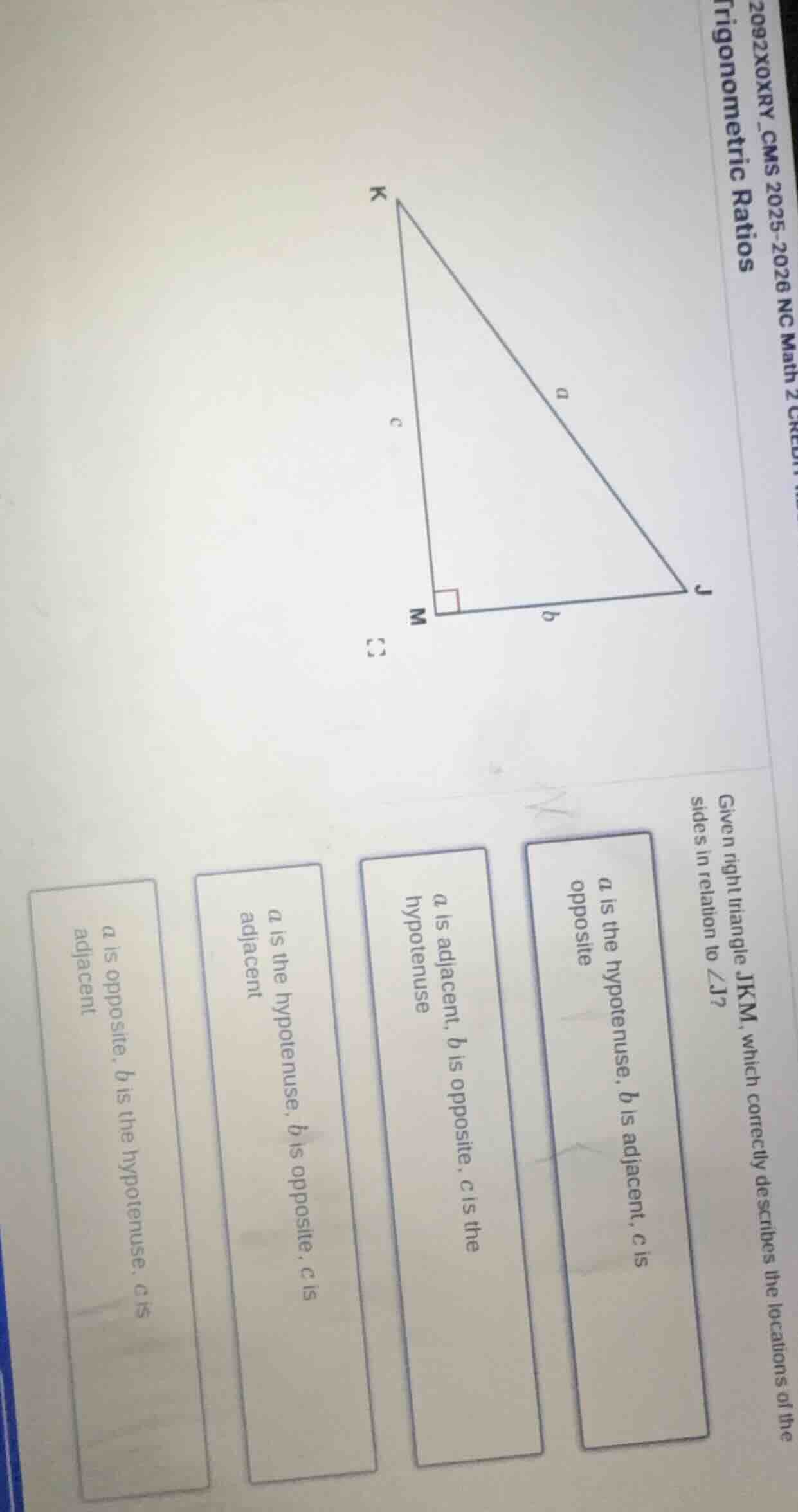
given right triangle jkm, which correctly describes the locations of the sides in relation to ∠j?
options (from left to right):
- a is opposite, b is the hypotenuse, c is adjacent
- a is the hypotenuse, b is opposite, c is adjacent
- a is adjacent, b is opposite, c is the hypotenuse
- a is the hypotenuse, b is adjacent, c is opposite
(image of right triangle jkm with right angle at m, sides labeled a (jk), b (jm), c (km))
Step1: Recall right triangle sides
In a right triangle, the hypotenuse is the side opposite the right angle (longest side). The opposite side to an angle is across from it, adjacent is next to it. For \(\angle J\) in \(\triangle JKM\) (right - angled at \(M\)):
- Hypotenuse: The side opposite the right angle (\(\angle M\)) is \(a\) (since \(\angle M = 90^{\circ}\), \(a\) is the hypotenuse as it's opposite \(\angle M\)).
- Opposite side to \(\angle J\): The side opposite \(\angle J\) is \(c\) (since it's across from \(\angle J\)).
- Adjacent side to \(\angle J\): The side adjacent to \(\angle J\) is \(b\) (since it's next to \(\angle J\) and forms \(\angle J\) with the hypotenuse). Wait, no, let's re - check. Wait, the right angle is at \(M\), so vertices are \(J\), \(K\), \(M\) with right angle at \(M\). So sides: \(JM = b\), \(KM = c\), \(JK=a\) (hypotenuse as it's opposite right angle \(M\)). For \(\angle J\):
- Opposite side: The side opposite \(\angle J\) is \(KM = c\)? No, wait, \(\angle J\) is at vertex \(J\). So the sides: the side opposite \(\angle J\) is \(KM\) (length \(c\)), the side adjacent to \(\angle J\) is \(JM\) (length \(b\)), and the hypotenuse is \(JK\) (length \(a\)). Wait, the options: Let's analyze each option.
- Option 1: "a is the hypotenuse, b is adjacent, c is opposite" – Let's check. Hypotenuse: \(a\) (opposite right angle \(M\)) – correct. Adjacent to \(\angle J\): \(b\) (since \(b\) is next to \(\angle J\) and forms \(\angle J\) with hypotenuse \(a\)) – correct. Opposite to \(\angle J\): \(c\) (since \(c\) is across from \(\angle J\)) – Wait, no, the first option (the right - most one) says "a is the hypotenuse, b is adjacent, c is opposite" which matches. Wait, let's re - express:
In right triangle \(JKM\) with \(\angle M = 90^{\circ}\):
- Hypotenuse: \(a\) (opposite \(\angle M\)).
- For \(\angle J\):
- Adjacent side: \(b\) (shares the angle \(\angle J\) with the hypotenuse \(a\)).
- Opposite side: \(c\) (does not form \(\angle J\) and is across from \(\angle J\)). Wait, the first option (the right - most box) says "a is the hypotenuse, b is adjacent, c is opposite" – that's correct. Wait, maybe I misread earlier. Let's check the options again. The first option (from the right) is "a is the hypotenuse, b is adjacent, c is opposite" – yes, that's correct. Because:
- Hypotenuse: \(a\) (opposite right angle \(M\)).
- Adjacent to \(\angle J\): \(b\) (since \(b\) is one of the sides forming \(\angle J\) along with \(a\)).
- Opposite to \(\angle J\): \(c\) (since \(c\) is the side not forming \(\angle J\) and is across from \(\angle J\)).

Snap & solve any problem in the app
Get step-by-step solutions on Sovi AI
Photo-based solutions with guided steps
Explore more problems and detailed explanations
The correct option is the one with "a is the hypotenuse, b is adjacent, c is opposite" (the right - most boxed option).