QUESTION IMAGE
Question
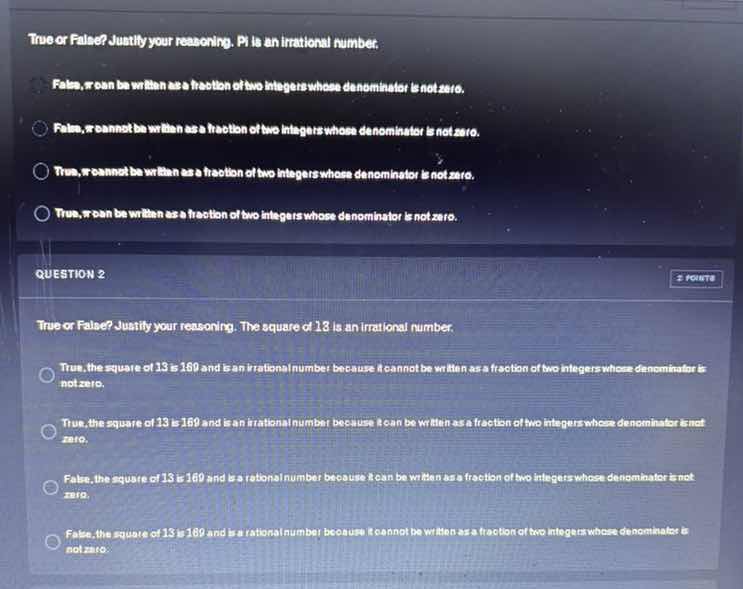
true or false? justify your reasoning. pi is an irrational number. false, π can be written as a fraction of two integers whose denominator is not zero. false, π cannot be written as a fraction of two integers whose denominator is not zero. true, π cannot be written as a fraction of two integers whose denominator is not zero. true, π can be written as a fraction of two integers whose denominator is not zero. question 2 2 points true or false? justify your reasoning. the square of 13 is an irrational number. true, the square of 13 is 169 and is an irrational number because it cannot be written as a fraction of two integers whose denominator is not zero. true, the square of 13 is 169 and is an irrational number because it can be written as a fraction of two integers whose denominator is not zero. false, the square of 13 is 169 and is a rational number because it can be written as a fraction of two integers whose denominator is not zero. false, the square of 13 is 169 and is a rational number because it cannot be written as a fraction of two integers whose denominator is not zero.
For the first question: By definition, an irrational number cannot be expressed as a fraction of two integers (denominator non-zero). Pi ($\pi$) fits this definition, so the statement is true.
For the second question: The square of 13 is $13^2 = 169$. A rational number can be written as a fraction of two integers (denominator non-zero), and $169 = \frac{169}{1}$, so it is rational, making the original statement false.

Snap & solve any problem in the app
Get step-by-step solutions on Sovi AI
Photo-based solutions with guided steps
Explore more problems and detailed explanations
- True, $\pi$ cannot be written as a fraction of two integers whose denominator is not zero.
- False, the square of 13 is 169 and is a rational number because it can be written as a fraction of two integers whose denominator is not zero.