QUESTION IMAGE
Question
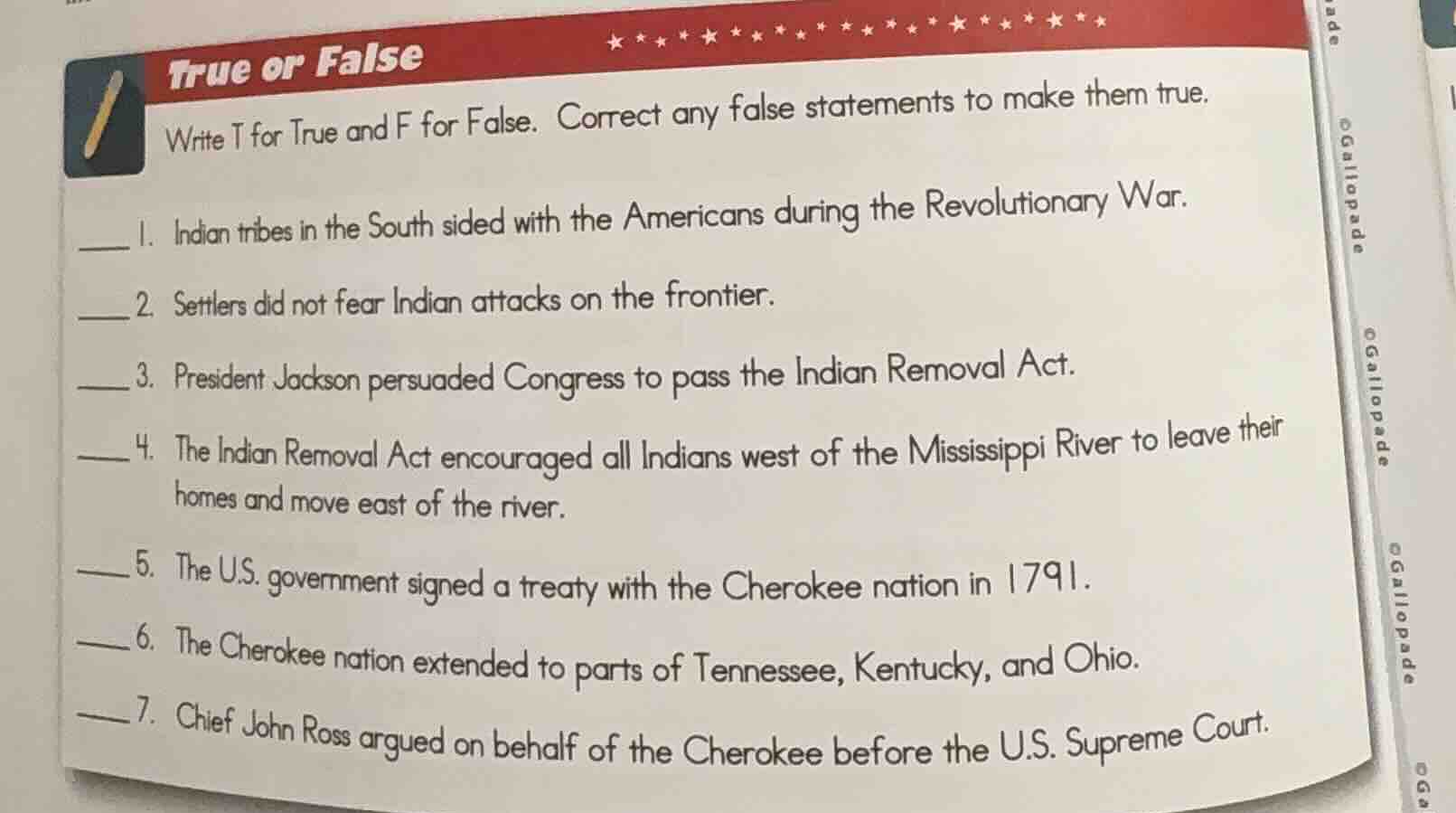
true or false
write t for true and f for false. correct any false statements to make them true.
- indian tribes in the south sided with the americans during the revolutionary war.
- settlers did not fear indian attacks on the frontier.
- president jackson persuaded congress to pass the indian removal act.
- the indian removal act encouraged all indians west of the mississippi river to leave their homes and move east of the river.
- the u.s. government signed a treaty with the cherokee nation in 1791.
- the cherokee nation extended to parts of tennessee, kentucky, and ohio.
- chief john ross argued on behalf of the cherokee before the u.s. supreme court.
Brief Explanations
- Most Southern Indian tribes allied with the British to protect their lands from American expansion.
- Frontier settlers faced frequent threats of raids, leading to widespread fear.
- President Andrew Jackson was a key advocate for and secured congressional passage of the 1830 Indian Removal Act.
- The act forced Eastern Indigenous nations to relocate to designated lands west of the Mississippi.
- The Treaty of Holston, signed in 1791, established formal relations between the U.S. and Cherokee.
- Traditional Cherokee lands centered on the Southeast, not Kentucky or Ohio.
- Chief John Ross led legal challenges, including arguing before the Supreme Court to defend Cherokee sovereignty.

Snap & solve any problem in the app
Get step-by-step solutions on Sovi AI
Photo-based solutions with guided steps
Explore more problems and detailed explanations
- F; Indian tribes in the South sided with the British during the Revolutionary War.
- F; Settlers feared Indian attacks on the frontier.
- T
- F; The Indian Removal Act encouraged all Indians east of the Mississippi River to leave their homes and move west of the river.
- T
- F; The Cherokee nation extended to parts of Tennessee, Georgia, and Alabama.
- T