QUESTION IMAGE
Question
trying self government
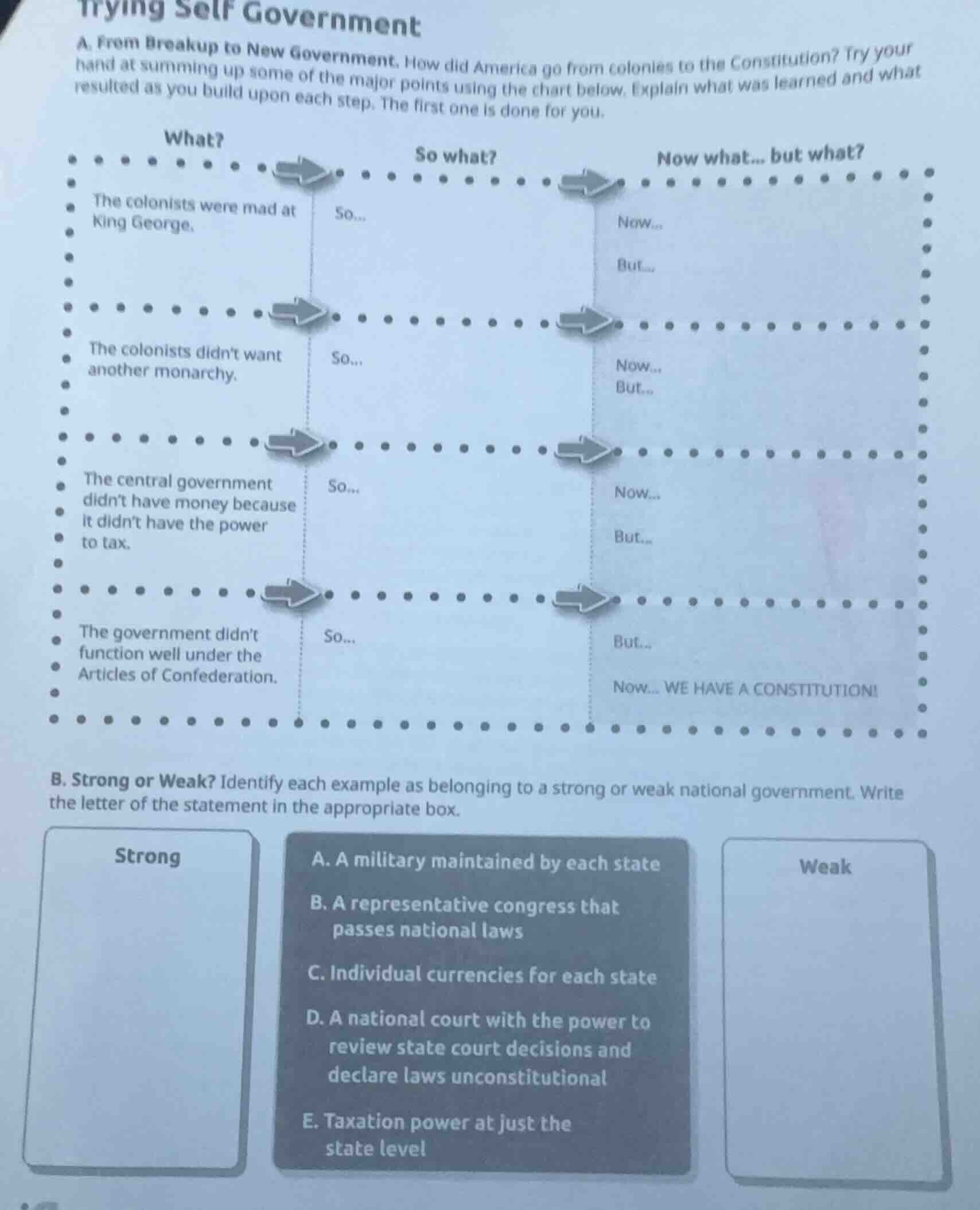
a. from breakup to new government. how did america go from colonies to the constitution? try your hand at summing up some of the major points using the chart below. explain what was learned and what resulted as you build upon each step. the first one is done for you.
what?
the colonists were mad at king george.
the colonists didnt want another monarchy.
the central government didnt have money because it didnt have the power to tax.
the government didnt function well under the articles of confederation.
so what?
so...
so...
so...
so...
now what... but what?
now...
but...
now...
but...
now...
but...
but...
now... we have a constitution!
b. strong or weak? identify each example as belonging to a strong or weak national government. write the letter of the statement in the appropriate box.
strong
weak
a. a military maintained by each state
b. a representative congress that passes national laws
c. individual currencies for each state
d. a national court with the power to review state court decisions and declare laws unconstitutional
e. taxation power at just the state level
Part A:
Each step connects a colonial-era issue to its outcome, lesson learned, and next action leading to the Constitution.
- Row 1: Colonists' anger at King George led to seeking independence; they learned direct royal rule was oppressive, leading to the Declaration of Independence, but faced the challenge of forming a new governing system.
- Row 2: Rejection of monarchy led to a focus on republicanism; they learned centralized, authoritarian power was to be avoided, leading to a weak central government under the Articles of Confederation, but this created inefficiencies in national governance.
- Row 3: Lack of federal taxing power meant the government couldn't pay debts or fund national needs; they learned the central government needed fiscal authority, leading to calls for reform of the Articles, but states resisted giving up tax control.
- Row 4: Failure of the Articles showed the need for a stronger federal structure; they learned balance between state and federal power was critical, leading to the Constitutional Convention, but debates over power distribution required compromise.
A strong national government holds centralized authority over national-level functions, while a weak one leaves key powers to individual states.

Snap & solve any problem in the app
Get step-by-step solutions on Sovi AI
Photo-based solutions with guided steps
Explore more problems and detailed explanations
Row 1
So... They declared independence from Britain.
Now... They established state governments.
But... They needed a unified national system.
Row 2
So... They created a weak central government (Articles of Confederation).
Now... States retained most governing power.
But... The central government lacked authority to act nationally.
Row 3
So... The government couldn't pay war debts or fund programs.
Now... Leaders pushed for federal taxing power.
But... States feared losing financial control.
Row 4
So... Delegates met to revise the Articles of Confederation.
Now... They drafted a new framework with balanced power.
But... They had to compromise on state vs. federal authority.
---