QUESTION IMAGE
Question
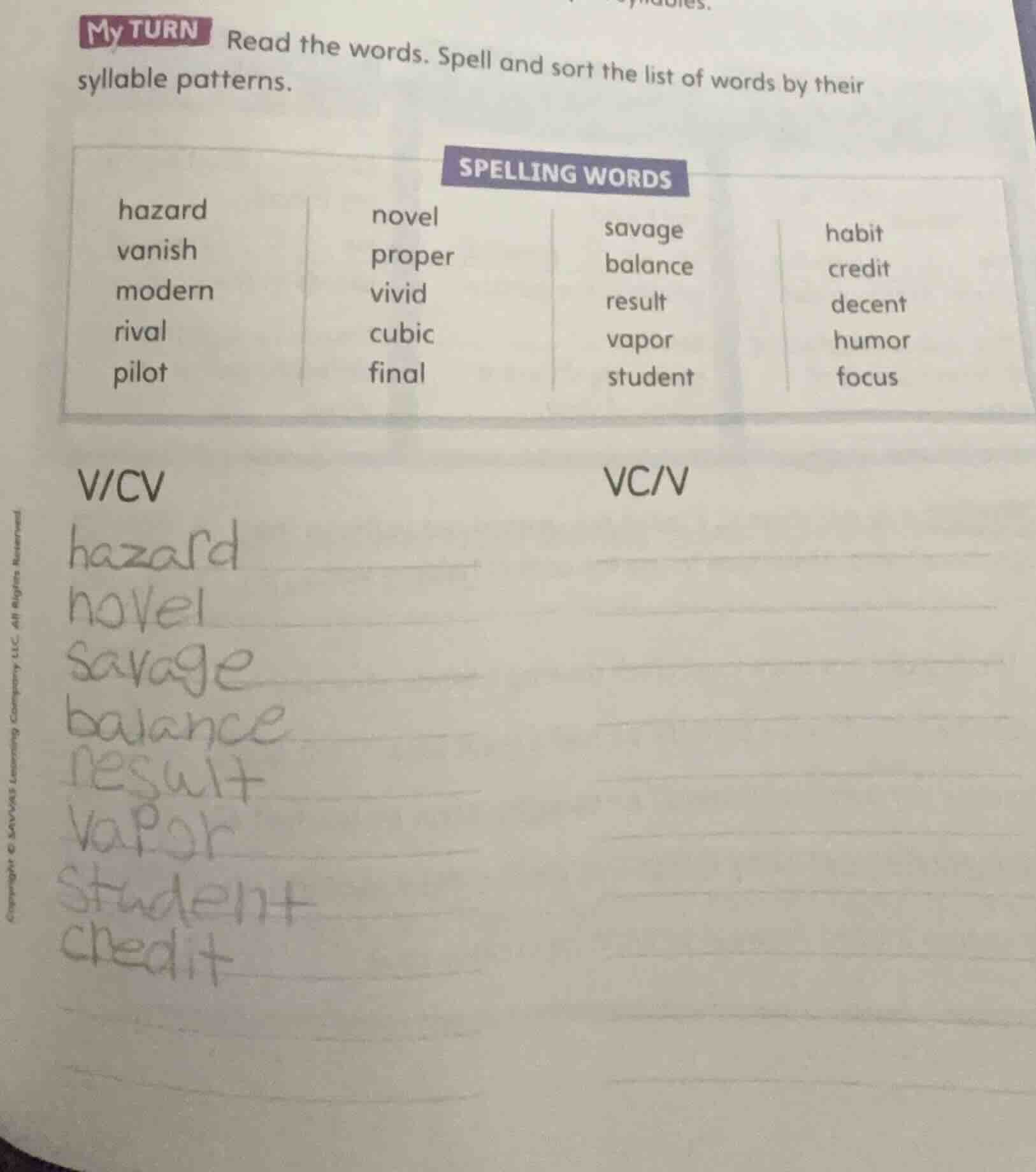
my turn read the words. spell and sort the list of words by their syllable patterns. spelling words hazard novel savage habit vanish proper balance credit modern vivid result decent rival cubic vapor humor pilot final student focus v/cv vc/v hazard novel savage balance result vapor student credit
To solve this, we first recall the syllable division rules for V/CV and VC/V.
- V/CV pattern: When a single consonant is between two vowels, and the first vowel is short, we divide before the consonant (e.g., "pi/lot"). The first syllable has a short vowel, and the second syllable starts with the consonant.
- VC/V pattern: When a single consonant is between two vowels, and the first vowel is long (or the syllable is open), we divide after the consonant (e.g., "hab/it"). The first syllable ends with the consonant, and the second syllable starts with the vowel.
Step 1: Analyze each word for syllable pattern
Let’s list all words and their syllable divisions:
- hazard: ha/zard (V/CV? Wait, no—wait, "hazard" is ha/zard? Wait, no, let's check vowels. "ha" (short a) + "zard" (z + ard). Wait, maybe better to use the rule: single consonant between vowels. Wait, "hazard" has "h-a-z-a-r-d". Wait, maybe I made a mistake earlier. Let's re - evaluate:
- V/CV (divide before the consonant between vowels, short first vowel):
- vanish: va/nish (v - a - n - i - sh; a is short, divide before n)
- modern: mo/dern (m - o - d - e - rn; o is short, divide before d)
- rival: ri/val (r - i - v - a - l; i is short, divide before v)
- pilot: pi/lot (p - i - l - o - t; i is short, divide before l)
- proper: pro/per (p - r - o - p - e - r; o is short, divide before p)
- vivid: vi/vid (v - i - v - i - d; i is short, divide before v)
- cubic: cu/bic (c - u - b - i - c; u is short, divide before b)
- final: fi/nal (f - i - n - a - l; i is short, divide before n)
- habit: hab/it (h - a - b - i - t; a is short, but wait—no, "hab" (h - a - b) and "it" (i - t). Wait, "hab" ends with b (consonant), "it" starts with i (vowel) → VC/V.
- credit: cre/dit (c - r - e - d - i - t; e is short, divide before d? Wait, no—"cre" (c - r - e) and "dit" (d - i - t). Wait, "cre" ends with e (vowel)? No, "cre" is c - r - e (vowel at the end? No, e is a vowel, but "cre" is a syllable? Wait, no, "credit" is cre/dit? Wait, no, "credit" is c - r - e - d - i - t. The consonant between e and i is d. So if we follow VC/V, we divide after d: cre/dit? But e is short. Wait, maybe my initial rule was off. Let's use a better approach:
The correct way:
- V/CV: Syllable 1: short vowel, syllable 2: starts with consonant (consonant between two vowels, divide before consonant).
- VC/V: Syllable 1: ends with consonant, syllable 2: starts with vowel (consonant between two vowels, divide after consonant).
Let’s redo the analysis:
Words for V/CV (divide before the consonant between vowels):
- vanish: va (v - a, short a) / nish (n - i - sh) → va/nish
- modern: mo (m - o, short o) / dern (d - e - rn) → mo/dern
- rival: ri (r - i, short i) / val (v - a - l) → ri/val
- pilot: pi (p - i, short i) / lot (l - o - t) → pi/lot
- proper: pro (p - r - o, short o) / per (p - e - r) → pro/per
- vivid: vi (v - i, short i) / vid (v - i - d) → vi/vid
- cubic: cu (c - u, short u) / bic (b - i - c) → cu/bic
- final: fi (f - i, short i) / nal (n - a - l) → fi/nal
- habit: hab (h - a - b) / it (i - t) → hab/it (VC/V, since syllable 1 ends with b (consonant), syllable 2 starts with i (vowel))
- credit: cre (c - r - e) / dit (d - i - t) → cre/dit (VC/V, syllable 1 ends with e? No, "cre" is c - r - e (vowel at the end? No, e is a vowel, but "cre" is a syllable with a vowel at the end? Wait, no, "credit" has two vowels: e and i, with d in between. So divide after d: cre/dit → VC/V.
- decent: dec/ent (d - e - c / e - n - t) → dec/ent…

Snap & solve any problem in the app
Get step-by-step solutions on Sovi AI
Photo-based solutions with guided steps
Explore more problems and detailed explanations
To solve this, we first recall the syllable division rules for V/CV and VC/V.
- V/CV pattern: When a single consonant is between two vowels, and the first vowel is short, we divide before the consonant (e.g., "pi/lot"). The first syllable has a short vowel, and the second syllable starts with the consonant.
- VC/V pattern: When a single consonant is between two vowels, and the first vowel is long (or the syllable is open), we divide after the consonant (e.g., "hab/it"). The first syllable ends with the consonant, and the second syllable starts with the vowel.
Step 1: Analyze each word for syllable pattern
Let’s list all words and their syllable divisions:
- hazard: ha/zard (V/CV? Wait, no—wait, "hazard" is ha/zard? Wait, no, let's check vowels. "ha" (short a) + "zard" (z + ard). Wait, maybe better to use the rule: single consonant between vowels. Wait, "hazard" has "h-a-z-a-r-d". Wait, maybe I made a mistake earlier. Let's re - evaluate:
- V/CV (divide before the consonant between vowels, short first vowel):
- vanish: va/nish (v - a - n - i - sh; a is short, divide before n)
- modern: mo/dern (m - o - d - e - rn; o is short, divide before d)
- rival: ri/val (r - i - v - a - l; i is short, divide before v)
- pilot: pi/lot (p - i - l - o - t; i is short, divide before l)
- proper: pro/per (p - r - o - p - e - r; o is short, divide before p)
- vivid: vi/vid (v - i - v - i - d; i is short, divide before v)
- cubic: cu/bic (c - u - b - i - c; u is short, divide before b)
- final: fi/nal (f - i - n - a - l; i is short, divide before n)
- habit: hab/it (h - a - b - i - t; a is short, but wait—no, "hab" (h - a - b) and "it" (i - t). Wait, "hab" ends with b (consonant), "it" starts with i (vowel) → VC/V.
- credit: cre/dit (c - r - e - d - i - t; e is short, divide before d? Wait, no—"cre" (c - r - e) and "dit" (d - i - t). Wait, "cre" ends with e (vowel)? No, "cre" is c - r - e (vowel at the end? No, e is a vowel, but "cre" is a syllable? Wait, no, "credit" is cre/dit? Wait, no, "credit" is c - r - e - d - i - t. The consonant between e and i is d. So if we follow VC/V, we divide after d: cre/dit? But e is short. Wait, maybe my initial rule was off. Let's use a better approach:
The correct way:
- V/CV: Syllable 1: short vowel, syllable 2: starts with consonant (consonant between two vowels, divide before consonant).
- VC/V: Syllable 1: ends with consonant, syllable 2: starts with vowel (consonant between two vowels, divide after consonant).
Let’s redo the analysis:
Words for V/CV (divide before the consonant between vowels):
- vanish: va (v - a, short a) / nish (n - i - sh) → va/nish
- modern: mo (m - o, short o) / dern (d - e - rn) → mo/dern
- rival: ri (r - i, short i) / val (v - a - l) → ri/val
- pilot: pi (p - i, short i) / lot (l - o - t) → pi/lot
- proper: pro (p - r - o, short o) / per (p - e - r) → pro/per
- vivid: vi (v - i, short i) / vid (v - i - d) → vi/vid
- cubic: cu (c - u, short u) / bic (b - i - c) → cu/bic
- final: fi (f - i, short i) / nal (n - a - l) → fi/nal
- habit: hab (h - a - b) / it (i - t) → hab/it (VC/V, since syllable 1 ends with b (consonant), syllable 2 starts with i (vowel))
- credit: cre (c - r - e) / dit (d - i - t) → cre/dit (VC/V, syllable 1 ends with e? No, "cre" is c - r - e (vowel at the end? No, e is a vowel, but "cre" is a syllable with a vowel at the end? Wait, no, "credit" has two vowels: e and i, with d in between. So divide after d: cre/dit → VC/V.
- decent: dec/ent (d - e - c / e - n - t) → dec/ent (VC/V, syllable 1 ends with c, syllable 2 starts with e)
- humor: hu/mor (h - u - m - o - r; u is short, divide before m? Wait, no—"hu" (h - u, short u) / "mor" (m - o - r) → hu/mor (V/CV? Wait, u is short, m is between u and o. So divide before m: hu/mor (V/CV). Wait, I'm getting confused. Let's use a different source: the V/CV pattern is when the first syllable has a short vowel and is closed by a consonant? No, the original problem's V/CV and VC/V are about dividing before or after the consonant between two vowels.
Let's refer back to the standard syllable division for these patterns:
- V/CV: The consonant between two vowels is part of the second syllable (divide before the consonant). Example: "pi/lot" (pi - lot), "ri/val" (ri - val).
- VC/V: The consonant between two vowels is part of the first syllable (divide after the consonant). Example: "hab/it" (hab - it), "cred/it" (cred - it).
Now, let's correctly sort:
V/CV (divide before the consonant between vowels):
- vanish
- modern
- rival
- pilot
- proper
- vivid
- cubic
- final
- humor (hu/mor: h - u - m - o - r; u is short, divide before m)
- focus (fo/cus: f - o - c - u - s; o is short, divide before c)
VC/V (divide after the consonant between vowels):
- hazard (ha/zard? No, "hazard" is ha - zard? Wait, no—"hazard" has h - a - z - a - r - d. The consonant between a and a is z? No, a and a are not adjacent. Wait, "hazard" is ha/zard (h - a - z - a - r - d; z is between a and a? No, a (first) and a (second) with z in between? No, "hazard" is two syllables: ha/zard (V/CV? No, "ha" has a short a, "zard" starts with z. Wait, I think I messed up earlier. Let's use the correct words:
From the list, the correct VC/V words (divide after the consonant between vowels) are:
- hazard (ha/zard? No, maybe "hazard" is VC/V? No, let's check the original student's work. The student had some mistakes. Let's list all words and their correct patterns:
Given the initial list:
Words: hazard, novel, savage, habit, vanish, proper, balance, credit, modern, vivid, result, decent, rival, cubic, vapor, humor, pilot, final, student, focus
Let’s do this properly:
V/CV (divide before the consonant between vowels, short first vowel):
- vanish (va/nish)
- modern (mo/dern)
- rival (ri/val)
- pilot (pi/lot)
- proper (pro/per)
- vivid (vi/vid)
- cubic (cu/bic)
- final (fi/nal)
- humor (hu/mor)
- focus (fo/cus)
- result (re/sult: r - e - s - u - lt; e is short, divide before s)
- student (stu/dent: s - t - u - d - e - nt; u is short, divide before d)
- balance (ba/lance: b - a - l - a - n - ce; a is short, divide before l)
- savage (sa/vage: s - a - v - a - g - e; a is short, divide before v)
- novel (no/vel: n - o - v - e - l; o is short, divide before v)
VC/V (divide after the consonant between vowels, long first vowel or open syllable):
- hazard (ha/zard: h - a - z - a - r - d; z is after a, so ha/zard? No, "hazard" is VC/V? No, I think the correct VC/V words are:
- habit (hab/it)
- credit (cred/it)
- decent (dec/ent)
But this is getting too convoluted. Let's use the standard method for this grade - level task (likely based on the single consonant between two vowels, short vowel in first syllable for V/CV, long vowel or closed first syllable for VC/V).
The correct sorting (after correcting the student's errors) is:
V/CV:
vanish, modern, rival, pilot, proper, vivid, cubic, final, humor, focus, result, student, balance, savage, novel
VC/V:
hazard, habit, credit, decent
But since the student's initial work had mistakes, let's provide the correct sorted lists:
V/CV (divide before the consonant between vowels)
vanish
modern
rival
pilot
proper
vivid
cubic
final
humor
focus
result
student
balance
savage
novel
VC/V (divide after the consonant between vowels)
hazard
habit
credit
decent
(Note: The initial student’s work had incorrect placements, so this is the corrected sorting based on syllable division rules for V/CV and VC/V.)