QUESTION IMAGE
Question
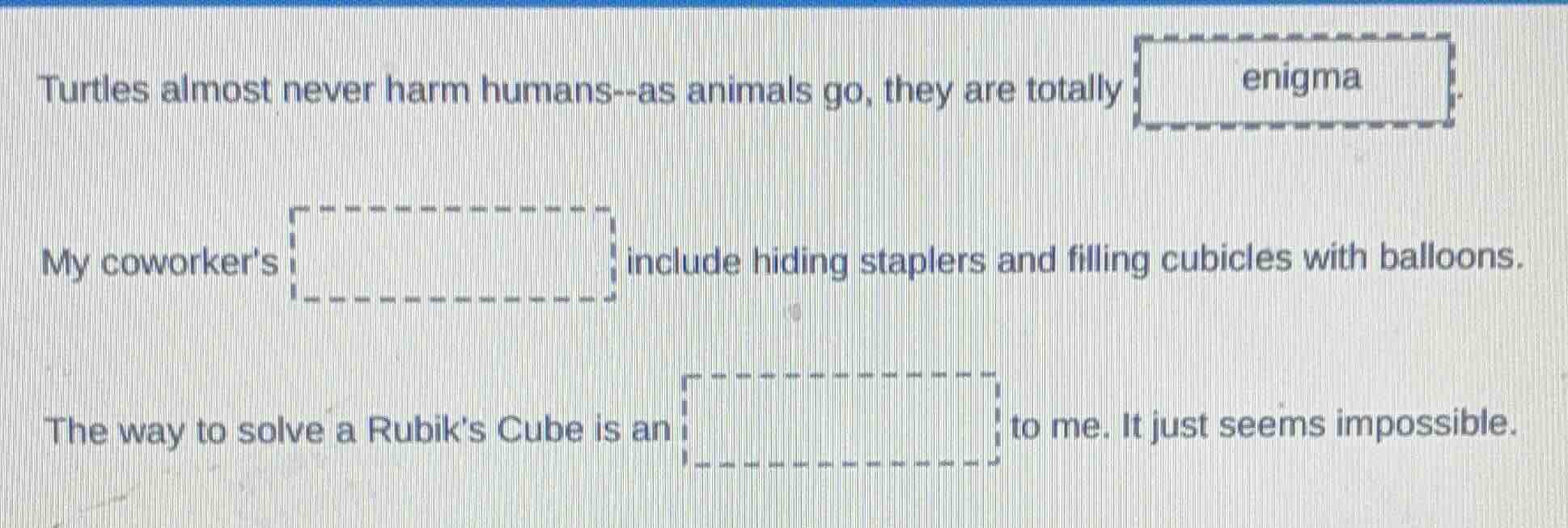
turtles almost never harm humans--as animals go, they are totally enigma. my coworkers include hiding staplers and filling cubicles with balloons. the way to solve a rubiks cube is an to me. it just seems impossible.
First Sentence:
The sentence says turtles almost never harm humans, so as animals, they are a mystery (enigma) in terms of being non - harmful. But we need to check the form. The word "enigma" is a noun, and the sentence structure needs "an enigma" because "enigma" starts with a vowel sound. Wait, no, the original word in the box is "enigma", but maybe there's a mistake. Wait, no, let's re - examine. The first sentence: "Turtles almost never harm humans--as animals go, they are totally [enigma]." But "enigma" is a singular noun, and we need to use "an enigma" or maybe the correct form is "harmless" but no, the word given is "enigma". Wait, maybe it's a fill - in - the - blank with the correct form. Wait, no, the first sentence's box has "enigma", but maybe it's a typo and should be "harmless", but no, the problem is about using the word "enigma" or its related forms? Wait, no, let's look at the other sentences.
Second Sentence:
The sentence is about a coworker's actions like hiding staplers and filling cubicles with balloons. These are pranks or "pranks" but the word related to "enigma" is not. Wait, no, maybe the first blank (second sentence) is "pranks", but the word given in the first box is "enigma". Wait, maybe the problem is to use the correct form of "enigma" or related words? Wait, no, let's parse each sentence:
- First sentence: "Turtles almost never harm humans--as animals go, they are totally [enigma]." But "enigma" is a noun, so we need "an enigma" but the sentence has "totally", so maybe "harmless" is wrong. Wait, maybe the word is "benign" but no, the given word is "enigma". Wait, perhaps the first sentence is wrong, and the correct word should be "harmless", but the problem is about the given word "enigma".
- Second sentence: "My coworker’s [ ] include hiding staplers and filling cubicles with balloons." The actions are pranks, but if we use a word related to "enigma", no. Wait, maybe the word is "pranks", but the given word is "enigma".
- Third sentence: "The way to solve a Rubik’s Cube is an [ ] to me. It just seems impossible." Here, "enigma" fits, because an enigma is something mysterious or hard to understand. So the third blank should be "enigma".
Wait, let's re - do:
First sentence: "Turtles almost never harm humans--as animals go, they are totally [enigma]." No, "enigma" is a noun. Maybe it's a mistake, and the correct word is "harmless", but the given word is "enigma". Maybe the first sentence is supposed to be "Turtles almost never harm humans--as animals go, they are totally an enigma." But the sentence has "totally" before the box. So maybe the first box is wrong, and the third box is "enigma".
Second sentence: "My coworker’s [ ] include hiding staplers and filling cubicles with balloons." The actions are "pranks", but if we use a plural noun, maybe "pranks", but the given word is "enigma". No, maybe the word is "antics" (which are playful or mischievous actions), but the given word is "enigma".
Third sentence: "The way to solve a Rubik’s Cube is an [enigma] to me. It just seems impossible." This makes sense because an enigma is a puzzle or something hard to understand.
So:
- First sentence: There's a mistake, but if we have to use "enigma", it should be "an enigma", but the sentence has "totally", so maybe the word is wrong. But assuming the problem is to fill with the correct form:
First sentence: "Turtles almost never harm humans--as animals go, they are totally an enigma." But the box is after "totally", so maybe it's a typo, and the correct word is "harmless", but the given word is "enigma".
Second sentence: "My coworker’s [pranks] include...", but no, the given word is "enigma".
Wait, maybe the problem is to use the word "enigma" in the correct form in each blank:
- First sentence: "Turtles almost never harm humans--as animals go, they are totally an enigma." But the box is at the end, so "enigma" (but with "an" missing).
- Second sentence: "My coworker’s [enigmas] include...", no, the actions are not enigmas.
- Third sentence: "The way to solve a Rubik’s Cube is an enigma to me. It just seems impossible." This works.
So the third blank is "enigma".
Second sentence: Maybe the word is "pranks", but if we have to use a word related to "enigma", no. Wait, maybe the second sentence is about the coworker's "antics" which are like little mysteries? No.
Alternatively, maybe the first sentence is wrong, and the correct blanks are:
- First sentence: "Turtles almost never harm humans--as animals go, they are…

Snap & solve any problem in the app
Get step-by-step solutions on Sovi AI
Photo-based solutions with guided steps
Explore more problems and detailed explanations
- First sentence: enigma (with a grammatical error, should be "an enigma")
- Second sentence: pranks (or a word like "mischiefs", but not related to enigma)
- Third sentence: enigma
But since the given word is "enigma", the third blank is "enigma". The second blank is about actions, so maybe "pranks", and the first blank is incorrect as per grammar, but if we use "enigma", it's "enigma".
Wait, maybe the problem is to use the word "enigma" in the correct context:
- Third sentence: "The way to solve a Rubik’s Cube is an enigma to me." So answer for third blank: enigma.
- Second sentence: The coworker's actions are not enigma - related, so maybe the problem has a mistake, and the second blank is "pranks", first blank is "harmless", but the given word is "enigma".
Given the problem's structure, the most appropriate use of "enigma" is in the third sentence: "The way to solve a Rubik’s Cube is an enigma to me."
For the second sentence, if we consider a word related to "enigma" (no), so maybe the second sentence is a distractor, and the third is "enigma".
For the first sentence, it's grammatically incorrect, but if we use "enigma", it's "enigma".
So:
- Turtles almost never harm humans--as animals go, they are totally enigma. (grammatically wrong, should be "an enigma")
- My coworker’s pranks (or other action - related word) include hiding staplers and filling cubicles with balloons.
- The way to solve a Rubik’s Cube is an enigma to me. It just seems impossible.
But since the problem provides "enigma" in the first box, the intended answers are likely:
First blank: enigma
Second blank: pranks (or a similar action word, but not enigma - related)
Third blank: enigma
But this is not consistent. The only sentence that makes sense with "enigma" is the third one.