QUESTION IMAGE
Question
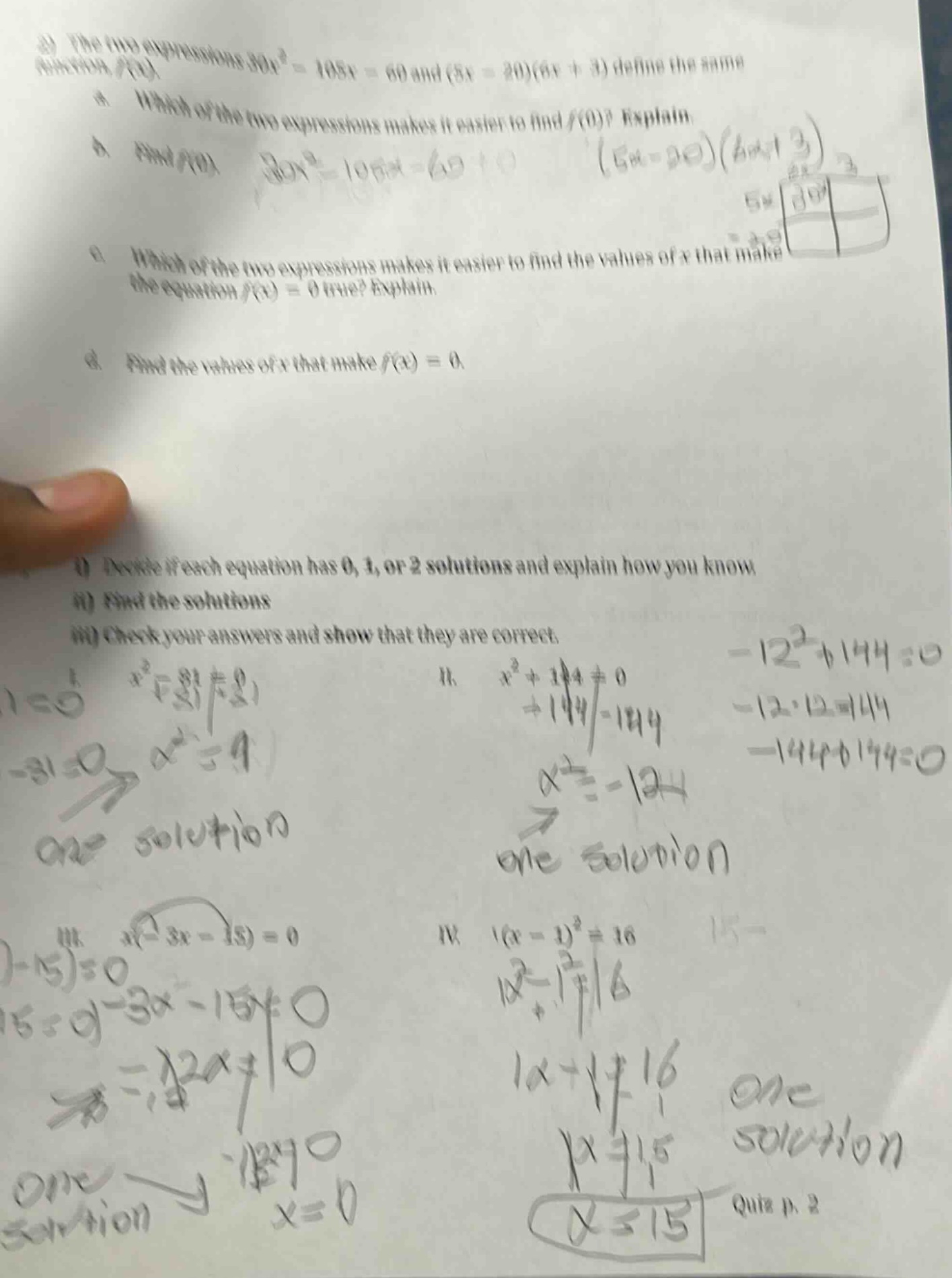
a) the two expressions (30x^{2}-105x - 60) and ((5x - 20)(6x + 3)) define the same function (f(x)).
a. which of the two expressions makes it easier to find (f(0))? explain.
b. find (f(0)).
c. which of the two expressions makes it easier to find the values of (x) that make the equation (f(x)=0) true? explain.
d. find the values of (x) that make (f(x)=0).
- decide if each equation has 0, 1, or 2 solutions and explain how you know.
ii) find the solutions
iii) check your answers and show that they are correct.
i. (x^{2}-81 = 0)
ii. (x^{2}+144 = 0)
iii. (x(-3x - 15)=0)
iv. ((x - 1)^{2}=16)
Part a (Finding \( f(0) \))
Step 1: Analyze the first expression \( 30x^2 - 105x - 60 \)
To find \( f(0) \), substitute \( x = 0 \) into the expression. When \( x = 0 \), the terms with \( x \) (i.e., \( 30x^2 \) and \( -105x \)) become \( 0 \) because any number multiplied by \( 0 \) is \( 0 \). So we have:
\( f(0) = 30(0)^2 - 105(0) - 60 \)
\( f(0) = 0 - 0 - 60 \)
\( f(0) = -60 \)
Step 2: Analyze the second expression \( (5x - 20)(6x + 3) \)
To find \( f(0) \), substitute \( x = 0 \) into the expression:
\( f(0) = (5(0) - 20)(6(0) + 3) \)
\( f(0) = (-20)(3) \)
\( f(0) = -60 \)
Step 3: Determine which is easier
The first expression \( 30x^2 - 105x - 60 \) is easier because when we substitute \( x = 0 \), the first two terms (with \( x \)) immediately become \( 0 \), and we only need to evaluate the constant term \( -60 \). For the factored form, we still need to perform two multiplications (even though they are simple), so the expanded form is more straightforward for finding \( f(0) \).
Part b (Finding \( f(0) \))
As calculated above, using either expression:
From the expanded form: \( f(0) = 30(0)^2 - 105(0) - 60 = -60 \)
From the factored form: \( f(0) = (5(0) - 20)(6(0) + 3) = (-20)(3) = -60 \)
Part c (Finding \( x \) where \( f(x) = 0 \))
Step 1: Analyze the expressions
To find the roots (values of \( x \) where \( f(x) = 0 \)), the factored form \( (5x - 20)(6x + 3) = 0 \) is easier. This is because of the Zero Product Property, which states that if \( ab = 0 \), then either \( a = 0 \) or \( b = 0 \).
Step 2: Apply the Zero Product Property
Set each factor equal to \( 0 \):
- For \( 5x - 20 = 0 \):
Add \( 20 \) to both sides: \( 5x = 20 \)
Divide by \( 5 \): \( x = 4 \)
- For \( 6x + 3 = 0 \):
Subtract \( 3 \) from both sides: \( 6x = -3 \)
Divide by \( 6 \): \( x = -\frac{3}{6} = -\frac{1}{2} \)
Part d (Solving Equations)
Equation I: \( x^2 = 81 \)
- i) Number of solutions:
Rewrite as \( x^2 - 81 = 0 \), which factors to \( (x - 9)(x + 9) = 0 \). By the Zero Product Property, \( x - 9 = 0 \) or \( x + 9 = 0 \), so there are 2 solutions.
- ii) Solutions:
\( x - 9 = 0 \implies x = 9 \)
\( x + 9 = 0 \implies x = -9 \)
- iii) Check:
For \( x = 9 \): \( 9^2 = 81 \implies 81 = 81 \) (true)
For \( x = -9 \): \( (-9)^2 = 81 \implies 81 = 81 \) (true)
Equation II: \( x^2 + 144 = 0 \)
- i) Number of solutions:
Rewrite as \( x^2 = -144 \). Since the square of a real number is always non-negative, there are 0 real solutions.
- ii) Solutions: No real solutions (in real numbers; in complex numbers, \( x = \pm 12i \), but likely considering real numbers here).
- iii) Check: For any real \( x \), \( x^2 \geq 0 \), so \( x^2 + 144 \geq 144 > 0 \), so no solution.
Equation III: \( x(-3x - 15) = 0 \)
- i) Number of solutions:
By the Zero Product Property, \( x = 0 \) or \( -3x - 15 = 0 \), so 2 solutions.
- ii) Solutions:
\( x = 0 \)
For \( -3x - 15 = 0 \): Add \( 15 \) to both sides: \( -3x = 15 \); Divide by \( -3 \): \( x = -5 \)
- iii) Check:
For \( x = 0 \): \( 0(-3(0) - 15) = 0(-15) = 0 \) (true)
For \( x = -5 \): \( -5(-3(-5) - 15) = -5(15 - 15) = -5(0) = 0 \) (true)
Equation IV: \( (x - 1)^2 = 16 \)
- i) Number of solutions:
Take square roots: \( x - 1 = \pm \sqrt{16} = \pm 4 \), so 2 solutions.
- ii) Solutions:
\( x - 1 = 4 \implies x = 5 \)
\( x - 1 = -4 \implies x = -3 \)
- iii) Check:
For \( x = 5 \): \( (5 - 1)^2 = 4^2 = 16 \) (true)
For \( x = -3 \): \( (-3 - 1)^2 = (-4)^2 =…

Snap & solve any problem in the app
Get step-by-step solutions on Sovi AI
Photo-based solutions with guided steps
Explore more problems and detailed explanations
Part a (Finding \( f(0) \))
Step 1: Analyze the first expression \( 30x^2 - 105x - 60 \)
To find \( f(0) \), substitute \( x = 0 \) into the expression. When \( x = 0 \), the terms with \( x \) (i.e., \( 30x^2 \) and \( -105x \)) become \( 0 \) because any number multiplied by \( 0 \) is \( 0 \). So we have:
\( f(0) = 30(0)^2 - 105(0) - 60 \)
\( f(0) = 0 - 0 - 60 \)
\( f(0) = -60 \)
Step 2: Analyze the second expression \( (5x - 20)(6x + 3) \)
To find \( f(0) \), substitute \( x = 0 \) into the expression:
\( f(0) = (5(0) - 20)(6(0) + 3) \)
\( f(0) = (-20)(3) \)
\( f(0) = -60 \)
Step 3: Determine which is easier
The first expression \( 30x^2 - 105x - 60 \) is easier because when we substitute \( x = 0 \), the first two terms (with \( x \)) immediately become \( 0 \), and we only need to evaluate the constant term \( -60 \). For the factored form, we still need to perform two multiplications (even though they are simple), so the expanded form is more straightforward for finding \( f(0) \).
Part b (Finding \( f(0) \))
As calculated above, using either expression:
From the expanded form: \( f(0) = 30(0)^2 - 105(0) - 60 = -60 \)
From the factored form: \( f(0) = (5(0) - 20)(6(0) + 3) = (-20)(3) = -60 \)
Part c (Finding \( x \) where \( f(x) = 0 \))
Step 1: Analyze the expressions
To find the roots (values of \( x \) where \( f(x) = 0 \)), the factored form \( (5x - 20)(6x + 3) = 0 \) is easier. This is because of the Zero Product Property, which states that if \( ab = 0 \), then either \( a = 0 \) or \( b = 0 \).
Step 2: Apply the Zero Product Property
Set each factor equal to \( 0 \):
- For \( 5x - 20 = 0 \):
Add \( 20 \) to both sides: \( 5x = 20 \)
Divide by \( 5 \): \( x = 4 \)
- For \( 6x + 3 = 0 \):
Subtract \( 3 \) from both sides: \( 6x = -3 \)
Divide by \( 6 \): \( x = -\frac{3}{6} = -\frac{1}{2} \)
Part d (Solving Equations)
Equation I: \( x^2 = 81 \)
- i) Number of solutions:
Rewrite as \( x^2 - 81 = 0 \), which factors to \( (x - 9)(x + 9) = 0 \). By the Zero Product Property, \( x - 9 = 0 \) or \( x + 9 = 0 \), so there are 2 solutions.
- ii) Solutions:
\( x - 9 = 0 \implies x = 9 \)
\( x + 9 = 0 \implies x = -9 \)
- iii) Check:
For \( x = 9 \): \( 9^2 = 81 \implies 81 = 81 \) (true)
For \( x = -9 \): \( (-9)^2 = 81 \implies 81 = 81 \) (true)
Equation II: \( x^2 + 144 = 0 \)
- i) Number of solutions:
Rewrite as \( x^2 = -144 \). Since the square of a real number is always non-negative, there are 0 real solutions.
- ii) Solutions: No real solutions (in real numbers; in complex numbers, \( x = \pm 12i \), but likely considering real numbers here).
- iii) Check: For any real \( x \), \( x^2 \geq 0 \), so \( x^2 + 144 \geq 144 > 0 \), so no solution.
Equation III: \( x(-3x - 15) = 0 \)
- i) Number of solutions:
By the Zero Product Property, \( x = 0 \) or \( -3x - 15 = 0 \), so 2 solutions.
- ii) Solutions:
\( x = 0 \)
For \( -3x - 15 = 0 \): Add \( 15 \) to both sides: \( -3x = 15 \); Divide by \( -3 \): \( x = -5 \)
- iii) Check:
For \( x = 0 \): \( 0(-3(0) - 15) = 0(-15) = 0 \) (true)
For \( x = -5 \): \( -5(-3(-5) - 15) = -5(15 - 15) = -5(0) = 0 \) (true)
Equation IV: \( (x - 1)^2 = 16 \)
- i) Number of solutions:
Take square roots: \( x - 1 = \pm \sqrt{16} = \pm 4 \), so 2 solutions.
- ii) Solutions:
\( x - 1 = 4 \implies x = 5 \)
\( x - 1 = -4 \implies x = -3 \)
- iii) Check:
For \( x = 5 \): \( (5 - 1)^2 = 4^2 = 16 \) (true)
For \( x = -3 \): \( (-3 - 1)^2 = (-4)^2 = 16 \) (true)
Final Answers
- a) The expression \( 30x^2 - 105x - 60 \) is easier (explanation as above).
- b) \( f(0) = \boldsymbol{-60} \)
- c) The factored form \( (5x - 20)(6x + 3) \) is easier (explanation as above).
- d)
- I: 2 solutions (\( x = 9, -9 \))
- II: 0 solutions
- III: 2 solutions (\( x = 0, -5 \))
- IV: 2 solutions (\( x = 5, -3 \))