QUESTION IMAGE
Question
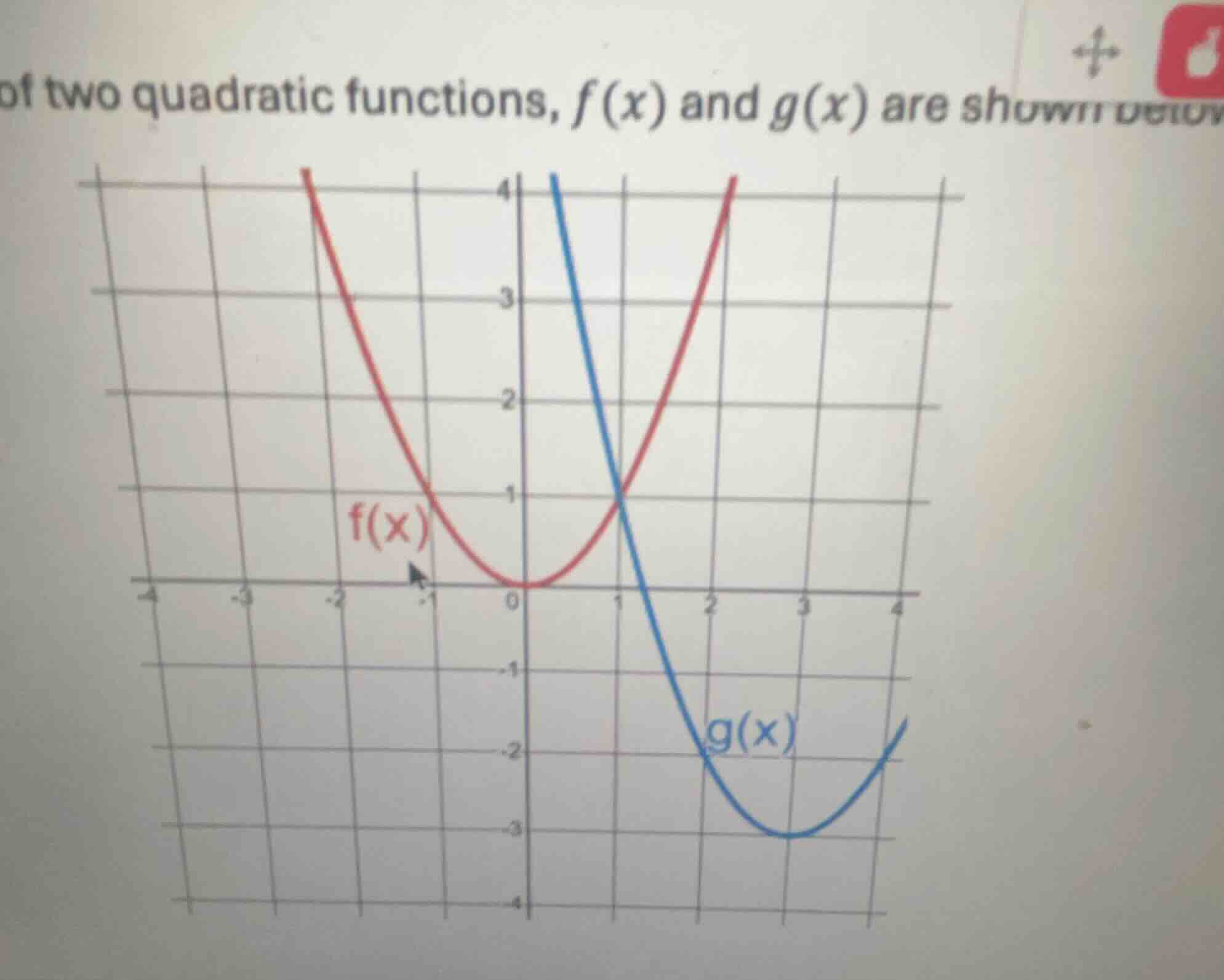
of two quadratic functions, f(x) and g(x) are shown below
Since the problem is about quadratic functions and their graphs, we can analyze the vertex form of quadratic functions. Let's assume we need to find the equations of \( f(x) \) and \( g(x) \) or compare their properties.
For \( f(x) \):
Step1: Identify the vertex
The vertex of \( f(x) \) is at \( (0, 0) \) (since it's a parabola opening upwards with vertex at the origin). The general form of a quadratic function in vertex form is \( f(x) = a(x - h)^2 + k \), where \( (h, k) \) is the vertex. Here, \( h = 0 \) and \( k = 0 \), so \( f(x) = ax^2 \).
To find \( a \), we can use a point on the graph. Let's take the point \( (1, 1) \) (since when \( x = 1 \), \( f(x) = 1 \)). Substituting into the equation:
\( 1 = a(1)^2 \)
\( a = 1 \)
So, \( f(x) = x^2 \).
For \( g(x) \):
Step1: Identify the vertex
The vertex of \( g(x) \) is at \( (3, -3) \) (from the graph, the lowest point of the blue parabola is at \( x = 3 \), \( y = -3 \)). So, the vertex form is \( g(x) = a(x - 3)^2 - 3 \).
Step2: Find \( a \)
We can use a point on the graph. Let's take the point \( (1, 1) \) (since the two parabolas intersect at \( (1, 1) \)). Substituting \( x = 1 \), \( g(x) = 1 \) into the equation:
\( 1 = a(1 - 3)^2 - 3 \)
\( 1 = a(-2)^2 - 3 \)
\( 1 = 4a - 3 \)
Step3: Solve for \( a \)
Adding 3 to both sides:
\( 4 = 4a \)
Dividing both sides by 4:
\( a = 1 \)
So, \( g(x) = (x - 3)^2 - 3 = x^2 - 6x + 9 - 3 = x^2 - 6x + 6 \).
If the question was to find the equations, the answers would be \( f(x) = x^2 \) and \( g(x) = (x - 3)^2 - 3 \) (or expanded form \( x^2 - 6x + 6 \)).
If the question was to compare the functions, for example, their leading coefficients: both \( f(x) \) and \( g(x) \) have a leading coefficient of 1 (since \( f(x) = x^2 \) has \( a = 1 \) and \( g(x) = (x - 3)^2 - 3 \) also has \( a = 1 \)), so they have the same "width" and both open upwards.
Since the original problem statement was cut off, but based on the graph, the above is a common analysis for quadratic functions.

Snap & solve any problem in the app
Get step-by-step solutions on Sovi AI
Photo-based solutions with guided steps
Explore more problems and detailed explanations
If finding the equation of \( f(x) \): \( f(x) = x^2 \)
If finding the equation of \( g(x) \): \( g(x) = (x - 3)^2 - 3 \) (or \( x^2 - 6x + 6 \))
If comparing leading coefficients: Both have leading coefficient 1.