QUESTION IMAGE
Question
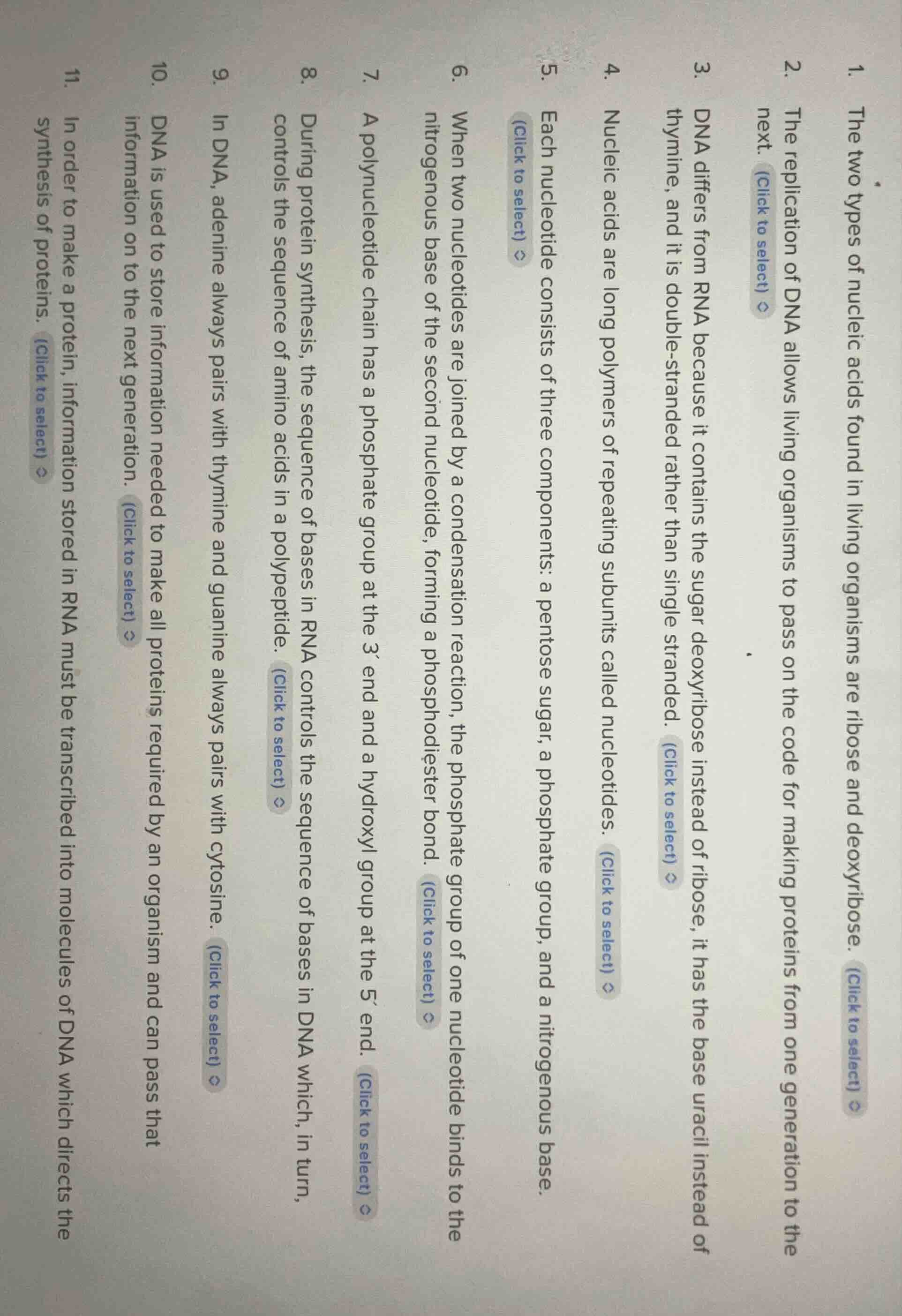
- the two types of nucleic acids found in living organisms are ribose and deoxyribose. (click to select) 2. the replication of dna allows living organisms to pass on the code for making proteins from one generation to the next. (click to select) 3. dna differs from rna because it contains the sugar deoxyribose instead of ribose, it has the base uracil instead of thymine, and it is double - stranded rather than single - stranded. (click to select) 4. nucleic acids are long polymers of repeating subunits called nucleotides. (click to select) 5. each nucleotide consists of three components: a pentose sugar, a phosphate group, and a nitrogenous base. (click to select) 6. when two nucleotides are joined by a condensation reaction, the phosphate group of one nucleotide binds to the nitrogenous base of the second nucleotide, forming a phosphodiester bond. (click to select) 7. a polynucleotide chain has a phosphate group at the 3’ end and a hydroxyl group at the 5’ end. (click to select) 8. during protein synthesis, the sequence of bases in rna controls the sequence of amino acids in a polypeptide. (click to select) 9. in dna, adenine always pairs with thymine and guanine always pairs with cytosine. (click to select) 10. dna is used to store information needed to make all proteins required by an organism and can pass that information on to the next generation. (click to select) 11. in order to make a protein, information stored in rna must be transcribed into molecules of dna which directs the synthesis of proteins. (click to select)
Brief Explanations
Each statement is evaluated based on core molecular biology facts about nucleic acids (DNA and RNA):
- The two nucleic acids are DNA and RNA; ribose/deoxyribose are their sugar components, not the acids themselves.
- DNA replication enables genetic information (for protein synthesis) to be passed between generations.
- DNA has deoxyribose, thymine, and is double-stranded; RNA has ribose, uracil, and is typically single-stranded.
- Nucleic acids are polymers made of nucleotide monomers.
- A nucleotide is defined by three parts: a pentose sugar, phosphate group, and nitrogenous base.
- Phosphodiester bonds form when the phosphate of one nucleotide links to the sugar of the next via condensation.
- Polynucleotide chains have a free phosphate at the 5' end and a free hydroxyl at the 3' end.
- DNA base sequences determine RNA sequences, which then determine protein amino acid sequences (central dogma).
- In DNA's double helix, adenine pairs with thymine, and guanine pairs with cytosine (complementary base pairing).
- DNA stores genetic information for protein synthesis and is passed to offspring during reproduction.
- The central dogma is DNA → RNA → protein: DNA is transcribed to RNA, which is translated to protein, not the reverse.

Snap & solve any problem in the app
Get step-by-step solutions on Sovi AI
Photo-based solutions with guided steps
Explore more problems and detailed explanations
- False
- True
- True
- True
- True
- True
- False
- True
- True
- True
- False