QUESTION IMAGE
Question
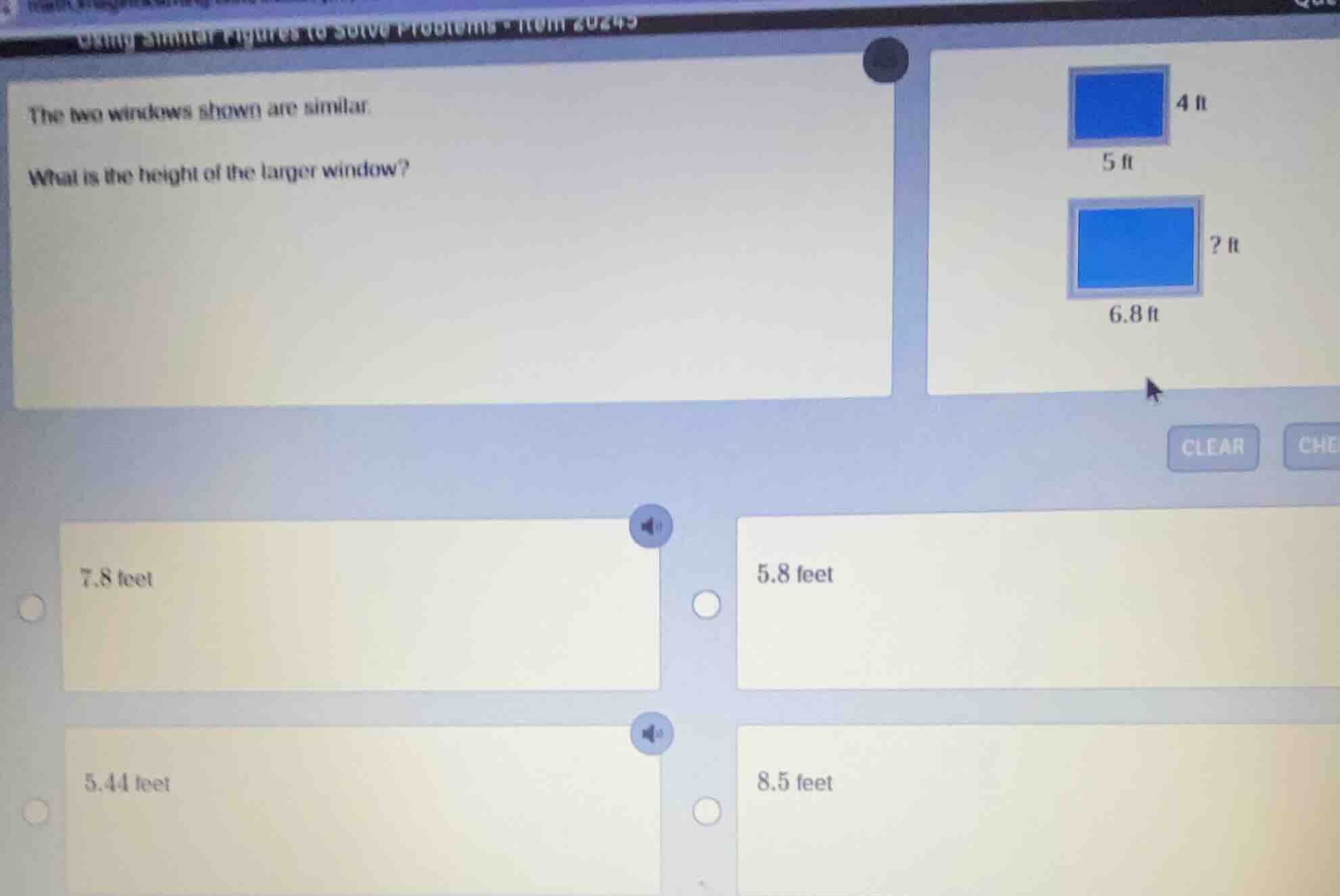
the two windows shown are similar. what is the height of the larger window? 7.8 feet 5.8 feet 5.44 feet 8.5 feet
Step1: Set up proportion for similar figures
Let \( x \) be the height of the larger window. Since the windows are similar, the ratios of corresponding sides are equal. So, \(\frac{4}{5}=\frac{x}{6.8}\) (Wait, no, correct ratio: smaller window has length 5 ft and height 4 ft; larger has length 6.8 ft and height \( x \). So ratio of length to height should be equal: \(\frac{5}{4}=\frac{6.8}{x}\)? Wait, no, similar figures: corresponding sides are proportional. So smaller window: length 5 ft, height 4 ft. Larger window: length 6.8 ft, height \( x \). So \(\frac{5}{4}=\frac{6.8}{x}\)? Wait, no, maybe length and height are corresponding. Wait, actually, the first window (smaller) has length 5 ft and height 4 ft. The second (larger) has length 6.8 ft and height \( x \). So the ratio of length to height for smaller is \( \frac{5}{4} \), for larger is \( \frac{6.8}{x} \). Wait, no, maybe I mixed up. Wait, similar rectangles, so length1/height1 = length2/height2. So smaller: length 5, height 4. Larger: length 6.8, height \( x \). So \( \frac{5}{4}=\frac{6.8}{x} \)? No, that would be if length and height are corresponding. Wait, no, maybe length of smaller is 5, length of larger is 6.8; height of smaller is 4, height of larger is \( x \). So the ratio of length to length is equal to ratio of height to height. So \( \frac{5}{6.8}=\frac{4}{x} \)? Wait, no, similar figures: corresponding sides are proportional. So smaller: length 5, height 4. Larger: length 6.8, height \( x \). So \( \frac{5}{6.8}=\frac{4}{x} \) is wrong. Wait, correct: \( \frac{\text{length of smaller}}{\text{length of larger}}=\frac{\text{height of smaller}}{\text{height of larger}} \). So \( \frac{5}{6.8}=\frac{4}{x} \)? No, that would be inverse. Wait, no: smaller to larger, so \( \frac{\text{smaller length}}{\text{larger length}}=\frac{\text{smaller height}}{\text{larger height}} \). So \( \frac{5}{6.8}=\frac{4}{x} \) → cross multiply: \( 5x = 4×6.8 \) → \( 5x = 27.2 \) → \( x = \frac{27.2}{5}=5.44 \)? Wait, no, that's not right. Wait, maybe I had the ratio reversed. Let's do it again. Let's say the first window (top) has length 5 ft and height 4 ft. The second (bottom) has length 6.8 ft and height \( x \) ft. Since they are similar, the ratio of length to height should be the same. So for the first window: length/height = 5/4. For the second: length/height = 6.8/x. So 5/4 = 6.8/x → cross multiply: 5x = 4×6.8 → 5x = 27.2 → x = 27.2 / 5 = 5.44? Wait, but 5.44 is one of the options? Wait, no, the options are 7.8, 5.8, 5.44, 8.5. Wait, maybe I mixed up length and height. Wait, maybe the first window has height 4 ft and length 5 ft (so it's a rectangle with length 5, height 4). The second window has length 6.8 ft (so longer length) and height \( x \). Wait, no, maybe the first window is 5 ft (length) and 4 ft (height), the second is 6.8 ft (length) and \( x \) (height). So similar, so 5/4 = 6.8/x → x = (4×6.8)/5 = 27.2/5 = 5.44. Wait, but let's check the options. One of the options is 5.44 feet. Wait, but let's re-express. Wait, maybe the ratio is height to length. So smaller window: height 4, length 5. Larger window: height \( x \), length 6.8. So 4/5 = x/6.8 → x = (4×6.8)/5 = 27.2/5 = 5.44. Yes, that's correct. So the height of the larger window is 5.44 feet.
Step2: Solve the proportion
We set up the proportion \(\frac{4}{5}=\frac{x}{6.8}\) (where \( x \) is the height of the larger window). Cross - multiplying gives us \( 5x = 4\times6.8 \).
First, calculate \( 4\times6.8 = 27.2 \). Then, solve for \( x \) by dividing both sides of the equation \( 5x = 27.2 \) by 5:…

Snap & solve any problem in the app
Get step-by-step solutions on Sovi AI
Photo-based solutions with guided steps
Explore more problems and detailed explanations
5.44 feet (corresponding to the option with 5.44 feet)