QUESTION IMAGE
Question
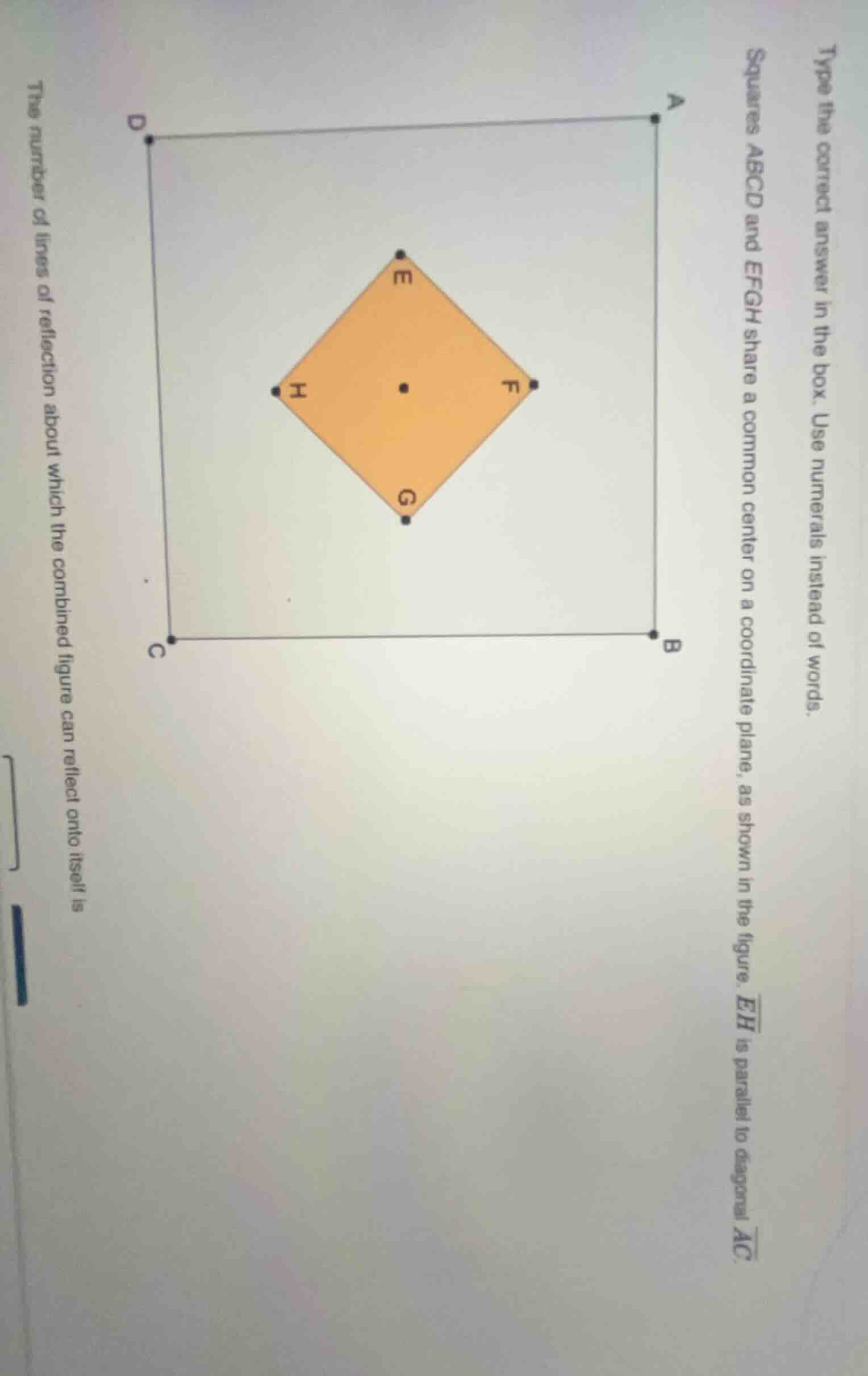
type the correct answer in the box. use numerals instead of words. squares abcd and efgh share a common center on a coordinate plane, as shown in the figure. $overline{eh}$ is parallel to diagonal $overline{ac}$. the number of lines of reflection about which the combined figure can reflect onto itself is
Step1: Analyze the squares' symmetry
Both squares ABCD and EFGH are squares with a common center. A square has 4 lines of reflection symmetry (2 diagonals, 2 lines through midpoints of opposite sides). But since EH is parallel to AC, we check the combined figure. The lines of reflection must map both squares onto themselves.
Step2: Identify valid reflection lines
The diagonals of ABCD (AC and BD) and the lines through midpoints of ABCD's sides (parallel to its sides) are considered. For the combined figure, the lines that are symmetry axes for both squares: the two diagonals of ABCD (since EFGH is rotated 45 degrees? Wait, no, EH is parallel to AC, so EFGH is oriented such that its sides are parallel to ABCD's diagonals. So the symmetry lines of the combined figure: the two diagonals of ABCD (AC, BD) and the two lines perpendicular to those diagonals (through the center, parallel to AB and AD? Wait, no. Wait, a square has 4 lines of symmetry. But when we have two squares with EH parallel to AC, the combined figure's symmetry lines: let's think. The large square ABCD has 4 lines (2 diagonals, 2 midlines). The small square EFGH, since EH is parallel to AC, its sides are parallel to ABCD's diagonals. So EFGH's symmetry lines are the same as ABCD's diagonals? No, EFGH is a square, so it has 4 lines too. But the combined figure: the lines that are symmetry for both. Let's see: the two diagonals of ABCD (AC, BD) – reflecting over AC: EH is parallel to AC, so EH maps to itself? Wait, EH is parallel to AC, so reflecting over AC would map EH to a line parallel to AC, and since EFGH is centered, it should map EFGH onto itself. Similarly for BD. Then the other two lines: the midlines of ABCD (horizontal and vertical, if ABCD is axis-aligned). Reflecting over the horizontal midline: would EFGH map onto itself? EFGH is rotated 45 degrees, so its sides are at 45 degrees. Reflecting over a horizontal line (midline of ABCD) would rotate EFGH? No, reflection over horizontal line: a square rotated 45 degrees would have its symmetry lines at 45 degrees. Wait, maybe I made a mistake. Wait, the problem says EH is parallel to AC. So AC is a diagonal of ABCD, EH is a side of EFGH, parallel to AC. So EFGH is a square with sides parallel to ABCD's diagonals. So the combined figure: the symmetry lines are the two diagonals of ABCD (AC, BD) and the two lines perpendicular to those diagonals (i.e., the lines parallel to AB and AD, through the center). Wait, no, a square has 4 lines. Wait, maybe the combined figure has 4 lines? No, wait, let's count. Wait, the large square has 4, the small square has 4, but the combined figure: the lines that are symmetry for both. Let's take an example: reflect over AC (diagonal of ABCD). ABCD maps to itself, EFGH: since EH is parallel to AC, EH is on a line parallel to AC, so reflecting over AC would map EH to a line parallel to AC, and since EFGH is centered, EFGH maps to itself. Similarly for BD. Then reflect over the midline of AB and CD (horizontal line through center). ABCD maps to itself, EFGH: its sides are at 45 degrees, so reflecting over horizontal line would flip EFGH vertically, but since it's centered, does it map to itself? Wait, EFGH is a square with sides parallel to diagonals of ABCD, so its vertices are at (center + (a,a), (a,-a), (-a,-a), (-a,a)) if ABCD is from (-b,-b) to (b,b). Then reflecting over horizontal line (y=0) would map (a,a) to (a,-a), (a,-a) to (a,a), (-a,-a) to (-a,a), (-a,a) to (-a,-a) – which is a rotation? No, reflection over y=0 swaps (x,y) and (x,-y). So (a,a) becomes (a,-a), which…

Snap & solve any problem in the app
Get step-by-step solutions on Sovi AI
Photo-based solutions with guided steps
Explore more problems and detailed explanations
4