QUESTION IMAGE
Question
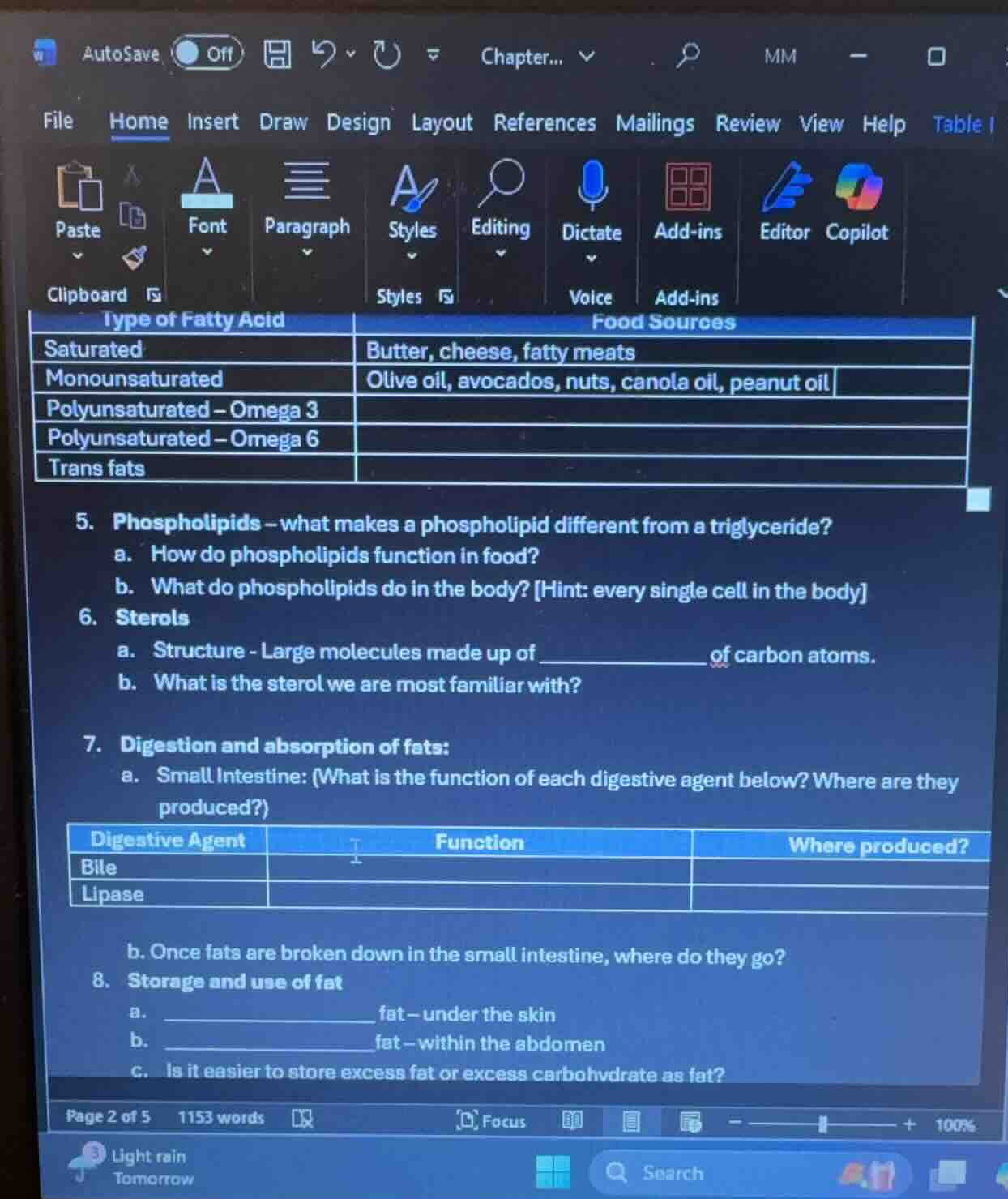
type of fatty acid | food sourcessaturated | butter, cheese, fatty meatsmonounsaturated | olive oil, avocados, nuts, canola oil, peanut oilpolyunsaturated - omega 3 |polyunsaturated - omega 6 |trans fats |5. phospholipids - what makes a phospholipid different from a triglyceride?a. how do phospholipids function in food?b. what do phospholipids do in the body? hint: every single cell in the body6. sterolsa. structure - large molecules made up of _____________ of carbon atoms.b. what is the sterol we are most familiar with?7. digestion and absorption of fats:a. small intestine: (what is the function of each digestive agent below? where are they produced?)digestive agent | function | where produced?bile | |lipase | |b. once fats are broken down in the small intestine, where do they go?8. storage and use of fata. ___________ fat - under the skinb. _____________ fat - within the abdomenc. is it easier to store excess fat or excess carbohydrate as fat?
Fatty Acid Food Sources:
- Polyunsaturated Omega-3 fatty acids are found in fatty fish, flaxseeds, chia seeds, and walnuts.
- Polyunsaturated Omega-6 fatty acids are found in sunflower oil, soybean oil, corn oil, and sesame oil.
- Trans fats are found in fried foods, processed snack foods, baked goods, and partially hydrogenated oils.
Question 5 (Phospholipids):
a. In food, phospholipids act as emulsifiers, mixing fat and water to keep mixtures stable (e.g., in mayonnaise).
b. In the body, phospholipids form the lipid bilayer of all cell membranes, creating a protective barrier and regulating what enters/exits cells.
Question 6 (Sterols):
a. Sterols are large molecules made up of four fused rings of carbon atoms.
b. The most familiar sterol is cholesterol.
Question 7 (Fat Digestion & Absorption):
a.
| Digestive Agent | Function | Where produced? |
|---|---|---|
| Lipase | Breaks down fat droplets into fatty acids and glycerol | Pancreas (and small intestine) |
b. After breakdown, fatty acids and glycerol are absorbed into intestinal cells, reassembled into fats, packaged into chylomicrons, and transported through the lymphatic system to the bloodstream.
Question 8 (Fat Storage & Use):
a. Subcutaneous fat – under the skin
b. Visceral fat – within the abdomen
c. It is easier to store excess carbohydrate as fat, since carbohydrates are quickly converted to fat when consumed in surplus, while excess fat is stored directly but requires more energy to process initially.

Snap & solve any problem in the app
Get step-by-step solutions on Sovi AI
Photo-based solutions with guided steps
Explore more problems and detailed explanations
Fatty Acid Food Sources:
- Polyunsaturated - Omega 3: Fatty fish, flaxseeds, chia seeds, walnuts
- Polyunsaturated - Omega 6: Sunflower oil, soybean oil, corn oil, sesame oil
- Trans fats: Fried foods, processed snacks, baked goods, partially hydrogenated oils
Question 5:
a. Act as food emulsifiers (stabilize fat-water mixtures)
b. Form cell membrane lipid bilayers
Question 6:
a. Four fused rings
b. Cholesterol
Question 7:
a.
| Digestive Agent | Function | Where produced? |
|---|---|---|
| Lipase | Breaks down fats into fatty acids/glycerol | Pancreas, small intestine |
b. Absorbed into intestinal cells, packaged into chylomicrons, transported via lymph to bloodstream
Question 8:
a. Subcutaneous
b. Visceral
c. It is easier to store excess carbohydrate as fat