QUESTION IMAGE
Question
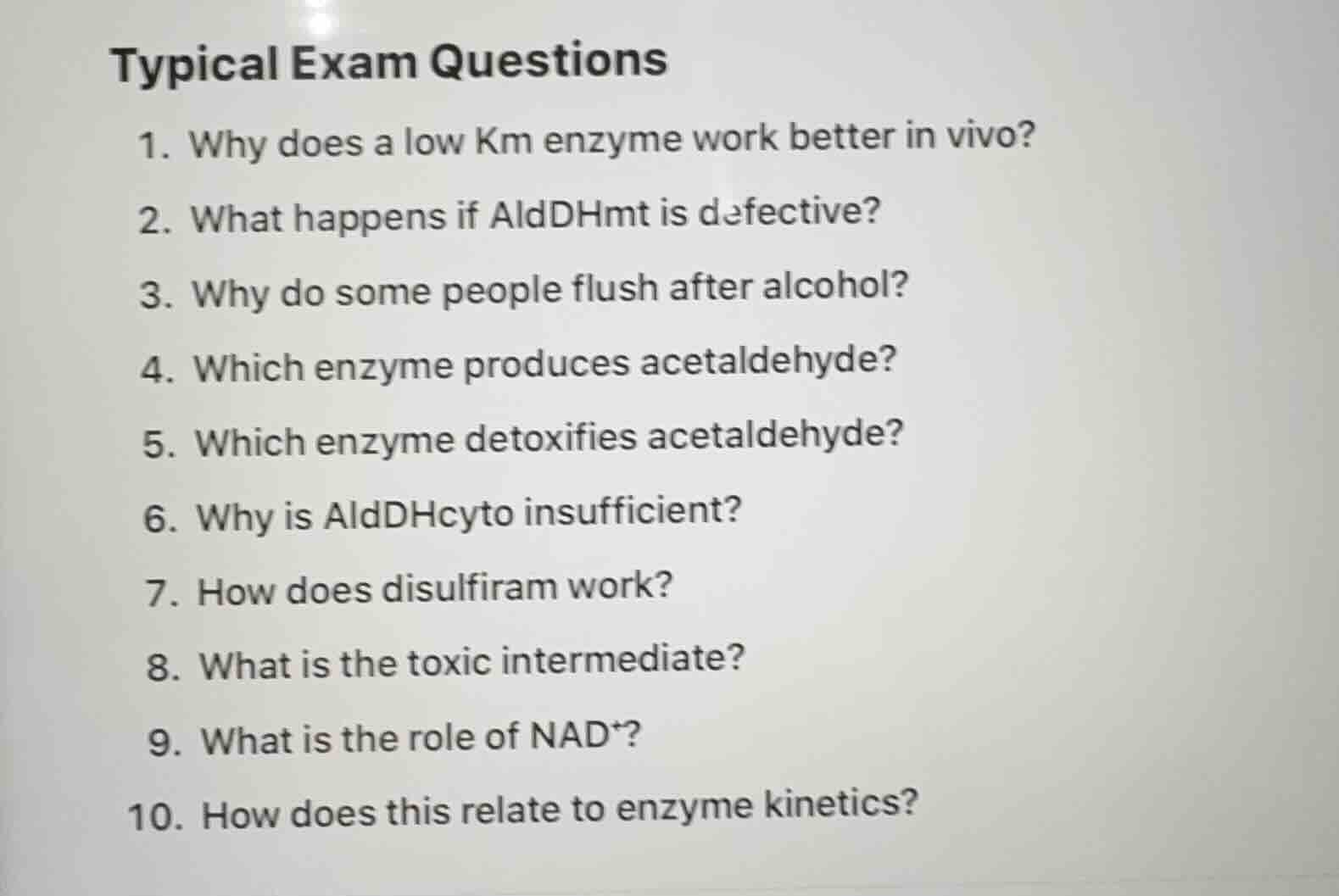
typical exam questions
- why does a low km enzyme work better in vivo?
- what happens if alddhmt is defective?
- why do some people flush after alcohol?
- which enzyme produces acetaldehyde?
- which enzyme detoxifies acetaldehyde?
- why is alddhcyto insufficient?
- how does disulfiram work?
- what is the toxic intermediate?
- what is the role of nad⁺?
- how does this relate to enzyme kinetics?
Brief Explanations
- Low $K_m$ means high substrate affinity, so enzymes function well at the low substrate concentrations present in living organisms.
- Mitochondrial aldehyde dehydrogenase (AldDHmt) deficiency leads to impaired acetaldehyde breakdown, causing buildup of this toxic metabolite.
- Alcohol flush occurs when AldDHmt is defective: acetaldehyde accumulates, triggering vasodilation of facial blood vessels.
- Alcohol dehydrogenase (ADH) catalyzes the conversion of ethanol to acetaldehyde.
- Mitochondrial aldehyde dehydrogenase (AldDHmt) is the primary enzyme that detoxifies acetaldehyde by converting it to acetate.
- Cytosolic aldehyde dehydrogenase (AldDHcyto) has low affinity for acetaldehyde (high $K_m$) and low activity, so it cannot effectively clear acetaldehyde when levels rise.
- Disulfiram inhibits AldDHmt, preventing acetaldehyde breakdown. This leads to toxic buildup, causing unpleasant symptoms that deter alcohol consumption.
- Acetaldehyde is the toxic intermediate produced during alcohol metabolism.
- $NAD^+$ acts as a coenzyme (electron acceptor) for ADH and AldDH, accepting hydrogen atoms during the oxidation of ethanol and acetaldehyde.
- Alcohol metabolism enzymes follow Michaelis-Menten kinetics: $K_m$ values determine their affinity for substrates, and defects in enzymes (like low-Activity AldDHmt) alter reaction rates and metabolite buildup, which aligns with enzyme kinetic principles of substrate affinity and catalytic efficiency.

Snap & solve any problem in the app
Get step-by-step solutions on Sovi AI
Photo-based solutions with guided steps
Explore more problems and detailed explanations
- It has high substrate affinity, works at low [substrate].
- Acetaldehyde accumulates, causing toxic effects.
- Defective AldDHmt causes acetaldehyde buildup, vasodilation.
- Alcohol dehydrogenase (ADH)
- Mitochondrial aldehyde dehydrogenase (AldDHmt)
- Low acetaldehyde affinity, low catalytic activity.
- Inhibits AldDHmt, blocks acetaldehyde breakdown.
- Acetaldehyde
- Electron acceptor coenzyme for metabolic enzymes.
- Enzyme $K_m$ and activity determine metabolite clearance, matching Michaelis-Menten kinetics.