QUESTION IMAGE
Question
understand
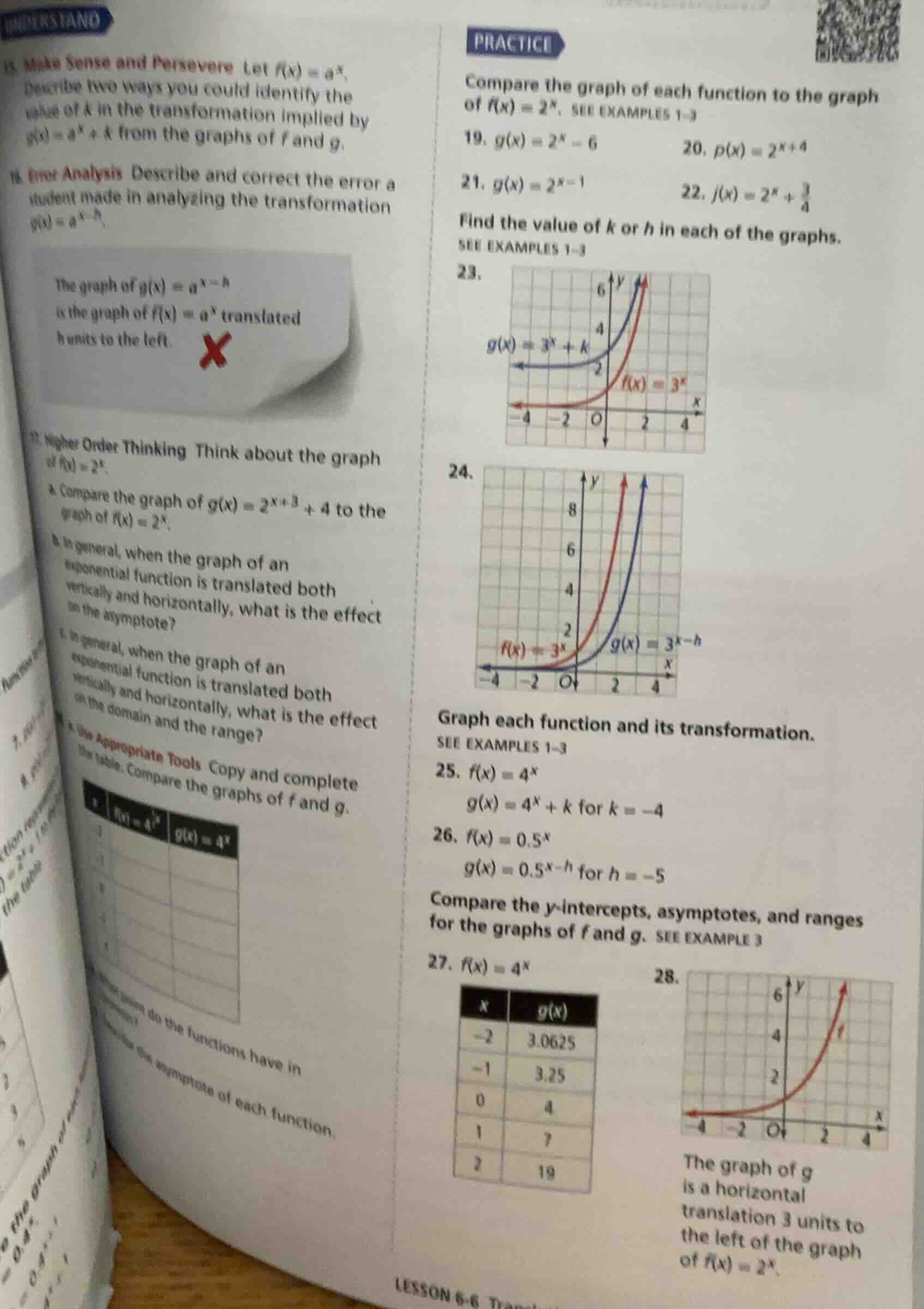
- make sense and persevere let ( f(x) = a^x ).
describe two ways you could identify the
value of ( k ) in the transformation implied by
( g(x) = a^x + k ) from the graphs of ( f ) and ( g ).
- error analysis describe and correct the error a
student made in analyzing the transformation
( g(x) = a^{x - h} ).
the graph of ( g(x) = a^{x - h} )
is the graph of ( f(x) = a^x ) translated( h ) units to the left.
- higher order thinking think about the graph
of ( f(x) = 2^x ).
a. compare the graph of ( g(x) = 2^{x + 3} + 4 ) to the
graph of ( f(x) = 2^x ).
b. in general, when the graph of an
exponential function is translated both
vertically and horizontally, what is the effect
on the asymptote?
c. in general, when the graph of an
exponential function is translated both
vertically and horizontally, what is the effect
on the domain and the range?
- use appropriate tools copy and complete
the table. compare the graphs of ( f ) and ( g ).
practice
compare the graph of each function to the graph
of ( f(x) = 2^x ). see examples 1–3
- ( g(x) = 2^x - 6 )
- ( p(x) = 2^{x + 4} )
- ( g(x) = 2^{x - 1} )
- ( j(x) = 2^x + \frac{3}{4} )
find the value of ( k ) or ( h ) in each of the graphs.
see examples 1–3
23.
( g(x) = 3^x + k )
( f(x) = 3^x )
24.
( f(x) = 3^x )
( g(x) = 3^{x - h} )
graph each function and its transformation.
see examples 1–3
- ( f(x) = 4^x )
( g(x) = 4^x + k ) for ( k = -4 )
- ( f(x) = 0.5^x )
( g(x) = 0.5^{x - h} ) for ( h = -5 )
compare the ( y )-intercepts, asymptotes, and ranges
for the graphs of ( f ) and ( g ). see example 3
- ( f(x) = 4^x )
28.
the graph of ( g )
is a horizontal
translation 3 units to
the left of the graph
of ( f(x) = 2^x ).
lesson 6-6
Solving Problems 19-24 (Exponential Transformations)
Step1: Recall transformation rules
For $f(x)=a^x$:
- $g(x)=a^x + k$: Vertical shift ($k>0$ up, $k<0$ down)
- $g(x)=a^{x-h}$: Horizontal shift ($h>0$ right, $h<0$ left)
---
Problem 19: $g(x)=2^x -6$
Step1: Identify transformation type
Vertical shift of $f(x)=2^x$
Step2: State shift direction/magnitude
Shift 6 units downward.
---
Problem 20: $p(x)=2^{x+4}$
Step1: Rewrite to match standard form
$p(x)=2^{x-(-4)}$
Step2: State shift direction/magnitude
Shift 4 units to the left.
---
Problem 21: $g(x)=2^{x-1}$
Step1: Identify transformation type
Horizontal shift of $f(x)=2^x$
Step2: State shift direction/magnitude
Shift 1 unit to the right.
---
Problem 22: $j(x)=2^x + \frac{3}{4}$
Step1: Identify transformation type
Vertical shift of $f(x)=2^x$
Step2: State shift direction/magnitude
Shift $\frac{3}{4}$ units upward.
---
Problem 23: Find $k$ for $g(x)=3^x +k$
Step1: Use y-intercepts
$f(0)=3^0=1$, $g(0)=3$
Step2: Solve for $k$
$3 = 1 + k \implies k=3-1=2$
---
Problem 24: Find $h$ for $g(x)=3^{x-h}$
Step1: Use matching points
$f(2)=3^2=9$, $g(3)=9=3^{3-h}$
Step2: Solve for $h$
$3-h=2 \implies h=3-2=1$
Step1: Recall horizontal shift rule
Left shift 3 units: replace $x$ with $x+3$ in $f(x)=2^x$
Step2: Write transformed function
$g(x)=2^{x+3}$

Snap & solve any problem in the app
Get step-by-step solutions on Sovi AI
Photo-based solutions with guided steps
Explore more problems and detailed explanations
- The graph of $g(x)=2^x -6$ is the graph of $f(x)=2^x$ shifted 6 units downward.
- The graph of $p(x)=2^{x+4}$ is the graph of $f(x)=2^x$ shifted 4 units to the left.
- The graph of $g(x)=2^{x-1}$ is the graph of $f(x)=2^x$ shifted 1 unit to the right.
- The graph of $j(x)=2^x + \frac{3}{4}$ is the graph of $f(x)=2^x$ shifted $\frac{3}{4}$ units upward.
- $k=2$
- $h=1$
---