QUESTION IMAGE
Question
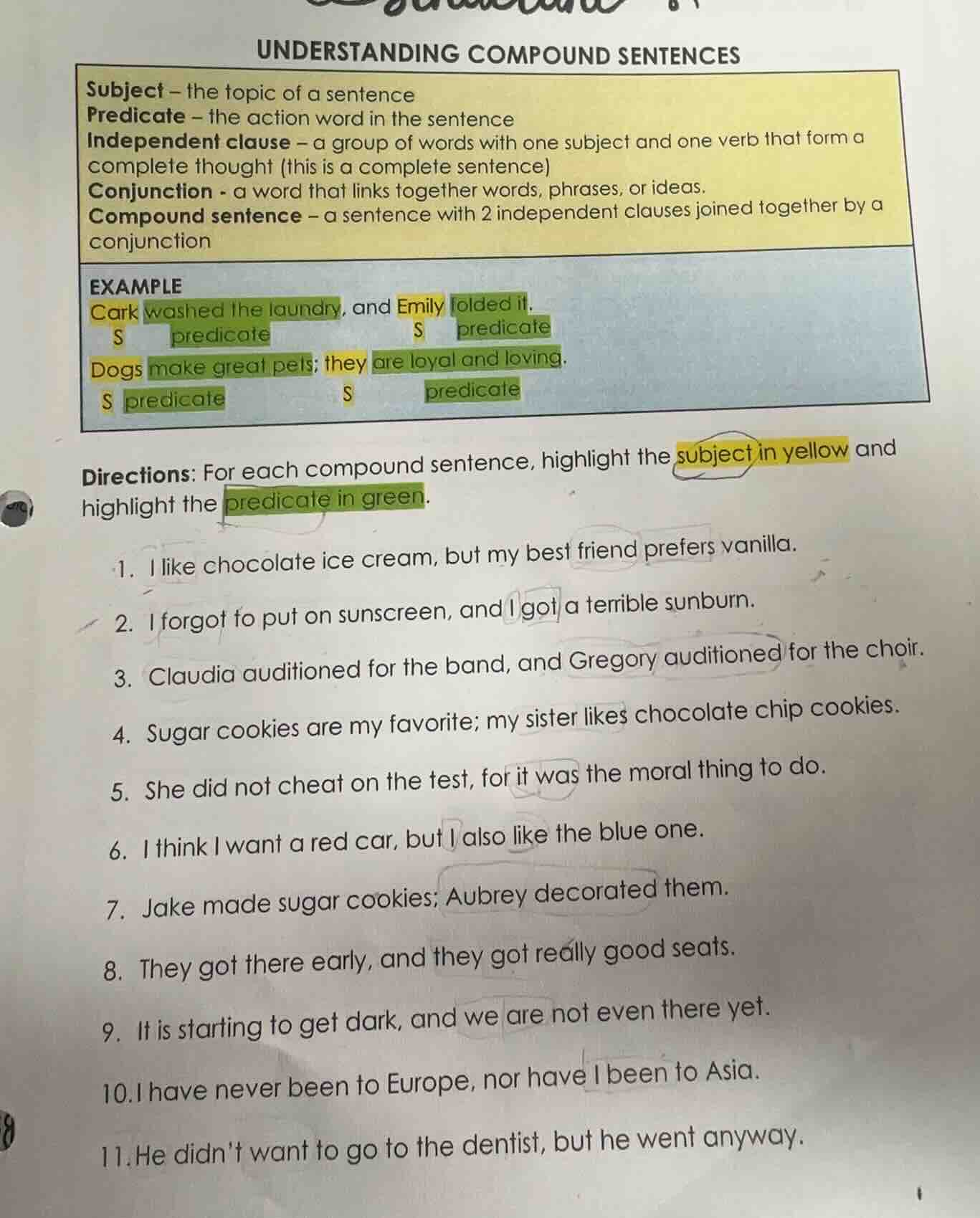
understanding compound sentences
subject – the topic of a sentence
predicate – the action word in the sentence
independent clause – a group of words with one subject and one verb that form a complete thought (this is a complete sentence)
conjunction - a word that links together words, phrases, or ideas.
compound sentence – a sentence with 2 independent clauses joined together by a conjunction
example
cark washed the laundry, and emily folded it.
s predicate s predicate
dogs make great pets; they are loyal and loving.
s predicate s predicate
directions: for each compound sentence, highlight the subject in yellow and highlight the predicate in green.
- i like chocolate ice cream, but my best friend prefers vanilla.
- i forgot to put on sunscreen, and i got a terrible sunburn.
- claudia auditioned for the band, and gregory auditioned for the choir.
- sugar cookies are my favorite; my sister likes chocolate chip cookies.
- she did not cheat on the test, for it was the moral thing to do.
- i think i want a red car, but i also like the blue one.
- jake made sugar cookies; aubrey decorated them.
- they got there early, and they got really good seats.
- it is starting to get dark, and we are not even there yet.
- i have never been to europe, nor have i been to asia.
- he didnt want to go to the dentist, but he went anyway.
For Sentence 1: "I like chocolate ice cream, but my best friend prefers vanilla."
- First Independent Clause:
- Subject (highlight yellow): \( \boldsymbol{\text{I}} \)
- Predicate (highlight green): \( \boldsymbol{\text{like chocolate ice cream}} \)
- Second Independent Clause:
- Subject (highlight yellow): \( \boldsymbol{\text{my best friend}} \)
- Predicate (highlight green): \( \boldsymbol{\text{prefers vanilla}} \)
For Sentence 2: "I forgot to put on sunscreen, and I got a terrible sunburn."
- First Independent Clause:
- Subject (highlight yellow): \( \boldsymbol{\text{I}} \)
- Predicate (highlight green): \( \boldsymbol{\text{forgot to put on sunscreen}} \)
- Second Independent Clause:
- Subject (highlight yellow): \( \boldsymbol{\text{I}} \)
- Predicate (highlight green): \( \boldsymbol{\text{got a terrible sunburn}} \)
For Sentence 3: "Claudia auditioned for the band, and Gregory auditioned for the choir."
- First Independent Clause:
- Subject (highlight yellow): \( \boldsymbol{\text{Claudia}} \)
- Predicate (highlight green): \( \boldsymbol{\text{auditioned for the band}} \)
- Second Independent Clause:
- Subject (highlight yellow): \( \boldsymbol{\text{Gregory}} \)
- Predicate (highlight green): \( \boldsymbol{\text{auditioned for the choir}} \)
For Sentence 4: "Sugar cookies are my favorite; my sister likes chocolate chip cookies."
- First Independent Clause:
- Subject (highlight yellow): \( \boldsymbol{\text{Sugar cookies}} \)
- Predicate (highlight green): \( \boldsymbol{\text{are my favorite}} \)
- Second Independent Clause:
- Subject (highlight yellow): \( \boldsymbol{\text{my sister}} \)
- Predicate (highlight green): \( \boldsymbol{\text{likes chocolate chip cookies}} \)
For Sentence 5: "She did not cheat on the test, for it was the moral thing to do."
- First Independent Clause:
- Subject (highlight yellow): \( \boldsymbol{\text{She}} \)
- Predicate (highlight green): \( \boldsymbol{\text{did not cheat on the test}} \)
- Second Independent Clause:
- Subject (highlight yellow): \( \boldsymbol{\text{it}} \)
- Predicate (highlight green): \( \boldsymbol{\text{was the moral thing to do}} \)
For Sentence 6: "I think I want a red car, but I also like the blue one."
- First Independent Clause:
- Subject (highlight yellow): \( \boldsymbol{\text{I}} \)
- Predicate (highlight green): \( \boldsymbol{\text{think I want a red car}} \)
- Second Independent Clause:
- Subject (highlight yellow): \( \boldsymbol{\text{I}} \)
- Predicate (highlight green): \( \boldsymbol{\text{also like the blue one}} \)
For Sentence 7: "Jake made sugar cookies; Aubrey decorated them."
- First Independent Clause:
- Subject (highlight yellow): \( \boldsymbol{\text{Jake}} \)
- Predicate (highlight green): \( \boldsymbol{\text{made sugar cookies}} \)
- Second Independent Clause:
- Subject (highlight yellow): \( \boldsymbol{\text{Aubrey}} \)
- Predicate (highlight green): \( \boldsymbol{\text{decorated them}} \)
For Sentence 8: "They got there early, and they got really good seats."
- First Independent Clause:
- Subject (highlight yellow): \( \boldsymbol{\text{They}} \)
- Predicate (highlight green): \( \boldsymbol{\text{got there early}} \)
- Second Independent Clause:
- Subject (highlight yellow): \( \boldsymbol{\text{They}} \)
- Predicate (highlight green): \( \boldsymbol{\text{got really good seats}} \)
For Sentence 9: "…

Snap & solve any problem in the app
Get step-by-step solutions on Sovi AI
Photo-based solutions with guided steps
Explore more problems and detailed explanations
For Sentence 1: "I like chocolate ice cream, but my best friend prefers vanilla."
- First Independent Clause:
- Subject (highlight yellow): \( \boldsymbol{\text{I}} \)
- Predicate (highlight green): \( \boldsymbol{\text{like chocolate ice cream}} \)
- Second Independent Clause:
- Subject (highlight yellow): \( \boldsymbol{\text{my best friend}} \)
- Predicate (highlight green): \( \boldsymbol{\text{prefers vanilla}} \)
For Sentence 2: "I forgot to put on sunscreen, and I got a terrible sunburn."
- First Independent Clause:
- Subject (highlight yellow): \( \boldsymbol{\text{I}} \)
- Predicate (highlight green): \( \boldsymbol{\text{forgot to put on sunscreen}} \)
- Second Independent Clause:
- Subject (highlight yellow): \( \boldsymbol{\text{I}} \)
- Predicate (highlight green): \( \boldsymbol{\text{got a terrible sunburn}} \)
For Sentence 3: "Claudia auditioned for the band, and Gregory auditioned for the choir."
- First Independent Clause:
- Subject (highlight yellow): \( \boldsymbol{\text{Claudia}} \)
- Predicate (highlight green): \( \boldsymbol{\text{auditioned for the band}} \)
- Second Independent Clause:
- Subject (highlight yellow): \( \boldsymbol{\text{Gregory}} \)
- Predicate (highlight green): \( \boldsymbol{\text{auditioned for the choir}} \)
For Sentence 4: "Sugar cookies are my favorite; my sister likes chocolate chip cookies."
- First Independent Clause:
- Subject (highlight yellow): \( \boldsymbol{\text{Sugar cookies}} \)
- Predicate (highlight green): \( \boldsymbol{\text{are my favorite}} \)
- Second Independent Clause:
- Subject (highlight yellow): \( \boldsymbol{\text{my sister}} \)
- Predicate (highlight green): \( \boldsymbol{\text{likes chocolate chip cookies}} \)
For Sentence 5: "She did not cheat on the test, for it was the moral thing to do."
- First Independent Clause:
- Subject (highlight yellow): \( \boldsymbol{\text{She}} \)
- Predicate (highlight green): \( \boldsymbol{\text{did not cheat on the test}} \)
- Second Independent Clause:
- Subject (highlight yellow): \( \boldsymbol{\text{it}} \)
- Predicate (highlight green): \( \boldsymbol{\text{was the moral thing to do}} \)
For Sentence 6: "I think I want a red car, but I also like the blue one."
- First Independent Clause:
- Subject (highlight yellow): \( \boldsymbol{\text{I}} \)
- Predicate (highlight green): \( \boldsymbol{\text{think I want a red car}} \)
- Second Independent Clause:
- Subject (highlight yellow): \( \boldsymbol{\text{I}} \)
- Predicate (highlight green): \( \boldsymbol{\text{also like the blue one}} \)
For Sentence 7: "Jake made sugar cookies; Aubrey decorated them."
- First Independent Clause:
- Subject (highlight yellow): \( \boldsymbol{\text{Jake}} \)
- Predicate (highlight green): \( \boldsymbol{\text{made sugar cookies}} \)
- Second Independent Clause:
- Subject (highlight yellow): \( \boldsymbol{\text{Aubrey}} \)
- Predicate (highlight green): \( \boldsymbol{\text{decorated them}} \)
For Sentence 8: "They got there early, and they got really good seats."
- First Independent Clause:
- Subject (highlight yellow): \( \boldsymbol{\text{They}} \)
- Predicate (highlight green): \( \boldsymbol{\text{got there early}} \)
- Second Independent Clause:
- Subject (highlight yellow): \( \boldsymbol{\text{They}} \)
- Predicate (highlight green): \( \boldsymbol{\text{got really good seats}} \)
For Sentence 9: "It is starting to get dark, and we are not even there yet."
- First Independent Clause:
- Subject (highlight yellow): \( \boldsymbol{\text{It}} \)
- Predicate (highlight green): \( \boldsymbol{\text{is starting to get dark}} \)
- Second Independent Clause:
- Subject (highlight yellow): \( \boldsymbol{\text{we}} \)
- Predicate (highlight green): \( \boldsymbol{\text{are not even there yet}} \)
For Sentence 10: "I have never been to Europe, nor have I been to Asia."
- First Independent Clause:
- Subject (highlight yellow): \( \boldsymbol{\text{I}} \)
- Predicate (highlight green): \( \boldsymbol{\text{have never been to Europe}} \)
- Second Independent Clause:
- Subject (highlight yellow): \( \boldsymbol{\text{I}} \)
- Predicate (highlight green): \( \boldsymbol{\text{have been to Asia}} \) (Note: The structure "nor have I been..." has the subject "I" and predicate "have been to Asia" after inversion for the compound sentence structure)
For Sentence 11: "He didn't want to go to the dentist, but he went anyway."
- First Independent Clause:
- Subject (highlight yellow): \( \boldsymbol{\text{He}} \)
- Predicate (highlight green): \( \boldsymbol{\text{didn't want to go to the dentist}} \)
- Second Independent Clause:
- Subject (highlight yellow): \( \boldsymbol{\text{He}} \)
- Predicate (highlight green): \( \boldsymbol{\text{went anyway}} \)
To complete the task, you would physically highlight the subjects (in yellow) and predicates (in green) as identified above for each sentence.