QUESTION IMAGE
Question
unit 2.0
examples:
1.
2.
3.
4.
- (handwritten 3×3)
6.
7.
8.
9.
10.
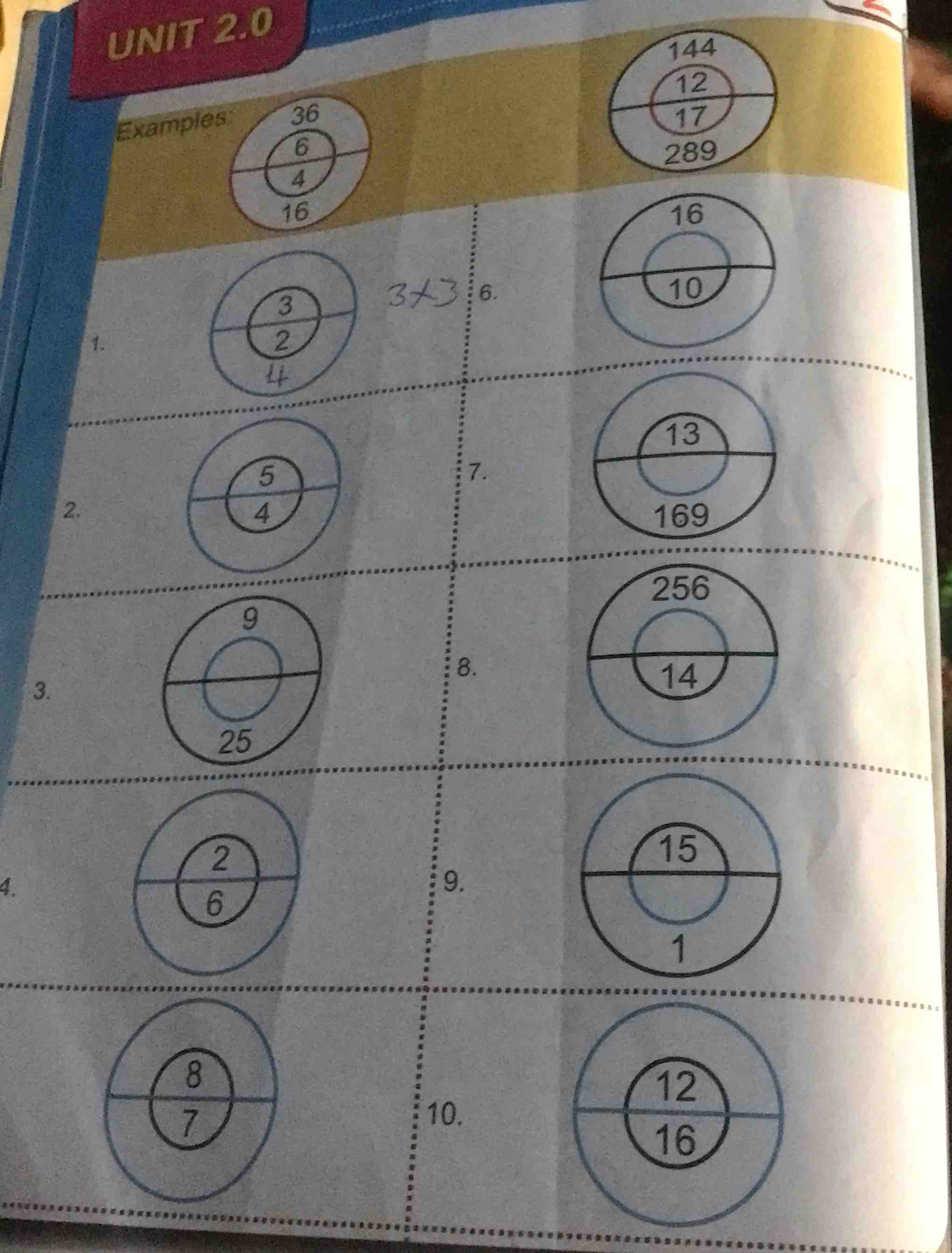
circles with numbers:
example 1: outer circle top 36, middle circle 6, bottom 4, inner bottom 16
example 2: outer circle top 144, middle circle 12, bottom 17, inner bottom 289
- circle: middle 3, bottom 2, inner bottom 4 (handwritten)
- circle: middle 5, bottom 4
- circle: top 9, bottom 25, middle empty
- circle: middle 2, bottom 6
- (handwritten 3×3)
- circle: top 16, middle 10, inner empty
- circle: middle 13, bottom 169, inner empty
- circle: top 256, middle 14, inner empty
- circle: middle 15, bottom 1, inner empty
- circle: middle 12, bottom 16, inner empty
also, a circle with 8 (top) and 7 (bottom) in the middle circle (for problem 5?)
To solve these problems, we analyze the examples to find the pattern:
Example 1 (Left):
- Inner circle: \( 6 \) (top), \( 4 \) (bottom)
- Outer circle: \( 36 = 6^2 \) (top), \( 16 = 4^2 \) (bottom)
Example 2 (Right):
- Inner circle: \( 12 \) (top), \( 17 \) (bottom)
- Outer circle: \( 144 = 12^2 \) (top), \( 289 = 17^2 \) (bottom)
Pattern:
- The top outer number is the square of the top inner number (\( \text{top outer} = (\text{top inner})^2 \)).
- The bottom outer number is the square of the bottom inner number (\( \text{bottom outer} = (\text{bottom inner})^2 \)).
Solving Each Problem:
1.
- Top inner: \( 3 \), Bottom inner: \( 2 \)
- Top outer: \( 3^2 = 9 \) (wait, no—wait, the outer circle’s top? Wait, in the first example, the outer circle’s top is \( 36 = 6^2 \), and the inner top is \( 6 \). Wait, maybe the outer circle’s top is the square of the inner top, and outer bottom is square of inner bottom. Wait, in problem 1, the inner circle has top \( 3 \), bottom \( 2 \). The outer bottom is \( 4 \)? Wait, no—wait the first problem’s outer bottom is \( 4 \)? Wait, the first problem’s outer circle: let’s re-examine.
Wait, the first problem (left column, row 1) has inner circle: top \( 3 \), bottom \( 2 \). The outer circle’s bottom is \( 4 \)? Wait, no—maybe the outer circle’s bottom is the square of the inner bottom? Wait, \( 2^2 = 4 \), yes! And the outer top? Wait, maybe the outer top is the square of the inner top? Wait, \( 3^2 = 9 \), but the outer circle’s top is empty. Wait, maybe the outer circle’s top is the square of the inner top, and outer bottom is square of inner bottom. Let’s check:
Problem 1:
- Inner top: \( 3 \), Inner bottom: \( 2 \)
- Outer top: \( 3^2 = 9 \) (wait, no—wait the first example’s outer top is \( 36 = 6^2 \), inner top \( 6 \); outer bottom \( 16 = 4^2 \), inner bottom \( 4 \). So yes: outer top = (inner top)², outer bottom = (inner bottom)².
So problem 1:
- Inner top: \( 3 \) → Outer top: \( 3^2 = 9 \)
- Inner bottom: \( 2 \) → Outer bottom: \( 2^2 = 4 \) (which matches the given \( 4 \) in the outer bottom). So the outer top is \( 9 \).
2.
- Inner top: \( 5 \), Inner bottom: \( 4 \)
- Outer top: \( 5^2 = 25 \)
- Outer bottom: \( 4^2 = 16 \)
3.
- Outer top: \( 9 = 3^2 \) (so inner top: \( 3 \))
- Outer bottom: \( 25 = 5^2 \) (so inner bottom: \( 5 \))
- Inner circle: top \( 3 \), bottom \( 5 \)
4.
- Inner top: \( 2 \), Inner bottom: \( 6 \)
- Outer top: \( 2^2 = 4 \)
- Outer bottom: \( 6^2 = 36 \)
5.
- Inner top: \( 8 \), Inner bottom: \( 7 \)
- Outer top: \( 8^2 = 64 \)
- Outer bottom: \( 7^2 = 49 \)
6.
- Outer top: \( 16 = 4^2 \) (so inner top: \( 4 \))
- Inner bottom: \( 10 \)
- Outer bottom: \( 10^2 = 100 \)
7.
- Inner top: \( 13 \)
- Outer bottom: \( 169 = 13^2 \) (so inner bottom: \( 13 \)? Wait, no—wait outer bottom is \( 169 = 13^2 \), so inner bottom is \( 13 \). Wait, inner circle: top \( 13 \), bottom \( 13 \)? Wait, no—wait the inner circle has top \( 13 \), bottom empty. Outer bottom is \( 169 = 13^2 \), so inner bottom is \( 13 \). So inner bottom: \( 13 \).
8.
- Inner bottom: \( 14 \)
- Outer top: \( 256 = 16^2 \) (so inner top: \( 16 \))
- Outer bottom: \( 14^2 = 196 \)
9.
- Inner top: \( 15 \)
- Outer bottom: \( 1 = 1^2 \) (so inner bottom: \( 1 \))
- Outer top: \( 15^2 = 225 \)
10.
- Inner top: \( 12 \), Inner bottom: \( 16 \)
- Outer top: \( 12^2 = 144 \)
- Outer bottom: \( 16^2 = 256 \)
Final Answers (Key Values):
- Outer top: \( \boldsymbol{9} \), Outer bottom: \( \boldsymbo…

Snap & solve any problem in the app
Get step-by-step solutions on Sovi AI
Photo-based solutions with guided steps
Explore more problems and detailed explanations
To solve these problems, we analyze the examples to find the pattern:
Example 1 (Left):
- Inner circle: \( 6 \) (top), \( 4 \) (bottom)
- Outer circle: \( 36 = 6^2 \) (top), \( 16 = 4^2 \) (bottom)
Example 2 (Right):
- Inner circle: \( 12 \) (top), \( 17 \) (bottom)
- Outer circle: \( 144 = 12^2 \) (top), \( 289 = 17^2 \) (bottom)
Pattern:
- The top outer number is the square of the top inner number (\( \text{top outer} = (\text{top inner})^2 \)).
- The bottom outer number is the square of the bottom inner number (\( \text{bottom outer} = (\text{bottom inner})^2 \)).
Solving Each Problem:
1.
- Top inner: \( 3 \), Bottom inner: \( 2 \)
- Top outer: \( 3^2 = 9 \) (wait, no—wait, the outer circle’s top? Wait, in the first example, the outer circle’s top is \( 36 = 6^2 \), and the inner top is \( 6 \). Wait, maybe the outer circle’s top is the square of the inner top, and outer bottom is square of inner bottom. Wait, in problem 1, the inner circle has top \( 3 \), bottom \( 2 \). The outer bottom is \( 4 \)? Wait, no—wait the first problem’s outer bottom is \( 4 \)? Wait, the first problem’s outer circle: let’s re-examine.
Wait, the first problem (left column, row 1) has inner circle: top \( 3 \), bottom \( 2 \). The outer circle’s bottom is \( 4 \)? Wait, no—maybe the outer circle’s bottom is the square of the inner bottom? Wait, \( 2^2 = 4 \), yes! And the outer top? Wait, maybe the outer top is the square of the inner top? Wait, \( 3^2 = 9 \), but the outer circle’s top is empty. Wait, maybe the outer circle’s top is the square of the inner top, and outer bottom is square of inner bottom. Let’s check:
Problem 1:
- Inner top: \( 3 \), Inner bottom: \( 2 \)
- Outer top: \( 3^2 = 9 \) (wait, no—wait the first example’s outer top is \( 36 = 6^2 \), inner top \( 6 \); outer bottom \( 16 = 4^2 \), inner bottom \( 4 \). So yes: outer top = (inner top)², outer bottom = (inner bottom)².
So problem 1:
- Inner top: \( 3 \) → Outer top: \( 3^2 = 9 \)
- Inner bottom: \( 2 \) → Outer bottom: \( 2^2 = 4 \) (which matches the given \( 4 \) in the outer bottom). So the outer top is \( 9 \).
2.
- Inner top: \( 5 \), Inner bottom: \( 4 \)
- Outer top: \( 5^2 = 25 \)
- Outer bottom: \( 4^2 = 16 \)
3.
- Outer top: \( 9 = 3^2 \) (so inner top: \( 3 \))
- Outer bottom: \( 25 = 5^2 \) (so inner bottom: \( 5 \))
- Inner circle: top \( 3 \), bottom \( 5 \)
4.
- Inner top: \( 2 \), Inner bottom: \( 6 \)
- Outer top: \( 2^2 = 4 \)
- Outer bottom: \( 6^2 = 36 \)
5.
- Inner top: \( 8 \), Inner bottom: \( 7 \)
- Outer top: \( 8^2 = 64 \)
- Outer bottom: \( 7^2 = 49 \)
6.
- Outer top: \( 16 = 4^2 \) (so inner top: \( 4 \))
- Inner bottom: \( 10 \)
- Outer bottom: \( 10^2 = 100 \)
7.
- Inner top: \( 13 \)
- Outer bottom: \( 169 = 13^2 \) (so inner bottom: \( 13 \)? Wait, no—wait outer bottom is \( 169 = 13^2 \), so inner bottom is \( 13 \). Wait, inner circle: top \( 13 \), bottom \( 13 \)? Wait, no—wait the inner circle has top \( 13 \), bottom empty. Outer bottom is \( 169 = 13^2 \), so inner bottom is \( 13 \). So inner bottom: \( 13 \).
8.
- Inner bottom: \( 14 \)
- Outer top: \( 256 = 16^2 \) (so inner top: \( 16 \))
- Outer bottom: \( 14^2 = 196 \)
9.
- Inner top: \( 15 \)
- Outer bottom: \( 1 = 1^2 \) (so inner bottom: \( 1 \))
- Outer top: \( 15^2 = 225 \)
10.
- Inner top: \( 12 \), Inner bottom: \( 16 \)
- Outer top: \( 12^2 = 144 \)
- Outer bottom: \( 16^2 = 256 \)
Final Answers (Key Values):
- Outer top: \( \boldsymbol{9} \), Outer bottom: \( \boldsymbol{4} \)
- Outer top: \( \boldsymbol{25} \), Outer bottom: \( \boldsymbol{16} \)
- Inner top: \( \boldsymbol{3} \), Inner bottom: \( \boldsymbol{5} \)
- Outer top: \( \boldsymbol{4} \), Outer bottom: \( \boldsymbol{36} \)
- Outer top: \( \boldsymbol{64} \), Outer bottom: \( \boldsymbol{49} \)
- Inner top: \( \boldsymbol{4} \), Outer bottom: \( \boldsymbol{100} \)
- Inner bottom: \( \boldsymbol{13} \)
- Inner top: \( \boldsymbol{16} \), Outer bottom: \( \boldsymbol{196} \)
- Outer top: \( \boldsymbol{225} \), Inner bottom: \( \boldsymbol{1} \)
- Outer top: \( \boldsymbol{144} \), Outer bottom: \( \boldsymbol{256} \)
(Note: For each problem, the missing value is filled using the pattern: \( \text{outer top} = (\text{inner top})^2 \) and \( \text{outer bottom} = (\text{inner bottom})^2 \), or vice versa.)