QUESTION IMAGE
Question
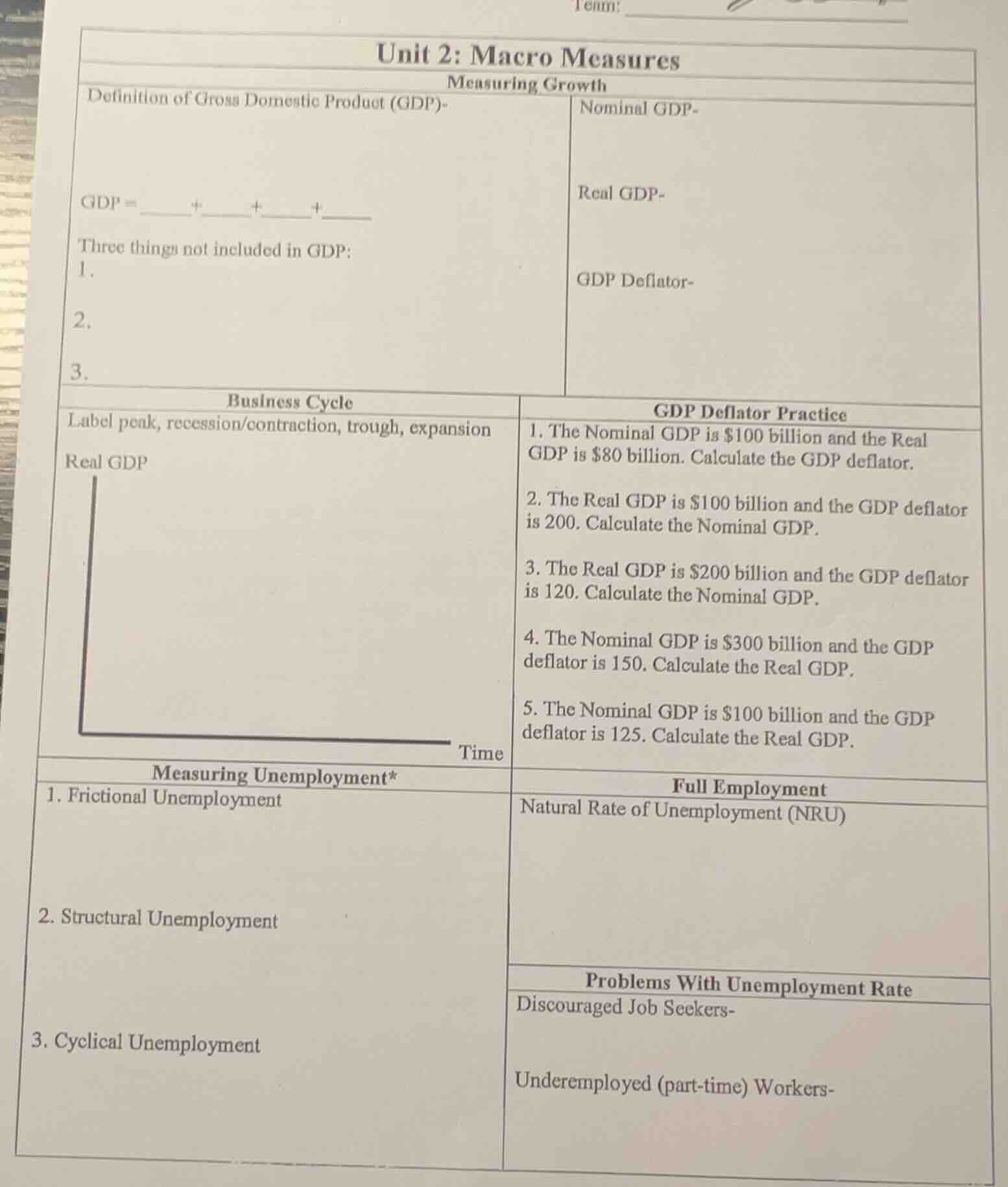
unit 2: macro measures
measuring growth
definition of gross domestic product (gdp)-
nominal gdp-
gdp = __+++__
real gdp-
three things not included in gdp:
1.
2.
3.
gdp deflator-
business cycle
label peak, recession/contraction, trough, expansion
real gdp
time
gdp deflator practice
- the nominal gdp is $100 billion and the real gdp is $80 billion. calculate the gdp deflator.
- the real gdp is $100 billion and the gdp deflator is 200. calculate the nominal gdp.
- the real gdp is $200 billion and the gdp deflator is 120. calculate the nominal gdp.
- the nominal gdp is $300 billion and the gdp deflator is 150. calculate the real gdp.
- the nominal gdp is $100 billion and the gdp deflator is 125. calculate the real gdp.
measuring unemployment*
- frictional unemployment
- structural unemployment
- cyclical unemployment
full employment
natural rate of unemployment (nru)
problems with unemployment rate
discouraged job seekers-
underemployed (part-time) workers-
Step1: Recall GDP deflator formula
The core formula is:
$$\text{GDP Deflator} = \frac{\text{Nominal GDP}}{\text{Real GDP}} \times 100$$
This can be rearranged to solve for Nominal GDP ($\text{Nominal GDP} = \text{Real GDP} \times \frac{\text{GDP Deflator}}{100}$) or Real GDP ($\text{Real GDP} = \frac{\text{Nominal GDP}}{\text{GDP Deflator}} \times 100$) as needed.
Step2: Solve Practice Problem 1
Plug given values into the formula.
$$\text{GDP Deflator} = \frac{\$100 \text{ billion}}{\$80 \text{ billion}} \times 100 = 125$$
Step3: Solve Practice Problem 2
Use rearranged formula for nominal GDP.
$$\text{Nominal GDP} = \$100 \text{ billion} \times \frac{200}{100} = \$200 \text{ billion}$$
Step4: Solve Practice Problem 3
Apply the nominal GDP formula.
$$\text{Nominal GDP} = \$200 \text{ billion} \times \frac{120}{100} = \$240 \text{ billion}$$
Step5: Solve Practice Problem 4
Use rearranged formula for real GDP.
$$\text{Real GDP} = \frac{\$300 \text{ billion}}{150} \times 100 = \$200 \text{ billion}$$
Step6: Solve Practice Problem 5
Calculate real GDP with given values.
$$\text{Real GDP} = \frac{\$100 \text{ billion}}{125} \times 100 = \$80 \text{ billion}$$
---
GDP Definition & Related Terms:
GDP Formula:
$\text{GDP} = \text{Consumption (C)} + \text{Investment (I)} + \text{Government Spending (G)} + \text{Net Exports (X-M)}$
Three things not included in GDP:
- Intermediate goods (used to make final products)
- Non-market activities (e.g., unpaid household work)
- Used/second-hand goods sales
Key GDP Definitions:
- Nominal GDP: GDP measured in current year prices (not adjusted for inflation)
- Real GDP: GDP adjusted for inflation, measured in base-year prices
- GDP Deflator: A price index measuring inflation for all goods/services in GDP
---
Business Cycle Labels:
On the Real GDP vs. Time graph:
- Peak: The highest point of real GDP before a decline
- Recession/Contraction: Period where real GDP falls
- Trough: The lowest point of real GDP before a recovery
- Expansion: Period where real GDP rises
---
Unemployment Definitions:
Measuring Unemployment:
- Frictional Unemployment: Temporary unemployment from workers transitioning between jobs (e.g., new graduates, people switching careers)
- Structural Unemployment: Unemployment from a mismatch between worker skills and available jobs (e.g., outdated industry skills)
- Cyclical Unemployment: Unemployment caused by economic downturns/recessions (tied to the business cycle)
Full Employment:
- Natural Rate of Unemployment (NRU): The unemployment rate when only frictional and structural unemployment exist (no cyclical unemployment)
Problems With Unemployment Rate:
- Discouraged Job Seekers: Workers who stop looking for work, so they are not counted in the official unemployment rate
- Underemployed (part-time) Workers: Workers in part-time jobs who want full-time work, counted as "employed" in the official rate even if they are not fully utilized
---
GDP Deflator Practice Answers:
- 125
- $200 billion
- $240 billion
- $200 billion
- $80 billion

Snap & solve any problem in the app
Get step-by-step solutions on Sovi AI
Photo-based solutions with guided steps
Explore more problems and detailed explanations
Step1: Recall GDP deflator formula
The core formula is:
$$\text{GDP Deflator} = \frac{\text{Nominal GDP}}{\text{Real GDP}} \times 100$$
This can be rearranged to solve for Nominal GDP ($\text{Nominal GDP} = \text{Real GDP} \times \frac{\text{GDP Deflator}}{100}$) or Real GDP ($\text{Real GDP} = \frac{\text{Nominal GDP}}{\text{GDP Deflator}} \times 100$) as needed.
Step2: Solve Practice Problem 1
Plug given values into the formula.
$$\text{GDP Deflator} = \frac{\$100 \text{ billion}}{\$80 \text{ billion}} \times 100 = 125$$
Step3: Solve Practice Problem 2
Use rearranged formula for nominal GDP.
$$\text{Nominal GDP} = \$100 \text{ billion} \times \frac{200}{100} = \$200 \text{ billion}$$
Step4: Solve Practice Problem 3
Apply the nominal GDP formula.
$$\text{Nominal GDP} = \$200 \text{ billion} \times \frac{120}{100} = \$240 \text{ billion}$$
Step5: Solve Practice Problem 4
Use rearranged formula for real GDP.
$$\text{Real GDP} = \frac{\$300 \text{ billion}}{150} \times 100 = \$200 \text{ billion}$$
Step6: Solve Practice Problem 5
Calculate real GDP with given values.
$$\text{Real GDP} = \frac{\$100 \text{ billion}}{125} \times 100 = \$80 \text{ billion}$$
---
GDP Definition & Related Terms:
GDP Formula:
$\text{GDP} = \text{Consumption (C)} + \text{Investment (I)} + \text{Government Spending (G)} + \text{Net Exports (X-M)}$
Three things not included in GDP:
- Intermediate goods (used to make final products)
- Non-market activities (e.g., unpaid household work)
- Used/second-hand goods sales
Key GDP Definitions:
- Nominal GDP: GDP measured in current year prices (not adjusted for inflation)
- Real GDP: GDP adjusted for inflation, measured in base-year prices
- GDP Deflator: A price index measuring inflation for all goods/services in GDP
---
Business Cycle Labels:
On the Real GDP vs. Time graph:
- Peak: The highest point of real GDP before a decline
- Recession/Contraction: Period where real GDP falls
- Trough: The lowest point of real GDP before a recovery
- Expansion: Period where real GDP rises
---
Unemployment Definitions:
Measuring Unemployment:
- Frictional Unemployment: Temporary unemployment from workers transitioning between jobs (e.g., new graduates, people switching careers)
- Structural Unemployment: Unemployment from a mismatch between worker skills and available jobs (e.g., outdated industry skills)
- Cyclical Unemployment: Unemployment caused by economic downturns/recessions (tied to the business cycle)
Full Employment:
- Natural Rate of Unemployment (NRU): The unemployment rate when only frictional and structural unemployment exist (no cyclical unemployment)
Problems With Unemployment Rate:
- Discouraged Job Seekers: Workers who stop looking for work, so they are not counted in the official unemployment rate
- Underemployed (part-time) Workers: Workers in part-time jobs who want full-time work, counted as "employed" in the official rate even if they are not fully utilized
---
GDP Deflator Practice Answers:
- 125
- $200 billion
- $240 billion
- $200 billion
- $80 billion