QUESTION IMAGE
Question
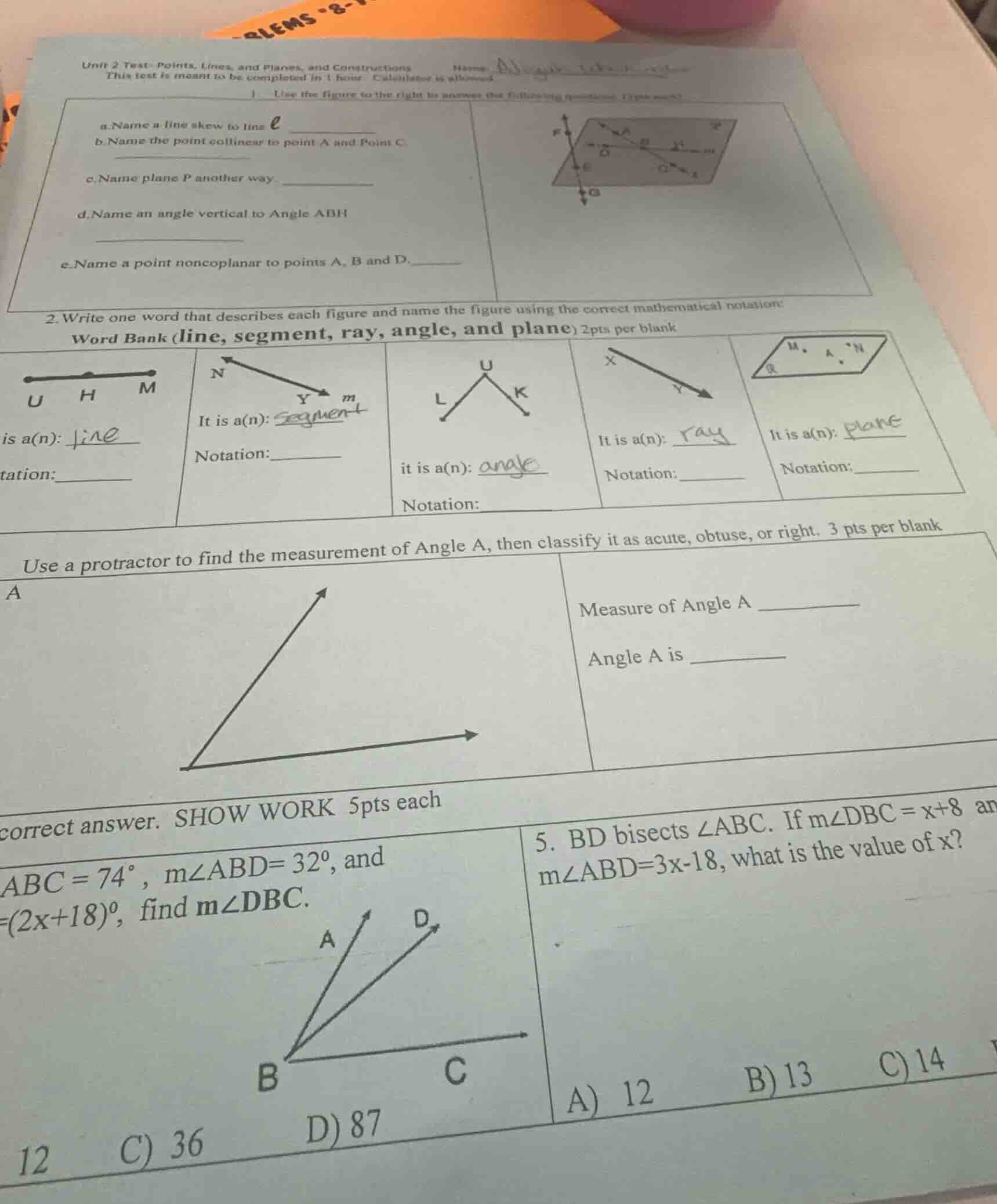
unit 2 test: points, lines, and planes, and constructions
name
this test is meant to be completed in 1 hour. calculator is allowed
- use the figure to the right to answer the following questions (2 pts each)
a.name a line skew to line $\boldsymbol{ell}$ __________
b.name the point collinear to point a and point c
c.name plane p another way. __________
d.name an angle vertical to angle abh
__________
e.name a point noncoplanar to points a, b and d.________
- write one word that describes each figure and name the figure using the correct mathematical notation:
word bank (line, segment, ray, angle, and plane) 2pts per blank
u h m
is a(n): _______
tation:________
n y
it is a(n): _______
notation:________
l u k
it is a(n): _______
notation:________
x y
it is a(n): _______
notation:________
m a n
it is a(n): _______
notation:________
use a protractor to find the measurement of angle a, then classify it as acute, obtuse, or right. 3 pts per blank
a
measure of angle a __________
angle a is __________
correct answer. show work 5pts each
$angle abc = 74^circ$, $mangle abd= 32^0$, and $mangle dbc=(2x+18)^0$, find $mangle dbc$.
a) 12 c) 36 d) 87
- bd bisects $angle abc$. if $mangle dbc = x+8$ and $mangle abd=3x-18$, what is the value of x?
a) 12 b) 13 c) 14
Section 1 (Using the 3D Figure)
a. Skew lines do not intersect and are not coplanar; line $FG$ does not intersect line $\boldsymbol{\ell}$ and is not on the same plane.
b. Collinear points lie on the same line; point $B$ is on the line through $A$ and $C$.
c. A plane can be named by 3 non-collinear points on it; plane $ABC$ (or any 3 non-collinear points from the plane works).
d. Vertical angles are opposite each other at an intersection; $\angle DBJ$ is opposite $\angle ABH$.
e. Noncoplanar points do not lie on the same plane; point $F$ is not on the plane containing $A, B, D$.
- A line extends infinitely in both directions, notation uses two endpoints with a double arrow.
- A segment has two fixed endpoints, notation uses endpoints with a bar.
- An angle is formed by two rays sharing a vertex, notation uses the vertex in the middle.
- A ray extends infinitely in one direction, notation uses endpoint first with a single arrow.
- A plane is a flat surface, notation uses 3 non-collinear points or a script letter.
- Use a protractor to align the base ray with the 0° mark, then read the angle measure.
- Classify: Acute < 90°, Right = 90°, Obtuse > 90°.

Snap & solve any problem in the app
Get step-by-step solutions on Sovi AI
Photo-based solutions with guided steps
Explore more problems and detailed explanations
a. $\boldsymbol{\overleftrightarrow{FG}}$
b. $\boldsymbol{B}$
c. $\boldsymbol{\text{Plane } ABC}$ (or equivalent with 3 non-collinear points from the plane)
d. $\boldsymbol{\angle DBJ}$
e. $\boldsymbol{F}$ (or $\boldsymbol{G}$)
---