QUESTION IMAGE
Question
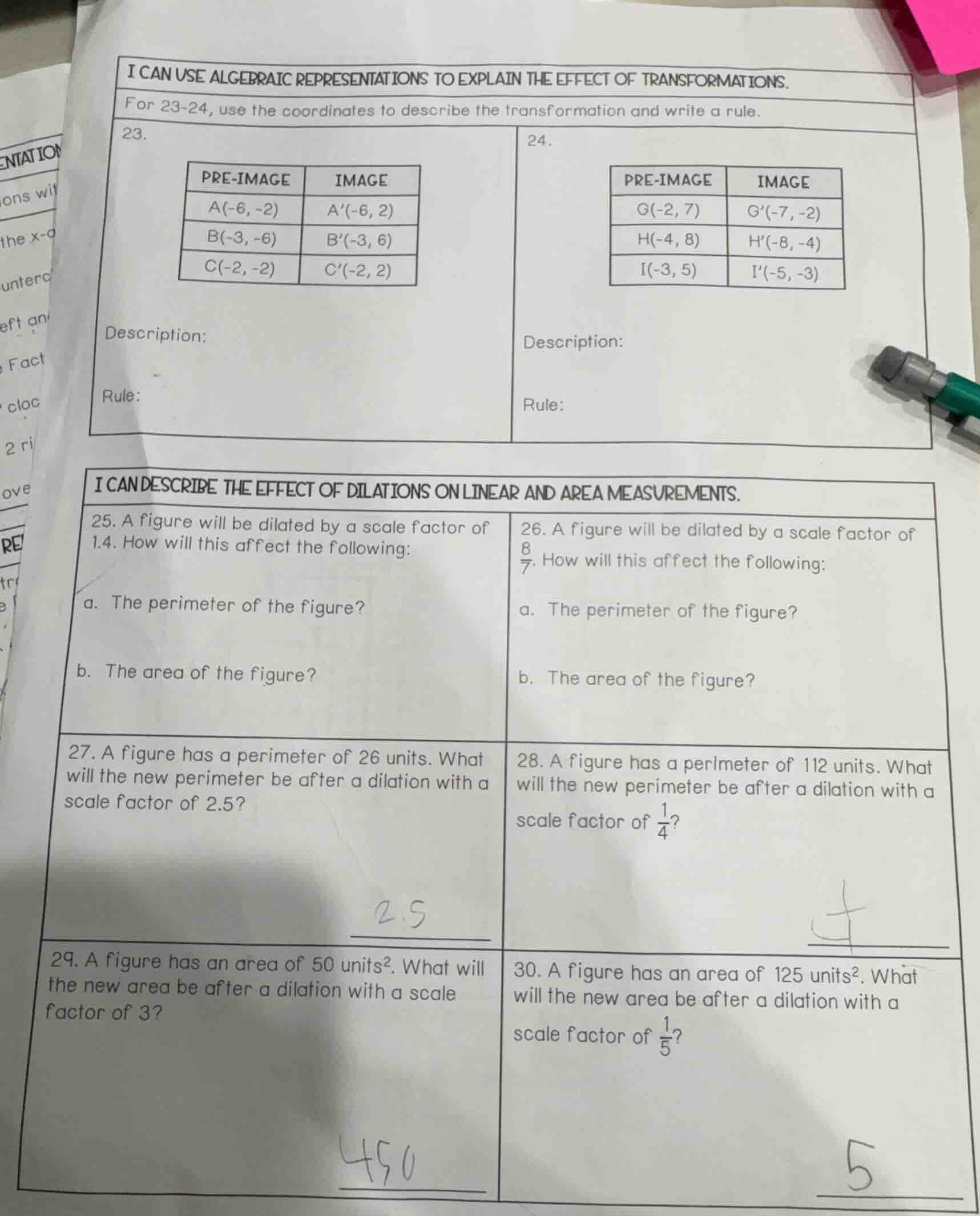
i can use algebraic representations to explain the effect of transformations.
for 23-24, use the coordinates to describe the transformation and write a rule.
23.
| pre-image | image |
|---|---|
| b(-3, -6) | b(-3, 6) |
| c(-2, -2) | c(-2, 2) |
description:
rule:
24.
| pre-image | image |
|---|---|
| h(-4, 8) | h(-8, -4) |
| i(-3, 5) | i(-5, -3) |
description:
rule:
i can describe the effect of dilations on linear and area measurements.
- a figure will be dilated by a scale factor of 1.4. how will this affect the following:
a. the perimeter of the figure?
b. the area of the figure?
- a figure will be dilated by a scale factor of $\frac{8}{7}$. how will this affect the following:
a. the perimeter of the figure?
b. the area of the figure?
- a figure has a perimeter of 26 units. what will the new perimeter be after a dilation with a scale factor of 2.5?
- a figure has a perimeter of 112 units. what will the new perimeter be after a dilation with a scale factor of $\frac{1}{4}$?
- a figure has an area of 50 units$^2$. what will the new area be after a dilation with a scale factor of 3?
- a figure has an area of 125 units$^2$. what will the new area be after a dilation with a scale factor of $\frac{1}{5}$?
Step1: Analyze Q23 coordinate changes
Compare pre-image/image coordinates:
$A(-6,-2)\to A'(-6,2)$, $B(-3,-6)\to B'(-3,6)$, $C(-2,-2)\to C'(-2,2)$
Step2: Describe Q23 transformation
x-values stay, y-values flip sign.
Step3: Write Q23 rule
$(x,y)\to(x,-y)$
Step4: Analyze Q24 coordinate changes
Compute differences:
$G(-2,7)\to G'(-7,-2)$: $-2-5=-7$, $7-9=-2$
$H(-4,8)\to H'(-8,-4)$: $-4-4=-8$, $8-12=-4$
$I(-3,5)\to I'(-5,-3)$: $-3-2=-5$, $5-8=-3$
Wait, correct pattern: $x\to x-5$, $y\to y-9$ (consistent shift)
Step5: Describe Q24 transformation
Shift left 5, down 9 units.
Step6: Write Q24 rule
$(x,y)\to(x-5,y-9)$
Step7: Q25a: Perimeter dilation effect
Perimeter scales with scale factor.
New perimeter = $1.4\times$ original
Step8: Q25b: Area dilation effect
Area scales with square of scale factor.
New area = $(1.4)^2\times$ original = $1.96\times$ original
Step9: Q26a: Perimeter dilation effect
Perimeter scales with $\frac{8}{7}$.
New perimeter = $\frac{8}{7}\times$ original
Step10: Q26b: Area dilation effect
Area scales with $(\frac{8}{7})^2$.
New area = $\frac{64}{49}\times$ original
Step11: Q27: Calculate new perimeter
New perimeter = $26\times2.5$
$=65$
Step12: Q28: Calculate new perimeter
New perimeter = $112\times\frac{1}{4}$
$=28$
Step13: Q29: Calculate new area
New area = $50\times3^2$
$=50\times9=450$
Step14: Q30: Calculate new area
New area = $125\times(\frac{1}{5})^2$
$=125\times\frac{1}{25}=5$

Snap & solve any problem in the app
Get step-by-step solutions on Sovi AI
Photo-based solutions with guided steps
Explore more problems and detailed explanations
23.
Description: Reflection over the x-axis
Rule: $(x,y)\to(x,-y)$
24.
[LLM SSE On Failure]