QUESTION IMAGE
Question
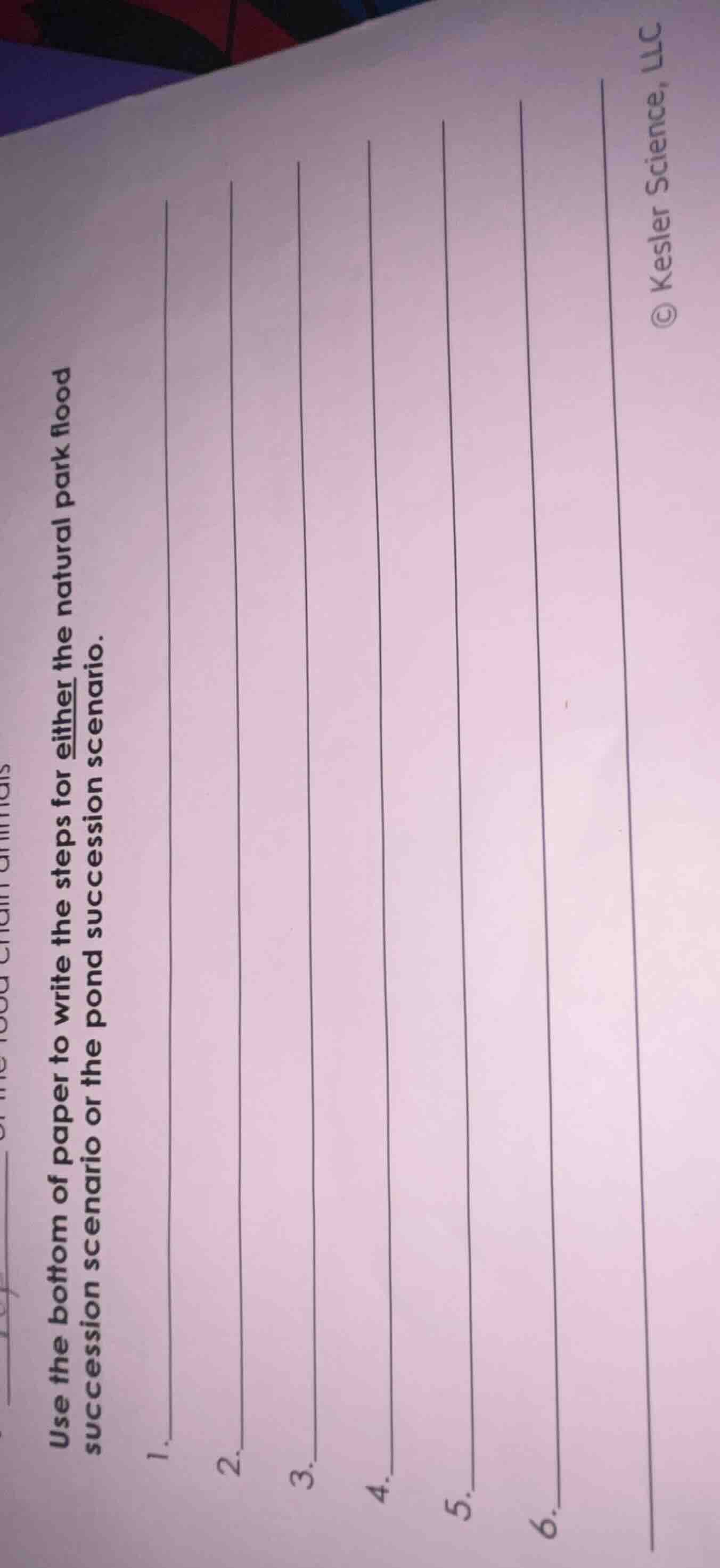
use the bottom of paper to write the steps for either the natural park flood succession scenario or the pond succession scenario.
1.
2.
3.
4.
5.
6.
© kesler science, llc
To solve this problem about ecological succession (natural park flood succession scenario), we can break down the steps of primary or secondary succession (since a flood is a disturbance, it's secondary succession for the park):
Natural Park Flood Succession Steps (Secondary Succession)
Step 1: Disturbance and Initial Recovery
After the flood, the park is disturbed. The floodwater recedes, leaving behind wet soil, some surviving plants (like flood - tolerant grasses or shrubs) and dead organic matter. Microorganisms (bacteria, fungi) start decomposing the dead matter, releasing nutrients into the soil.
Step 2: Pioneer Species Establishment
Pioneer species, which are adapted to disturbed environments, begin to colonize the area. These could be fast - growing plants like annual weeds (e.g., ragweed) or grasses. They have seeds that are easily dispersed (by wind, water, or animals) and can germinate quickly in the nutrient - rich, moist soil left by the flood.
Step 3: Soil Improvement
As the pioneer plants grow, they help improve the soil. Their roots break up the soil, allowing for better aeration. When they die and decompose, they add more organic matter to the soil. Also, the roots hold the soil in place, reducing erosion. Insects and small invertebrates start to move into the area, attracted by the new plant growth.
Step 4: Intermediate Species Growth
Intermediate species, such as perennial grasses, small shrubs (like dogwood shrubs), and herbaceous plants, begin to grow. These species are more competitive than the pioneer species and start to outcompete them for resources like sunlight, water, and nutrients. The soil continues to become more fertile and structured, supporting a greater diversity of plant life. Birds and small mammals may start to frequent the area, feeding on the insects and using the plants for shelter.
Step 5: Climax Community Approximation
The community starts to resemble a more stable, mature ecosystem. Larger trees (like oak or maple trees in a temperate park) begin to grow, shading out the smaller intermediate plants. The plant community becomes more complex, with different layers (canopy, understory, ground layer). A diverse range of animals, including larger mammals, birds of various species, and reptiles, inhabit the area. The ecosystem reaches a state of relative equilibrium, with a stable community of plants and animals.
Step 6: Maintenance of the Ecosystem
The climax community is maintained, but it is still subject to natural disturbances (like small - scale floods, windstorms) and ecological processes. New generations of plants and animals continue to grow and reproduce. Nutrient cycling, energy flow (through food webs), and species interactions (predation, competition, mutualism) are all in balance, sustaining the ecosystem.
If we were to list these steps in a more concise way for the answer:
- Flood recedes, microorganisms decompose dead matter.
- Pioneer species (e.g., weeds, grasses) colonize.
- Pioneer plants improve soil (aeration, organic matter addition).
- Intermediate species (shrubs, perennials) outcompete pioneers.
- Larger trees grow, forming a more complex community.
- Ecosystem reaches stability (climax community) with balanced interactions.

Snap & solve any problem in the app
Get step-by-step solutions on Sovi AI
Photo-based solutions with guided steps
Explore more problems and detailed explanations
To solve this problem about ecological succession (natural park flood succession scenario), we can break down the steps of primary or secondary succession (since a flood is a disturbance, it's secondary succession for the park):
Natural Park Flood Succession Steps (Secondary Succession)
Step 1: Disturbance and Initial Recovery
After the flood, the park is disturbed. The floodwater recedes, leaving behind wet soil, some surviving plants (like flood - tolerant grasses or shrubs) and dead organic matter. Microorganisms (bacteria, fungi) start decomposing the dead matter, releasing nutrients into the soil.
Step 2: Pioneer Species Establishment
Pioneer species, which are adapted to disturbed environments, begin to colonize the area. These could be fast - growing plants like annual weeds (e.g., ragweed) or grasses. They have seeds that are easily dispersed (by wind, water, or animals) and can germinate quickly in the nutrient - rich, moist soil left by the flood.
Step 3: Soil Improvement
As the pioneer plants grow, they help improve the soil. Their roots break up the soil, allowing for better aeration. When they die and decompose, they add more organic matter to the soil. Also, the roots hold the soil in place, reducing erosion. Insects and small invertebrates start to move into the area, attracted by the new plant growth.
Step 4: Intermediate Species Growth
Intermediate species, such as perennial grasses, small shrubs (like dogwood shrubs), and herbaceous plants, begin to grow. These species are more competitive than the pioneer species and start to outcompete them for resources like sunlight, water, and nutrients. The soil continues to become more fertile and structured, supporting a greater diversity of plant life. Birds and small mammals may start to frequent the area, feeding on the insects and using the plants for shelter.
Step 5: Climax Community Approximation
The community starts to resemble a more stable, mature ecosystem. Larger trees (like oak or maple trees in a temperate park) begin to grow, shading out the smaller intermediate plants. The plant community becomes more complex, with different layers (canopy, understory, ground layer). A diverse range of animals, including larger mammals, birds of various species, and reptiles, inhabit the area. The ecosystem reaches a state of relative equilibrium, with a stable community of plants and animals.
Step 6: Maintenance of the Ecosystem
The climax community is maintained, but it is still subject to natural disturbances (like small - scale floods, windstorms) and ecological processes. New generations of plants and animals continue to grow and reproduce. Nutrient cycling, energy flow (through food webs), and species interactions (predation, competition, mutualism) are all in balance, sustaining the ecosystem.
If we were to list these steps in a more concise way for the answer:
- Flood recedes, microorganisms decompose dead matter.
- Pioneer species (e.g., weeds, grasses) colonize.
- Pioneer plants improve soil (aeration, organic matter addition).
- Intermediate species (shrubs, perennials) outcompete pioneers.
- Larger trees grow, forming a more complex community.
- Ecosystem reaches stability (climax community) with balanced interactions.