QUESTION IMAGE
Question
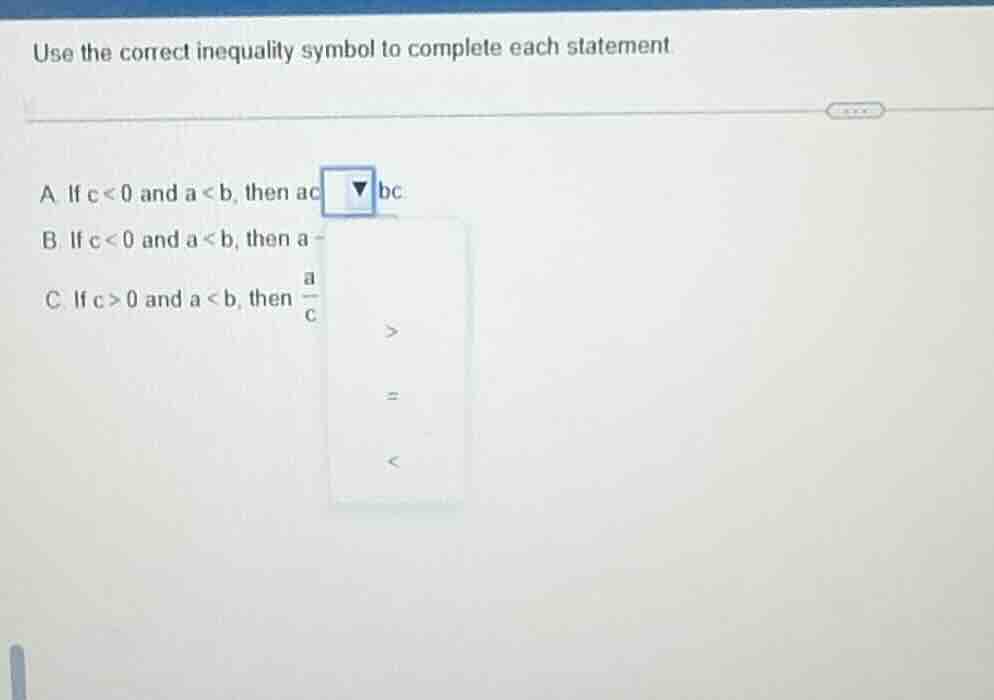
use the correct inequality symbol to complete each statement
a. if $c < 0$ and $a < b$, then $ac$ $\boldsymbol{\bigtriangledown}$ $bc$
b. if $c < 0$ and $a < b$, then $a -$
c. if $c > 0$ and $a < b$, then $dfrac{a}{c}$
Part A
Step1: Recall inequality rule for multiplication
When multiplying both sides of an inequality \(a < b\) by a negative number \(c\) (\(c<0\)), the inequality sign reverses.
Given \(a < b\) and \(c < 0\), multiply both sides by \(c\): \(ac>bc\) (since multiplying by a negative number flips the inequality).
Step1: Analyze subtraction of a constant
Subtracting a constant \(c\) from both sides of an inequality \(a < b\) does not change the inequality direction. So \(a - c < b - c\) (since subtracting the same number from both sides preserves the inequality).
Step1: Recall inequality rule for division
When dividing both sides of an inequality \(a < b\) by a positive number \(c\) (\(c>0\)), the inequality sign remains the same. So \(\frac{a}{c}<\frac{b}{c}\) (since dividing by a positive number does not flip the inequality).

Snap & solve any problem in the app
Get step-by-step solutions on Sovi AI
Photo-based solutions with guided steps
Explore more problems and detailed explanations
\(ac > bc\) (so the symbol is \(>\))